
A research team led by Prof. WANG Zhenyou at the Aerospace Information Research Institute of the Chinese Academy of Sciences (AIRCAS) has developed a microscopic time-gated Raman spectrometer capable of non-destructive, micrometer-scale chemical analysis of fragile archaeological ivory—even when strong fluorescence would normally obscure the signal. The study was recently published in ACS Applied Materials & Interfaces.
Ivory artifacts excavated from the Sanxingdui Ruins, dating back over 3,000 years, are invaluable for understanding the ancient Shu civilization. However, prolonged burial conditions—including groundwater, soluble salts, and microbial activity—can severely weaken ivory internally while leaving the exterior seemingly intact. This makes non-destructive, high-resolution analytical tools essential for conservation and restoration efforts.
Raman spectroscopy, widely used for analyzing molecular composition, is in principle well suited to this task. In practice, however, archaeological materials often produce strong fluorescence under laser illumination, overwhelming the much weaker Raman signals and rendering conventional measurements ineffective.
To address this challenge, the research team developed a time-gated Raman approach that separates Raman scattering signals from fluorescence based on their fundamentally different time scales. Raman signals occur instantaneously after laser excitation, whereas fluorescence persists far longer. By precisely synchronizing an ultrashort detection window with the Raman signal, the instrument effectively suppresses background fluorescence and retrieves Raman spectra from strongly fluorescent materials.
Through a combination of hardware design and algorithm optimization, the team achieved efficient fluorescence suppression, enhanced the localization of key chemical components, and reduced overall system costs—a critical step toward wider adoption of time-gated Raman technology in heritage science.
The team tested the new instrument on four ivory fragments excavated from Sanxingdui. Under conventional continuous-wave Raman conditions, two of the samples yielded little to no usable spectral information due to fluorescence. In contrast, time-gated Raman measurements effectively suppressed fluorescence interference and improved the signal-to-noise ratio by more than 20 times in strongly fluorescent samples, revealing clear internal compositional differences.
Analysis indicates that ivories from different burial environments exhibit pronounced differences in organic content, mineral crystallinity, and corrosion severity. The results further suggest that metal-ion infiltration and non-metal ion substitution—such as sulfate replacing structural components in hydroxyapatite—play a central role in the deep degradation of ivory. In some specimens, spectral features consistent with possible heat exposure were also observed, pointing to potential fire-related damage.
This study demonstrates that time-gated Raman spectroscopy can provide molecular-level evidence critical to understanding the long-term deterioration of ancient ivory. Beyond ivory, the method is expected to be broadly applicable to archaeological materials plagued by strong fluorescence.
This research was conducted in collaboration with researchers from the Sichuan Provincial Institute of Cultural Relics and Archaeology, Zhejiang University, and the University of Electronic Science and Technology of China.
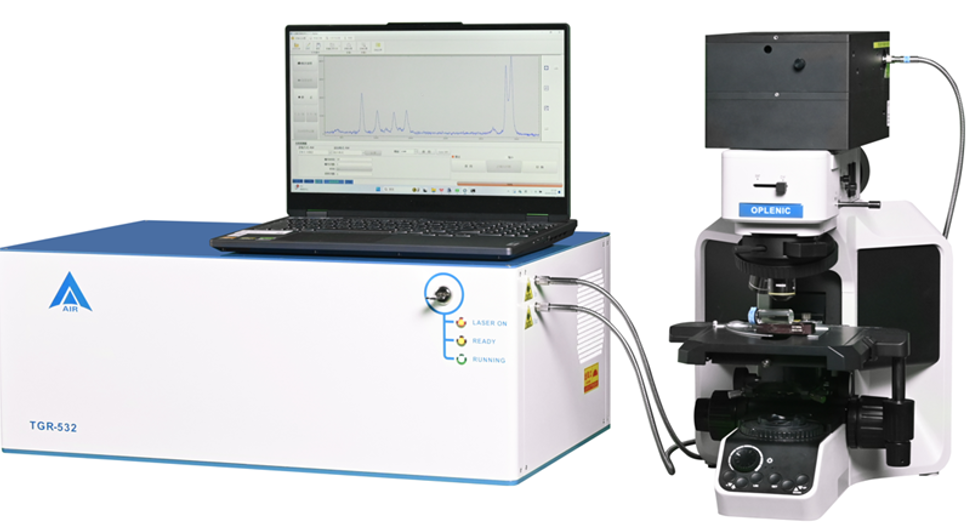
Prototype of the microscope-integrated time-gated Raman spectrometer. (Image by AIRCAS)

Time-gated Raman spectroscopy and its application to the analysis of ivory from the Sanxingdui Ruins. (Image by AIRCAS)

86-10-68597521 (day)
86-10-68597289 (night)

52 Sanlihe Rd., Xicheng District,
Beijing, China (100864)
Copyright © 2002 - Chinese Academy of Sciences


