
A research team led by Prof. FANG Yonghua from the Hefei Institutes of Physical Science of the Chinese Academy of Sciences proposed and systematically optimized a novel parabolic mirror cavity-enhanced Raman spectroscopy (PMCERS) technique, achieving a marked improvement in gas detection sensitivity through the integration of advanced optical design and signal processing methods.
The results were published in Optics & Laser Technology.
Multi-component gas detection is important for environmental, industrial, and medical applications. Raman spectroscopy is well-suited for this purpose because it enables the simultaneous, water-vapor-free detection of multiple gas species. However, its inherently weak scattering limits sensitivity. Conventional cavity-enhanced approaches relying on lens-based collection have a limited numerical aperture, resulting in inefficient capture of three-dimensionally distributed Raman signals.
In this study, the team developed a parabolic mirror-based cavity-enhanced Raman spectroscopy system that leverages the large-aperture characteristics of parabolic mirrors to significantly improve Raman signal collection. Through the systematic optimization of the cavity structure, an efficient closed-loop optical path was established, effectively eliminating signal collection blind spots and suppressing stray-light interference.
In addition, the researchers designed an optimized spectral analysis strategy to reliably extract weak Raman signals from noisy backgrounds under low signal-to-noise conditions. This approach effectively reduces random noise and baseline fluctuations, enabling the accurate identification of trace gas components.
The experimental results demonstrate that the optimized PMCERS system provides substantially greater signal strength and detection sensitivity than conventional cavity-enhanced Raman configurations. At the same time, the gas cavity was significantly miniaturized, demonstrating the technique’s strong potential for practical, compact, high-sensitivity gas sensing applications.
This work provides a new technical pathway for high-sensitivity and compact gas detection, with promising prospects for practical applications, according to the team.
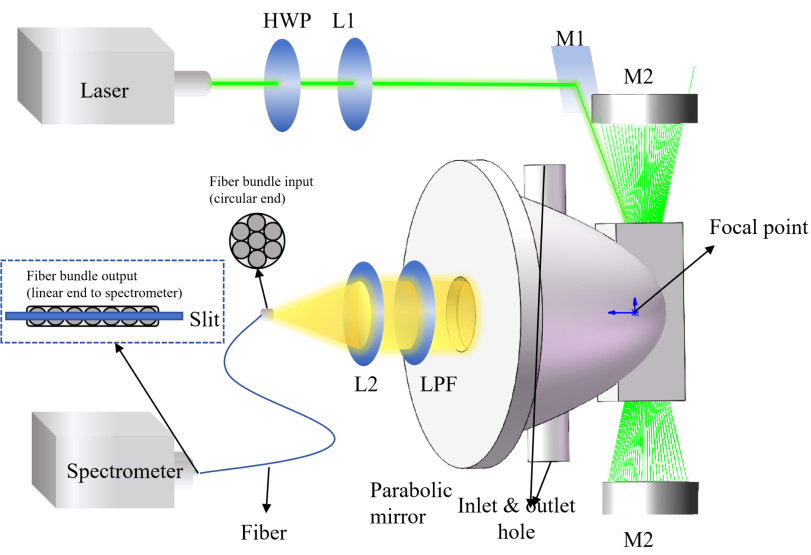
Schematic diagram of the O-PMCERS system (Image by LI Zhengang)

A Chinese scientist innovated a new technology of photoacoustic spectroscopy (PAS) in which a low cost polyvinylidene fluoride (PVDF) film was used as a cantilever to detect PAS signal. The piezoelectric property of the PVDF made the PAS signal be "heard" directly without...
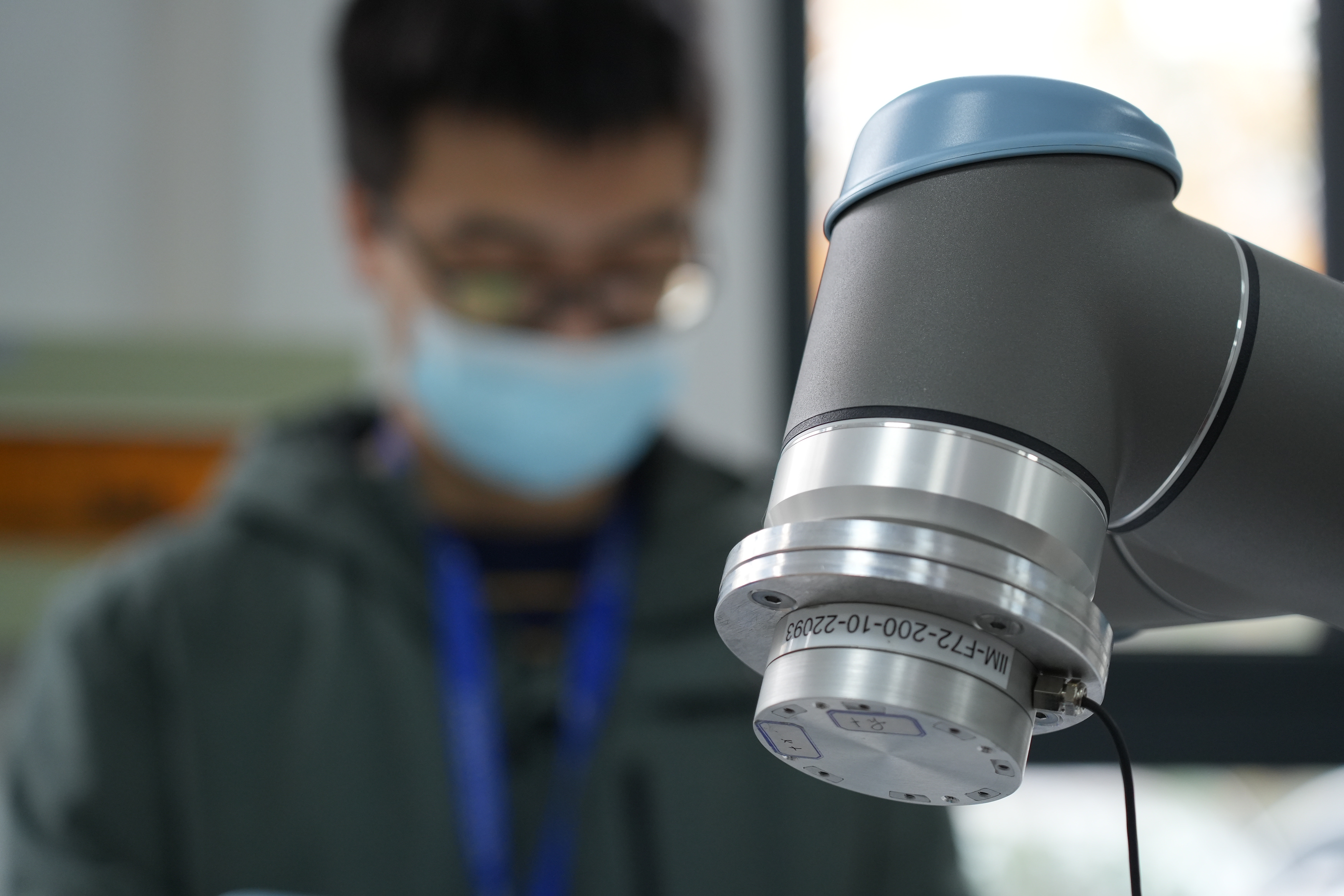
Sensors are used to measure physical input from the environment and converts it into data that can be interpreted by humans or machines. A six-dimensional force/torque sensor was developed by a research team from the Hefei Institutes of Physical Science.

86-10-68597521 (day)
86-10-68597289 (night)

52 Sanlihe Rd., Xicheng District,
Beijing, China (100864)
Copyright © 2002 - Chinese Academy of Sciences


