
Quasi-periodic oscillations (QPOs) are a rare phenomenon in active galactic nuclei. They have been observed to occur at periods ranging from minutes to hours, days, weeks, and even years across the electromagnetic spectrum. A new study by Ashutosh Tripathi from the Xinjiang Astronomical Observatory of the Chinese Academy of Sciences, together with his collaborators, has identified highly significant short-timescale QPOs in several blazars.
The study, published on December 12 in Monthly Notices of the Royal Astronomical Society, analyzed observations from NASA's Transiting Exoplanet Survey Satellite (TESS) combined with a 157-month hard X-ray survey conducted by Swift's Burst Alert Telescope (BAT).
In this study, 38 objects were found to be variable. These objects were further investigated for the periodic signatures with generalized Lomb-Scargle periodogram and weighted wavelet Z-transform methods. Four objects were found to have periodicity with very high significance.
"The periods of these oscillations were found to be in the range of five to ten days for all objects. One object exhibited a quasi-periodic signal in observations taken one year apart over five years. This suggests that the periodic behavior persists during intervals without TESS observations, indicating the potential for a QPO lasting several years," said Ashutosh.
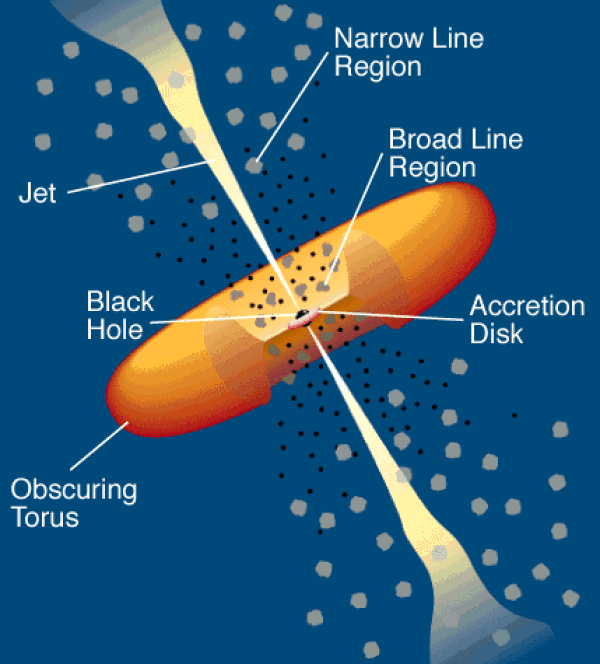
These periodicities are attributed to either the temporal evolution of a kink in the jet due to the plasma-driven instabilities or to the presence of sub-structures in the jet.
The results of this study provide insight into our basic understanding of these compact systems and demonstrate the effectiveness of using time-series analysis methods to search for periodic features.
It is believed that blazars show flux variability in complete electromagnetic (EM) spectrum on all possible timescales varying from few minutes to several years. A recent study led by Alok C. Gupta, a visiting scientist of Shanghai Astronomical Observatory (SHAO) shows th...
Active galactic nuclei (AGNs) and black hole X-ray binaries (BHBs) are the key directions in high-energy astrophysics. Recently, researchers at Shanghai Astronomical observatory (SHAO) of Chinese Academy of Sciences found that the quiescent AGNs follow a different radio/X...

86-10-68597521 (day)
86-10-68597289 (night)

52 Sanlihe Rd., Xicheng District,
Beijing, China (100864)
Copyright © 2002 - Chinese Academy of Sciences


