A research team from the Shanghai Astronomical Observatory (SHAO) of the Chinese Academy of Sciences has identified turbulence caused by shear-motion of molecular clouds as the dominant heating mechanism for molecular gas in the Galactic Center.
Using observations from the Shanghai Tianma 65-meter radio telescope and the Yebes 40-meter telescope in Spain, the researchers provided new observational and theoretical evidence for studying energy transfer mechanisms in the extreme environments of galactic centers.
The findings were published in The Astrophysical Journalon January 14.
The Central Molecular Zone (CMZ) of the Milky Way is a special region surrounding the supermassive black hole at the galactic center, spanning a radius of approximately 200 to 300 parsecs. It contains about 5% of the galaxy's molecular gas. Compared to molecular clouds in the galactic disk, which typically have temperatures between 10 and 20 Kelvin, the CMZ molecular clouds have significantly higher average temperatures and complex temperature structures. The dominant components are warm gas (50–150 K) and a small fraction of hot molecular gas exceeding 400 K.
The cooling time of hot molecular gas is extremely short (on the order of years), indicating the presence of a continuous and stable heating mechanism in the Galactic Center. However, the nature of this heating mechanism remains unresolved.
To investigate this problem, the researchers observed multiple transition lines of ammonia (NH3) in the molecular cloud G0.66-0.13 within the CMZ. For the first time, they detected the emission line of the high-energy transition (18, 18) of NH3 in interstellar space, with an energy level temperature as high as 3,100 K.
Analysis showed that the high-energy transition lines originate from hot molecular gas exceeding 400 K, and their spatial distribution differs significantly from that of the warm gas (50-150 K). By comparing the velocity field of warm gas with the spatial distribution of hot gas, the researchers found that hot gas is predominantly concentrated at the interfaces between different cloud components.
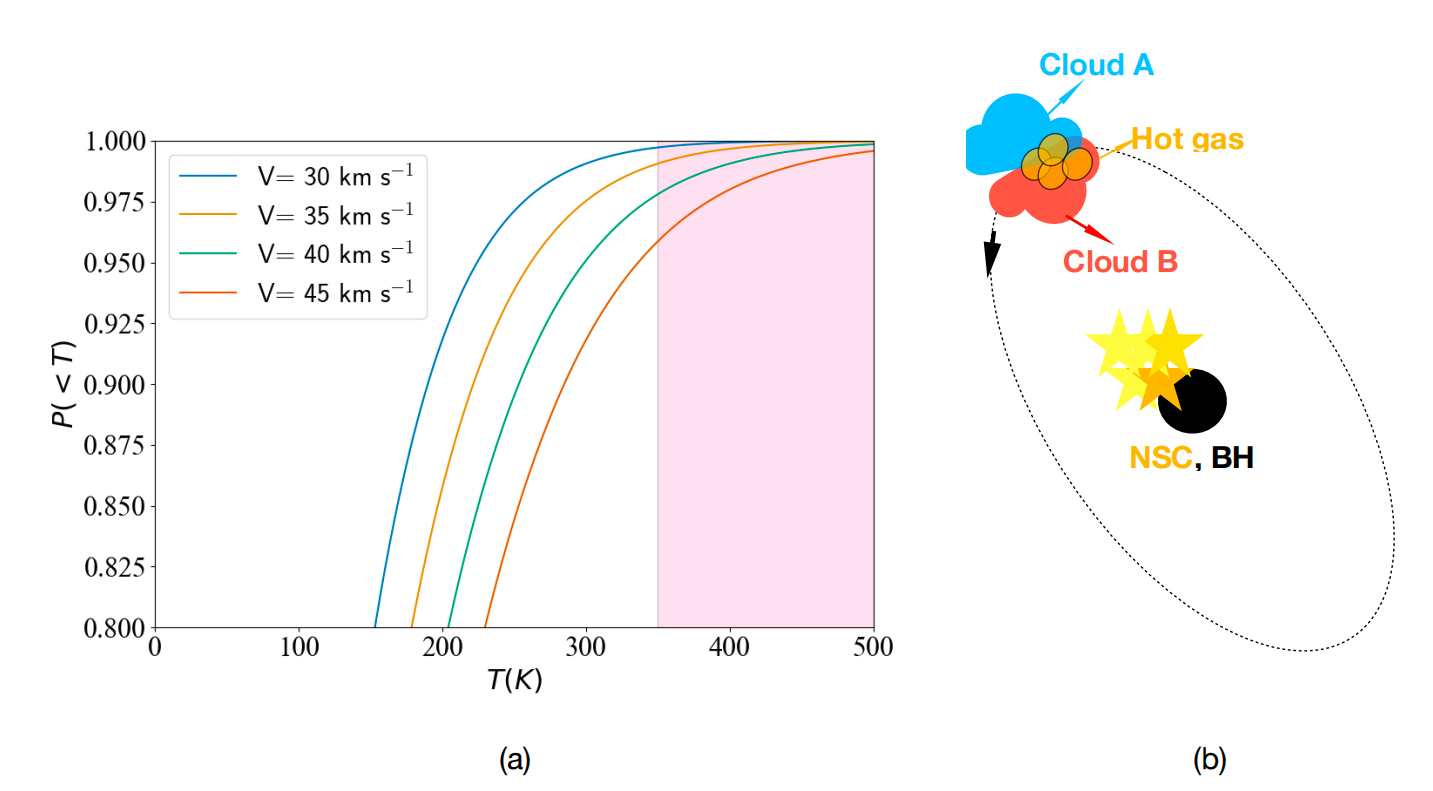
Calculations showed that the intermittent turbulent dissipation model predicts that localized extreme heating due to turbulent dissipation can directly produce gas components with temperatures exceeding 400 K, thereby explaining the complex temperature stratification of CMZ molecular clouds.
This finding suggests that shear motions between molecular clouds, under the gravitational potential of a nuclear star cluster and a supermassive black hole, can induce turbulence and heat some gases to high temperatures. This mechanism may be applicable to other extreme physical environments in galactic cores.
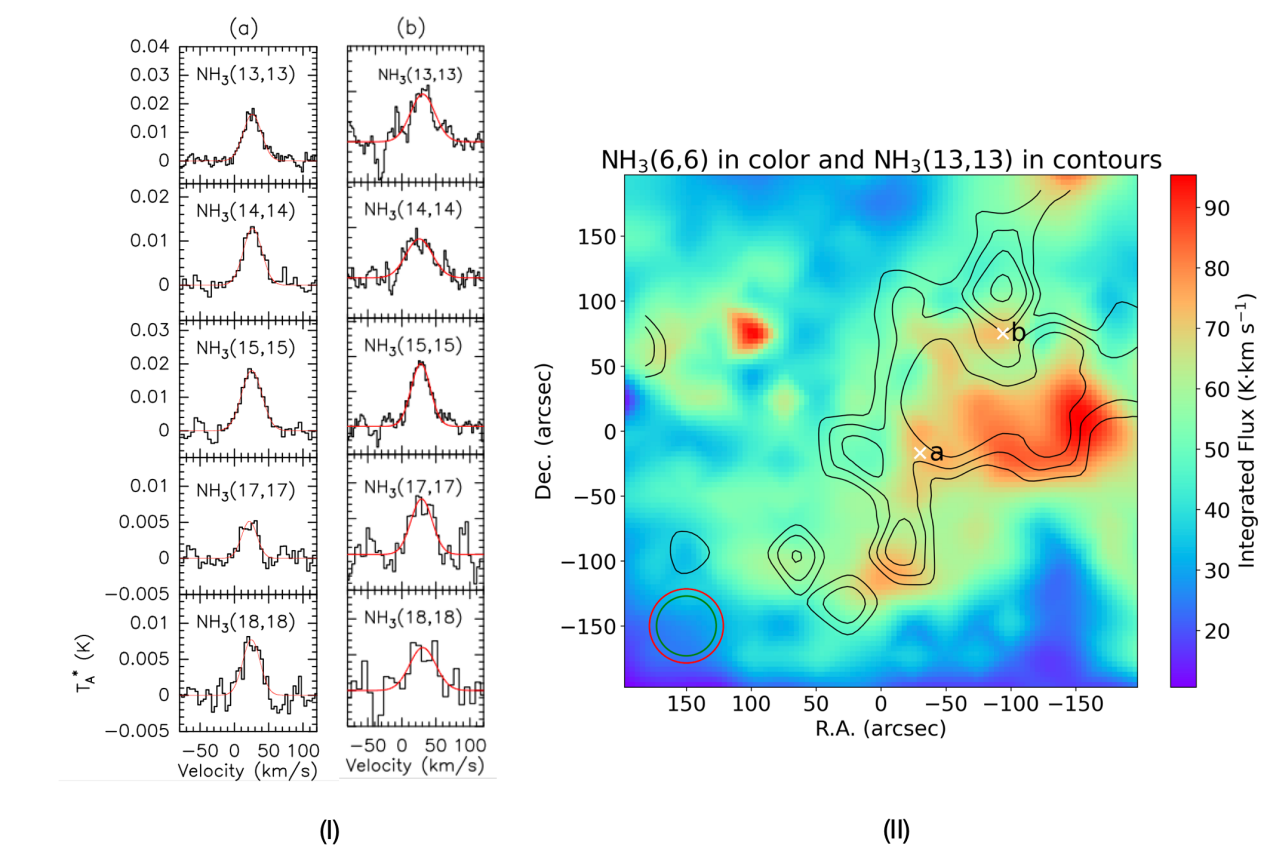
(I), The spectra of NH3 (13, 13) - (18, 18) toward positions (a) and (b) in G0.66-0.13. The black lines represent the observations, while the red lines represent the Gaussian fitting result. These spectra were observed with the Yebes 40m telescope. (II), The spatial distribution of NH3 (13, 13) (contours) overlayed on that of NH3 (6,6) (color-scale) toward G0.66-0.13. NH3 (13,13) was mapped with the Yebes 40 m telescope, while the NH3 (6,6) is mapped with TMRT. The white crosses denote the positions toward which long integration time observations were carried out and rotation diagrams were constructed. The green and red circles in the left corner denote the beam sizes for observations of NH3 (6, 6) and (13, 13), respectively. (Image by SHAO)
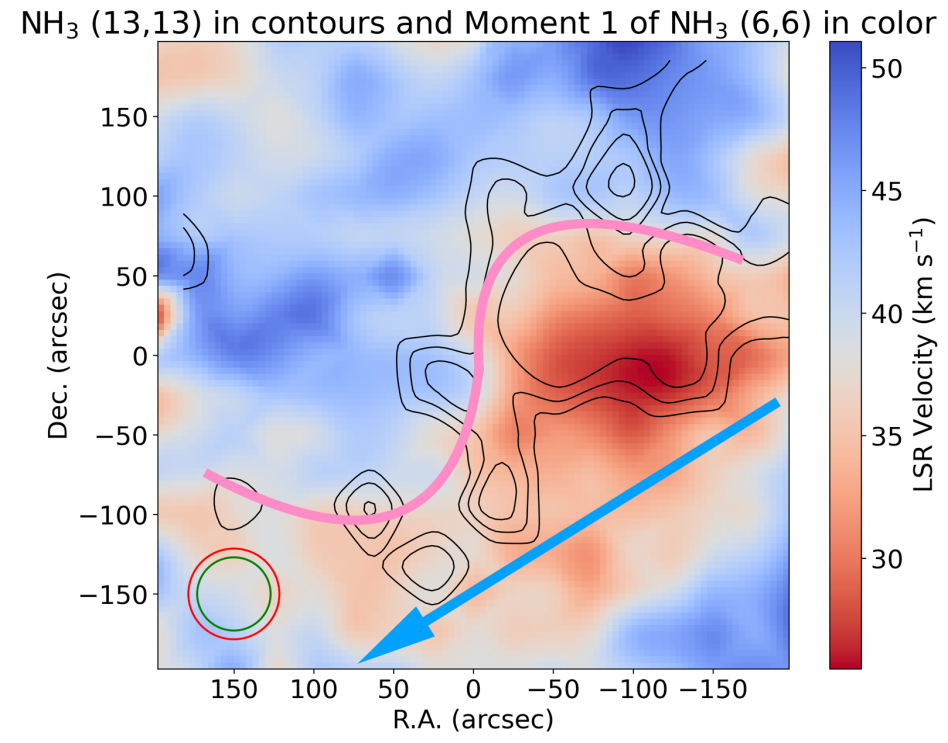
The distribution of integrated intensity of NH3 (13, 13) (contours) overlayed on intensity-weighted mean velocity map of NH3 (6, 6) in color scale. The blue line represents the orbit of stream around the gravitational potential center of the Galaxy. The pink curves mark the boundaries of different gas components. The green and red circles in the left corner denote the beam sizes for observations of NH3 (6, 6) and (13, 13), respectively. (Image by SHAO)
Figure 3 (a), The cumulative probability of temperature smaller than T in a molecular cloud with different line widths. The results are derived by assuming that the dissipation rate follows log-Poisson distribution, which is consistent with the intermittency turbulence model. The cloud size was assumed to be 5 pc. A pink box is used to highlight the high-temperature fraction predicted by the model. (b), A schematic picture of the proposed scenario on how hot molecular gas was generated in the Galactic center. Cloud A and Cloud B rotate around the Galactic center under the gravitational potential of the nuclear stellar clusters and the supper massive black hole. (Image by SHAO)

86-10-68597521 (day)
86-10-68597289 (night)

52 Sanlihe Rd., Xicheng District,
Beijing, China (100864)
Copyright © 2002 - Chinese Academy of Sciences