
In a new study published in Analytical Chemistry, a research team led by WANG Junfeng from the Hefei Institutes of Physical Science of the Chinese Academy of Sciences has developed a novel immobilization method for surface plasmon resonance (SPR) assays of membrane proteins, effectively addressing major technical constraints in the field.
Membrane proteins comprise approximately one-third of human proteins and nearly 60% of drug targets. They play crucial roles in signaling and transport. Accurately measuring their interactions with ligands is essential to understanding their function and developing drugs. SPR is a gold-standard, label-free technique that allows real-time analysis of binding kinetics. However, applying SPR to membrane proteins is difficult due to the challenge of stably immobilizing them while maintaining their native structure and activity.
To address this challenge, the researchers integrated the SpyCatcher-SpyTag covalent conjugation system with membrane scaffold protein (MSP)-based nanodisc technology to develop a simple, efficient, and stable strategy for immobilizing membrane proteins on sensor chips. This approach involves generating an MSP-SpyTag fusion protein to incorporate the target membrane protein into lipid nanodiscs. These nanodiscs carry a SpyTag label, enabling highly specific and efficient capture by SpyCatcher proteins pre-immobilized on a CM5 chip via standard amine coupling. This method facilitates the robust and stable immobilization of membrane proteins within a near-native lipid environment.
Using this method, the researchers performed SPR analysis on three representative types of membrane protein interactions: protein-lipid, transmembrane protein-antibody, and transmembrane protein-small molecule. The method consistently generated high-quality SPR data, enabling precise quantification of binding kinetics and affinities.
This novel approach effectively addresses the key bottlenecks of SPR technology in membrane protein studies and holds significant potential for advancing membrane protein research and drug discovery.
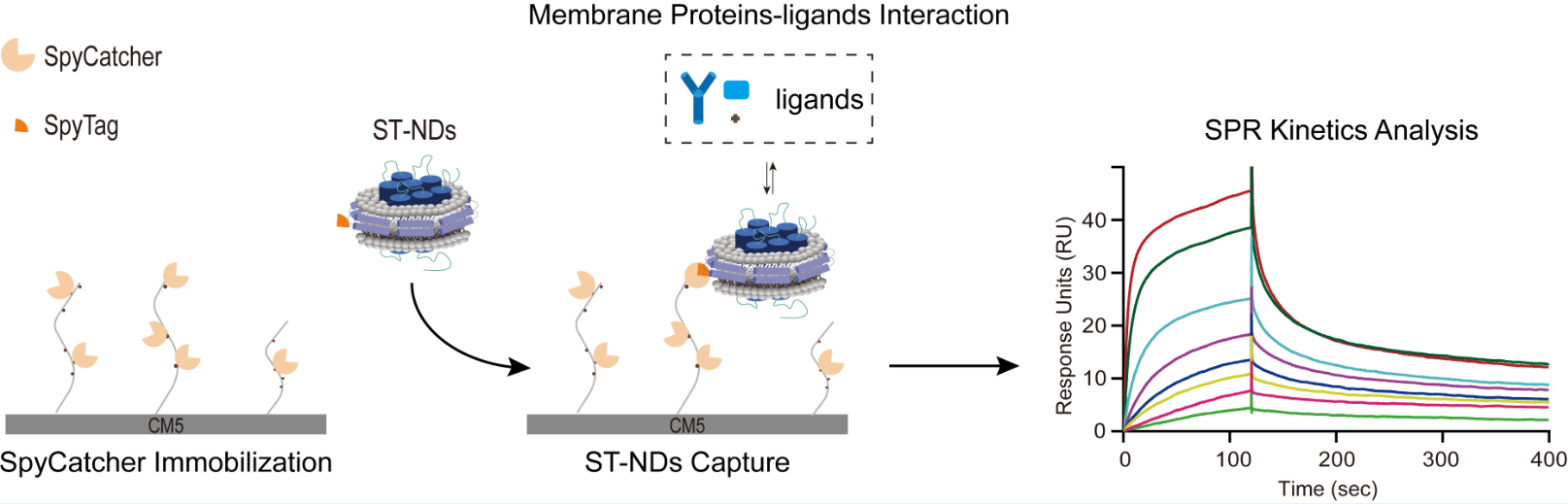
Schematic of the SpyCatcher-SpyTag-mediated covalent immobilization strategy for membrane protein SPR analysis (Image by WU Bo)
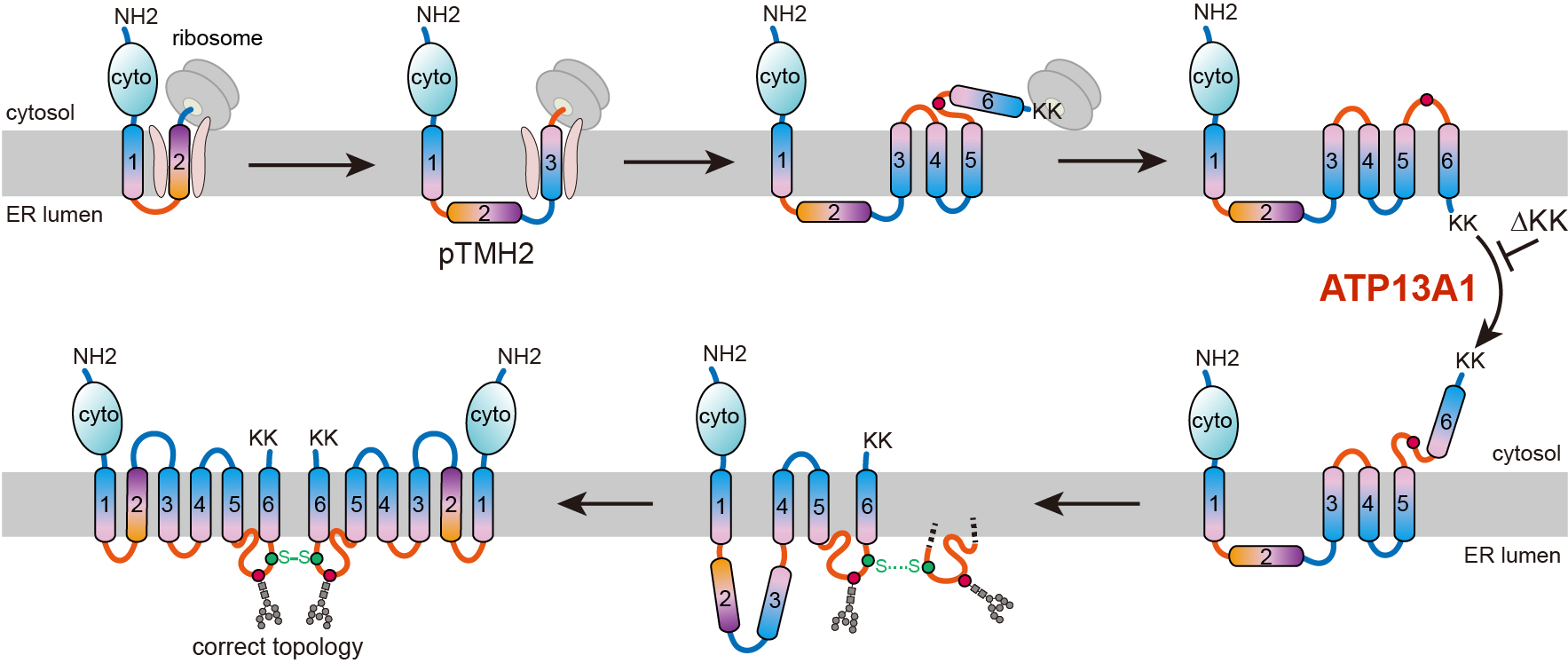
Researchers led by Prof. ZHANG Zairong from the Shanghai Institute of Organic Chemistry have identified a post-translational topogenesis pathway for the folding and assembly of multi-spanning membrane proteins.
In a recent study, LI Jie and colleagues solved the crystal structures of a MscL homolog from a methane-producing microbe (Methanosarcina acetivorans) in the closed and expanded states, revealing snapshots of two distinct conformational states of MscL.

86-10-68597521 (day)
86-10-68597289 (night)

52 Sanlihe Rd., Xicheng District,
Beijing, China (100864)
Copyright © 2002 - Chinese Academy of Sciences


