
In a recent study, Chinese scientists prepared a highly active surface exposed CoFe2O4 catalyst to activate H2O and then to generate free radicals. In so doing, the catalyst could remove doxycycline pollutants rapidly. This work was done by KONG Lingtao and his team from the Institute of Solid State Physics, Hefei Institutes of Physical Science.
Doxycycline (DC) is a semi-synthetic tetracycline antibiotic with strong antibacterial activity but less side effects, making it widely used in medical and aquaculture industries. But due to the rapid development of industry, more and more antibiotic residues could be detected in water even in drinking water. This residual puts human health as well as the environment at huge risk even with small concentration.
The researchers adopted solvothermal method to synthesize the CoFe2O4 precursor using sodium acetate as buffer, and then calcined at 550 ℃ to obtain uniformly sized, well crystallized CoFe2O4 catalyst.
The prepared catalyst expanded specific surface area exposing amounts of adsorption sites through its rough surface. The results of degradation experiments showed that 1.2 g/L CoFe2O4 could remove 92% of 20 ppm DC within 10 minutes under neutral pH conditions.
In addition to the preparing of the catalyst, the team also conducted mechanism analysis. Their further work exhibited that those active sites exposed on the surface of CoFe2O4 could rapidly activate H2O2 in a short time and then to produce a large number of strong oxidizing species ·OH, which degraded adsorbed DC in the restricted range. By Combining DFT calculation and LC-MS data, two possible degradation pathways were proposed.
This work breaks the traditional Fenton's stringent pH barriers and provides new ideas for the rapid and deep removal of micro-pollutants in water by nanomaterials.
The above job was supported by projects and units such as the National Key R&D Program of China, the National Natural Science Foundation of China, the Anhui Provincial Major Science and Technology Project, and the USTC Supercomputing Center.
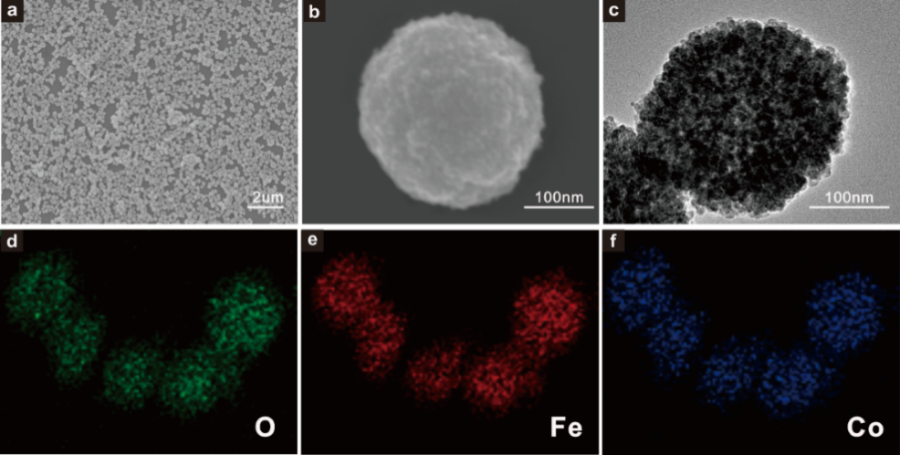
Fig. 1. (a and b) SEM images of CoFe2O4, (c) TEM image of CoFe2O4, (d, e and f) EDS Mapping. (Image by HONG Peidong)
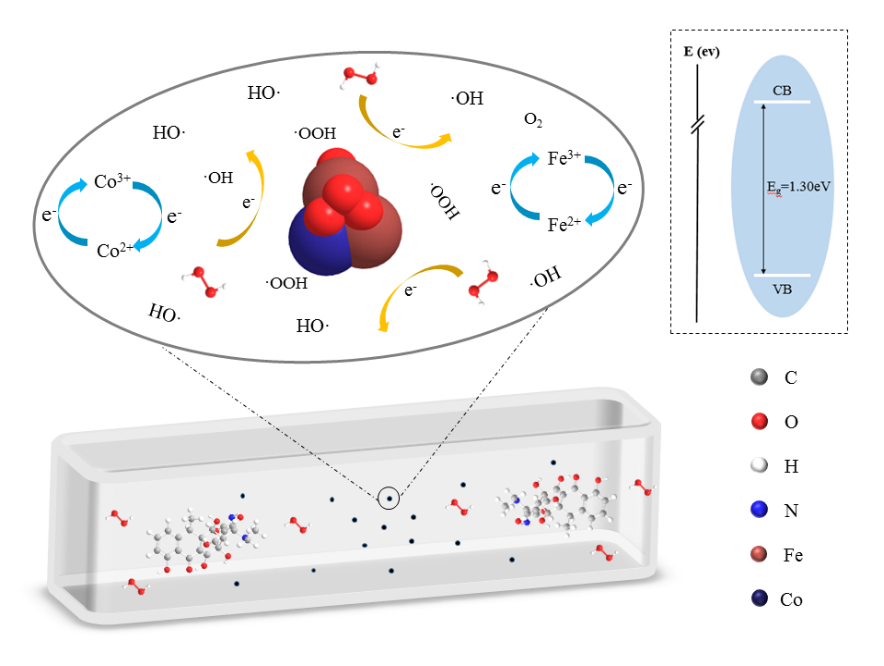
Fig. 2. The schematic of activation mechanism in the CoFe2O4/H2O2 system. (Image by HONG Peidong)

86-10-68597521 (day)
86-10-68597289 (night)

52 Sanlihe Rd., Xicheng District,
Beijing, China (100864)
Copyright © 2002 - Chinese Academy of Sciences


