
A research team led by Prof. CHONG Kang from the Institute of Botany of the Chinese Academy of Sciences, in collaboration with Prof. GUO Zifeng's research group, has identified a molecular regulatory module that controls flowering time in wheat, providing key genetic targets for improving and adapting wheat cultivars.
Their findings, published in Nature Communications, demonstrate that HtL1/FBA10—the major gene at a heading-date locus that encodes fructose 1,6-bisphosphate aldolase 10 ( a core metabolic enzyme in the glycolytic pathway)—accelerates vernalization-mediated flowering in wheat. HtL1 therefore acts as a critical gene in modern wheat breeding, facilitating adaptation to environmental changes and fine-tuning of the growth period.
By conducting a genome-wide association study (GWAS) on heading time using a core collection of wheat germplasm resources accumulated over the past 60 years, the researchers identified HtL1 as a key regulatory gene controlling flowering time.
The HtL1 haplotypes show significant differences in geographic distribution, reflecting the distinct adaptive characteristics of Chinese and American wheat germplasm in their respective local environments. Notably, Chinese wheat breeders have continuously selected against Hap-2, a haplotype associated with low HtL1 expression and late flowering. This trend indicates that Chinese breeders have long prioritized the retention and selection of early-flowering HtL1 haplotypes to address climatic constraints such as terminal dry-hot winds.
The study revealed that vernalization induces dynamic changes in the post-translational modifications of HtL1/FBA10: Its phosphorylation, catalyzed by TaCDPK13, gradually decreases, while its O-GlcNAcylation (catalyzed by TaOGT1) increases accordingly. This switch in post-translational modifications enhances both the stability and enzymatic activity of HtL1/FBA10, resulting in elevated histone acetylation in the chromatin region of the flowering-promoting gene VRN1. This, in turn, activates VRN1 transcription and accelerates wheat flowering.
The discovery of this "metabolism-epigenetics" regulatory pathway establishes a direct molecular link between carbohydrate metabolism and the vernalization response. Consequently, this finding provides a mechanistic explanation for a long-standing puzzle that has persisted for more than half a century: the molecular mechanism by which glucose metabolism promotes plant vernalization.
This study offers valuable new insights into agricultural adaptation to climate change. The findings suggest that targeted modulation of the HtL1-associated metabolic-epigenetic network could facilitate breeding high-yield and stable-yield wheat varieties that can sense ambient temperature fluctuations and fine-tune flowering time.
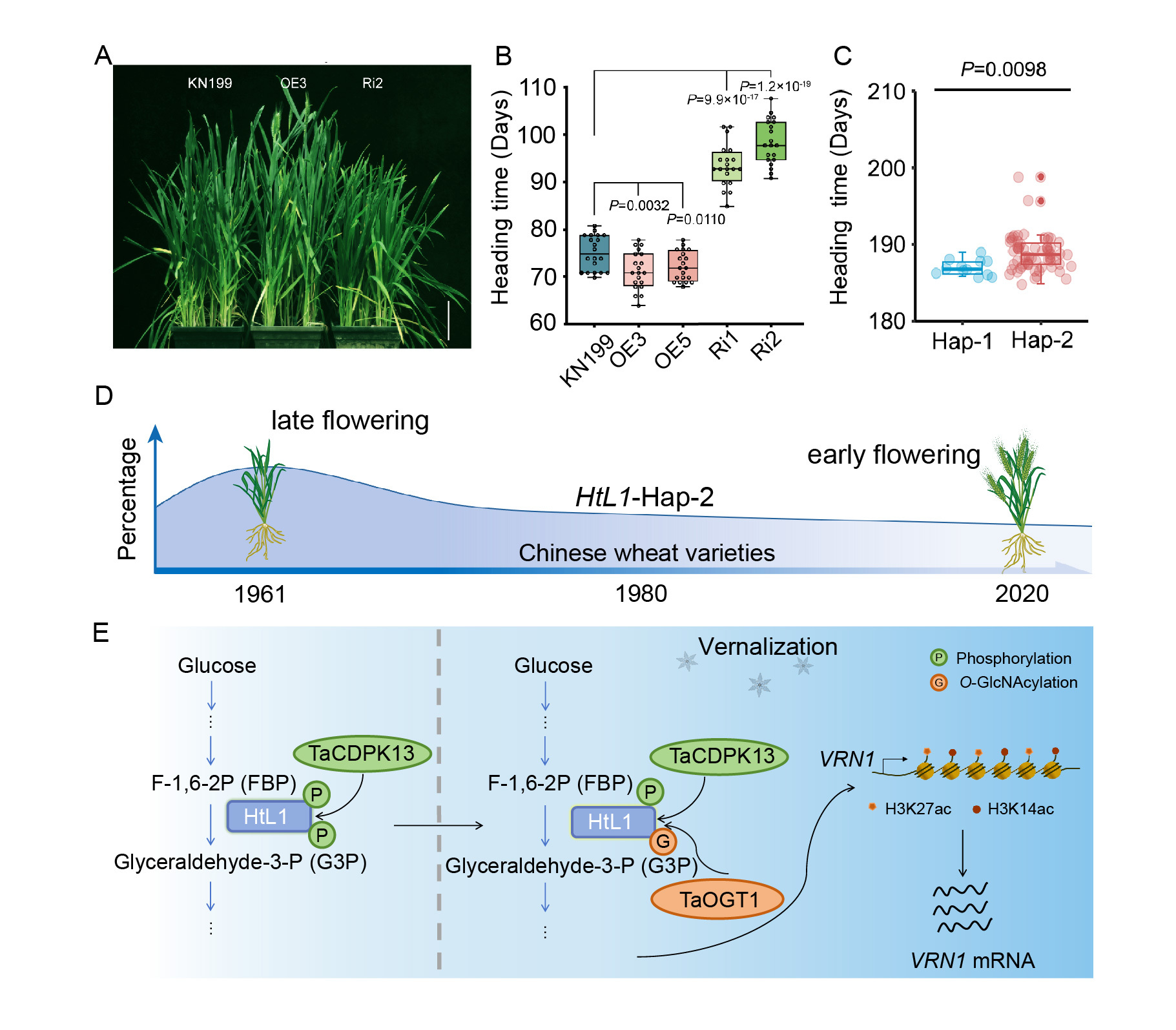
Dynamic post-translational modification of HtL1/FBA10, a key enzyme in the glycolysis pathway, regulates vernalization-mediated flowering time in wheat. A and B. HtL1 positively regulates flowering time in wheat; C. Cultivars carrying Hap-2 of HtL1 flower later than those carrying Hap-1; D. Declining selection frequency of Hap-2 during Chinese wheat breeding history; E. A working model illustrating how vernalization-induced dynamic post-translational modifications of HtL1 regulate transcription of the flowering promoter VRN1 in wheat. (Imaged by XING Lijing)

86-10-68597521 (day)
86-10-68597289 (night)

52 Sanlihe Rd., Xicheng District,
Beijing, China (100864)
Copyright © 2002 - Chinese Academy of Sciences


