
La Niña—a climate phenomenon characterized by unusually cool sea surface temperatures in the central and eastern tropical Pacific Ocean—can persist for multiple years, exerting significant climate impacts worldwide. In recent decades, such prolonged La Niña events have grown more frequent. However, the mechanisms that sustain these multiyear cooling episodes have remained unclear.
To address this knowledge gap, a research team from the Institute of Oceanology of the Chinese Academy of Sciences (IOCAS) has identified a critical feedback loop involving rainfall and ocean salinity that helps maintain multiyear La Niña conditions. Their findings were published in Nature Communications on January 14.
In the vast western equatorial Pacific, the sustained reduction in rainfall driven by multiyear La Niña leads to a steady increase in upper-ocean salinity. This rise in salinity destabilizes the ocean's upper layers, which in turn triggers a series of ocean wave processes—ultimately causing cooling in the eastern equatorial Pacific, more than 10,000 kilometers away. When this positive salinity anomaly persists for two years, slower ocean circulation sets in, promoting cooling across the entire tropical Pacific.
Quantitative analysis shows that this rainfall-linked cooling enhances the intensity of multiyear La Niña by 14% in the first year and a further 32% in the second year. This effect allows reduced rainfall to play a key role in sustaining the prolonged cooling of multiyear La Niña events.
"We have demonstrated, for the first time, that multiyear rainfall and salinity feedbacks regulate the persistence of La Niña, reshaping our understanding of ocean-atmosphere interactions during these prolonged events," said Dr. TIAN Feng, the study's first author.
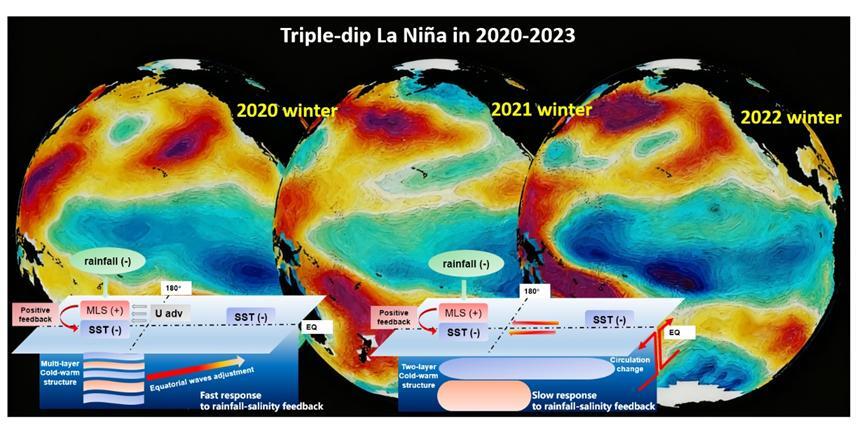
The role of salinity feedback caused by reduced rainfall in sustaining multi-year La Niña events. (Image by IOCAS)
A new study led by CHENG Lijing from the Institute of Atmospheric Physics derived a new estimate of water cycle change based on a new salinity data product since 1960. It provided strong evidence that the global water cycle has amplified substantially in the past 50 years.
A research team led by Prof. WANG Fan from the Institute of Oceanology has revealed the mechanisms of El Niño-Southern Oscillation asymmetry from the perspective of ocean salinity for the first time.

86-10-68597521 (day)
86-10-68597289 (night)

52 Sanlihe Rd., Xicheng District,
Beijing, China (100864)
Copyright © 2002 - Chinese Academy of Sciences


