
Carbon dioxide (CO2) emissions have been the primary driver of climate change and global warming since the pre-industrial era. Per the World Meteorological Organization (WMO), global fossil fuel-related CO2 concentrations hit a record 426.77 ppm in January 2025, prompting the conversion of CO2 into high-value products (e.g., CO, O2) to become a key research focus. Solid Oxide Electrolysis Cells (SOECs) are promising efficient electrochemical technologies for CO2-to-CO conversion; in SOEC systems, CO2 reduction reaction (CO2-RR) occurs at the cathode (electrochemically converting CO2 to CO and O2⁻ under applied voltage) with O2⁻ migrating through the electrolyte to the anode to form O2.
As the core of CO2 electroreduction, the cathode determines SOEC efficiency and performance, and ideal electrode materials require fast kinetics, high energy efficiency, and low cost. Currently, nickel (Ni)-based cathodes (mainly Ni-YSZ, Ni-GDC, Ni-SDC) are widely used for SOEC CO2-RR due to high conversion efficiency and cost-effectiveness, but their large-scale application is hindered by significant conductivity loss and deactivation—caused by Ni oxidation (Ni → NiO), carbon deposition under high CO concentrations, and Ni particle growth during operation.
To address these limitations, a research team led by Prof. Abudukeremu Kadier and Prof. MA Pengcheng from the Xinjiang Technical Institute of Physics and Chemistry (XTIPC) of the Chinese Academy of Sciences (CAS), has developed a novel nickel-basalt tablet (Ni-BT) material and applied it as a cathode for CO2 reduction in a SOEC. The cell configuration is Ni-BT/SDC/YSZ/SDC/LSCF.
In this setup, Ni-BT serves as the cathode material, LSCF as the anode material, and YSZ as the solid electrolyte. SDC is added as an interlayer between the electrodes to enhance ionic conductivity and strengthen the bonding between YSZ and Ni-BT.
The team employed a series of characterization methods to investigate the properties of the Ni-BT material and verify its effectiveness in CO2 electrolysis via SOEC. Test results showed that the Ni-BT/SDC/YSZ/SDC/LSCF single cell achieved a high current density of 480 mA/cm² and a low polarization resistance of 1.91 Ω·cm². The cell’s current density increased with rising operating temperature, a phenomenon attributed to favorable thermodynamics and accelerated electrochemical reaction kinetics.Notably, the cell exhibited high CO production of 7.45 ml·min⁻¹·cm⁻² with a Faradaic efficiency exceeding 90%.
The findings, recently published in International Journal of Hydrogen Energy, highlight nickel-basalt composites as a promising cathode material for CO2 electrolysis in SOECs.
Abudukeremu Kadier
Xinjiang Techinical Institute of Physics & Chemistry
E-mail: abudukeremu@ms.xjb.ac.cn
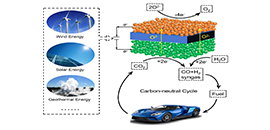
A research group led by Prof. WANG Guoxiong and Prof. BAO Xinhe from the Dalian Institute of Chemical Physics was invited to review the development, challenges and prospects of high-temperature CO2 electrolysis in solid oxide electrolysis cells.
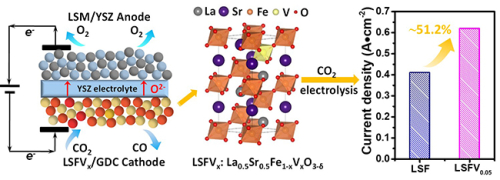
A research team led by Prof. BAO Xinhe and Prof. WANG Guoxiong in Dalian Institute of Chemical Physics enhanced carbon dioxide electrolysis performance with Vanadium-doped perovskite cathode in solid oxide electrolysis cell. This study regulated oxygen vacancy concentrati...

86-10-68597521 (day)
86-10-68597289 (night)

52 Sanlihe Rd., Xicheng District,
Beijing, China (100864)
Copyright © 2002 - Chinese Academy of Sciences


