Newsroom


Scientists have recently revealed the molecular mechanism of the MsWRKY65–MsLNC1–MsTRX5 module conferring resistance to Valsa canker in wild apple.
Led by Prof. ZHANG Daoyuan from the Xinjiang Institute of Ecology and Geography (XIEG) of the Chinese Academy of Sciences (CAS), the study was published in Horticulture Research.
Apple Valsa canker, caused by the necrotrophic fungus Valsa mali, leads to bark necrosis of branches, tree decline, and plant death, posing a severe threat to the sustainable development of the global apple industry and the preservation of wild apple populations. To date, the molecular regulatory network underlying apple resistance to Valsa canker remains incompletely understood.
In this study, the research team performed strand-specific transcriptome sequencing of V. mali-infected wild apple (Malus sieversii) samples and identified 35,898 long non-coding RNAs (lncRNAs). Through differential expression and weighted gene co‑expression network analysis (WGCNA), they found that a specific module, MEskyblue3, was strongly correlated with the previously reported resistance‑related transcription factor MsWRKY65 (correlation coefficient r = 0.91, p = 4e‑05).
Functional validation confirmed that both MsLNC1 and MsWRKY65 act as positive regulators of canker resistance. Overexpression of MsLNC1 reduced lesion length by 21.4% and upregulated defense genes, while knockdown increased susceptibility. MsWRKY65 was shown to directly bind to the MsLNC1 promoter and activate its transcription, placing MsWRKY65 upstream of MsLNC1.
More importantly, the researchers said this study revealed that MsLNC1 directly binds to homologous regions in the promoter of MsTRX5 (encoding thioredoxin H5) and recruits RNA polymerase II (Pol II) to drive MsTRX5 expression. MsTRX5 subsequently modulates cellular redox homeostasis—triggering an early nitric oxide (NO) burst and reducing H2O2 accumulation—which activates downstream defense responses and enhances resistance.
Based on these findings, the team proposed a complete regulatory model: upon V. mali infection, MsWRKY65 is activated and induces MsLNC1 expression by binding to W‑box motifs in its promoter. MsLNC1 then associates with homologous sequences in the MsTRX5 promoter and recruits Pol II machinery to drive MsTRX5 expression. MsTRX5, in turn, modulates cellular redox homeostasis (triggering NO burst and scavenging excess ROS)—which activates downstream defense responses and strengthens resistance.
According to the researchers, this study unveils a lncRNA‑mediated transcriptional regulatory cascade in disease resistance in woody fruit trees, expanding our understanding of plant lncRNA functions and the regulatory network of fruit tree immunity.
The three core components of this module—MsWRKY65, MsLNC1, and MsTRX5—represent promising targets for marker‑assisted selection or gene editing in breeding programs, offering practical strategies for developing canker-resistant apple varieties and supporting the sustainable development of the apple industry.
Looking ahead, future research may investigate the upstream activation signals of this module in response to pathogen infection and its natural allelic variations across apple accessions, which would provide richer genetic resources for resistance breeding, the researchers said.
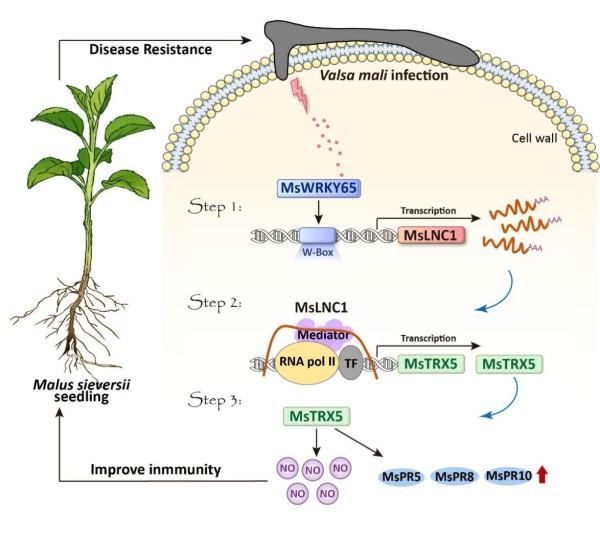
The proposed mode of action of MsWRKY65-MsLNC1-MsTRX5 module. (Image by XIEG)