Newsroom


A recent study published in Angewandte Chemie International Edition developed a Na–Auδ⁻ interface structure on MOR nanosheet that enables near-quantitative selectivity for methane oxidation to methanol, acetic acid, and other oxygenates under mild conditions.
The researchers found that the Au/1.2Na-MOR(NS) catalyst achieved nearly 100% selectivity toward hydroxylated oxygenates derived from methane, with a productivity of 2.02 mmol·gcat⁻¹·h⁻¹ under CH₄/CO/O₂/H₂O conditions at 150 °C.
The research was led by Profs. HOU Guangjin and GAO Pan from the Dalian Institute of Chemical Physics (DICP) of the Chinese Academy of Sciences (CAS).
"Our study elucidates the dynamic role of in situ generated H₂O₂ in methane activation under mild conditions and demonstrates that electronic microenvironment engineering is an effective strategy for achieving selective and controllable oxidation valorization of methane," HOU said.

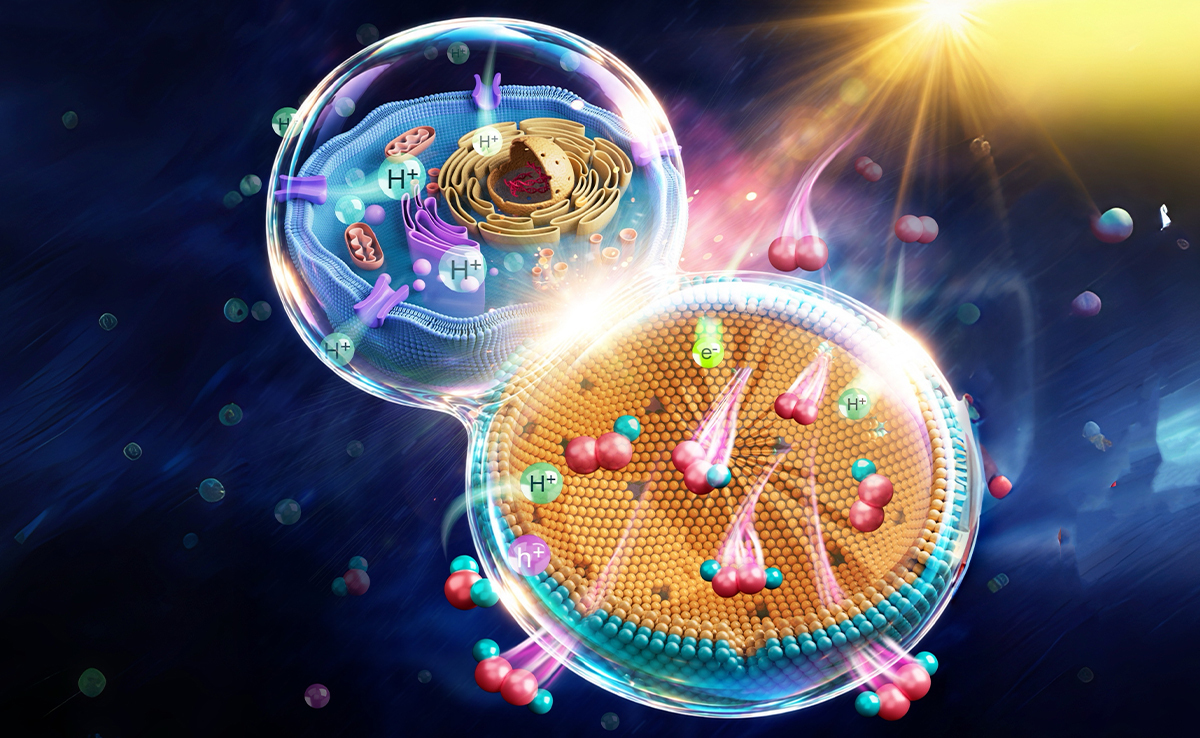
Selective methane conversion to methanol and acetic acid via ·OH/CH₃ radical coupling enabled by Na–Auδ⁻ interfacial sites that generate H₂O₂ and ·OH (Image by LI Xianquan)
The selective conversion of methane into high-value oxygenates via C–H activation under mild conditions is considered a promising strategy for energy diversification and greenhouse gas mitigation. In situ generation of H₂O₂ for methane activation offers an attractive alternative to the use of externally supplied H₂O₂, avoiding its high cost, low utilization efficiency, and transport and storage risks.
However, achieving efficient methane oxidation while suppressing overoxidation remains a major challenge, as it requires precise control over the generation rate, local concentration, and reactive oxygen species derived from H₂O₂, such as ·OH and ·OOH radicals.
This study combined operando spectroscopic characterizations and density functional theory calculations and revealed that the Na–Auδ⁻ interfacial sites promote kinetically favored O–O bond cleavage and H₂O dissociation. This process enables the controlled in situ generation of H₂O₂ and ·OH radicals, which are essential for methane C–H activation while effectively suppressing overoxidation.
Further mechanistic studies showed that methane oxidation proceeds through *CH₃ radicals generated via ·OH-mediated methane activation. Coupling of *CH₃ with ·OH produces methanol, whereas direct coupling with adsorbed CO leads to acetic acid formation. Isotopic labeling experiments confirmed CO serves as the sole carbonyl source, excluding the possibility of methanol carbonylation.