
Newsroom


Researchers have recently developed a hollow CdS@polydopamine nanoreactor that integrates two biomimetic features, providing a new strategy for mimicking the sophisticated functions of living cells in synthetic nanomaterials.
The study was published in Journal of the American Chemical Society. It was conducted by a team led by Prof. LI Can from the Dalian Institute of Chemical Physics (DICP) of the Chinese Academy of Sciences (CAS), in collaboration with Prof. LIU Jian's team from Inner Mongolia University.
Natural cells, as sophisticated soft matter systems, employ multi-level confined architectures and spatially organized components to drive biochemical reactions with remarkable efficiency and specificity. Translating these cellular principles into synthetic nanomaterials, that is, creating cell-like entities with tailored surface functionalities and compartmentalized pores or cavities through nanocell engineering, namely nanoreactors, represents a powerful convergence of cellular biology and nanotechnology.
The newly developed nanoreactor incorporates two key biomimetic features. First, a dynamic catechol/o-benzoquinone redox pair in the polydopamine shell functions as a proton relay rather than an active pump, accelerating proton-coupled electron transfer (PCET) through the reversible donation and acceptance of protons.
Second, its compartmentalized nanoreactor architecture, comprising a nanoscale cavity enclosed by a porous shell, creates a confined microenvironment that facilitates mass diffusion, reactant enrichment, and photon trapping.
Together, these two features help overcome the mismatch in reaction kinetics between the oxygen reduction and water oxidation half-reactions, enabling a H2O2 photosynthesis rate of 3.24 mmol gcat.-1 h-1 in aqueous solution under visible-light illumination, with a solar-to-chemical conversion efficiency of 1.2%.
By combining in situ spectroscopy, photochemical analysis, finite element simulations, and theoretical calculations, the researchers visualized the biomimetic machinery and elucidated the Z-scheme heterojunction-based photocatalytic mechanism. Furthermore, encapsulation within an environmentally benign sodium alginate hydrogel matrix yields monolithic and recyclable photocatalysts capable of stable H2O2 synthesis under natural sunlight.
"Our study provides a new strategy for engineering biomimetic nanoreactors that increasingly replicate the sophisticated functions of living cells, opening new opportunities in artificial photosynthesis, energy catalysis, and synthetic chemistry," said Prof. LI.
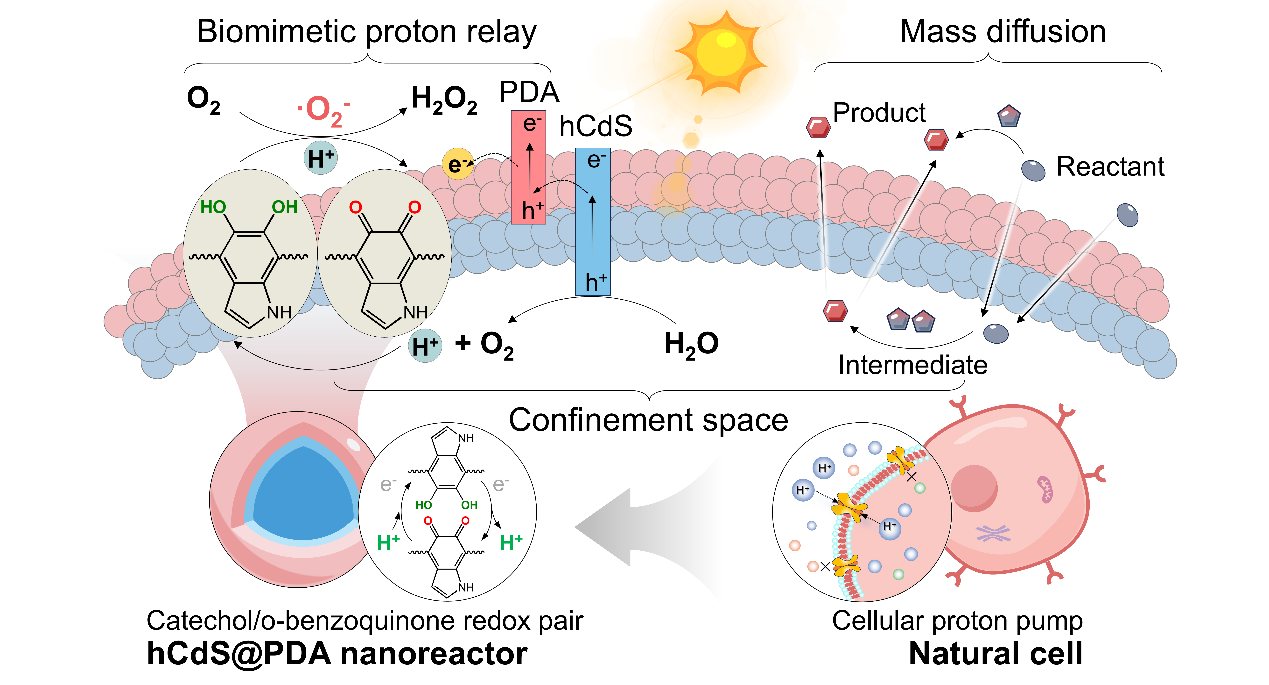
Schematic illustration of photocatalytic H2O2 synthesis over hollow CdS@polydopamine based on biomimetic proton relay machinery and nanoreactor engineering. (Image by LI Haitao)
