Newsroom


A collaborative research team led by the Qingdao Institute of Bioenergy and Bioprocess Technology (QIBEBT) of the Chinese Academy of Sciences has developed a new "process ramanomics" platform. This technology transforms industrial fermentation tanks from opaque "black boxes" into transparent, data-rich environments, enabling real-time, data-driven control of biomanufacturing. The study was published online on April 11 in Trends in Biotechnology.
Industrial biopolymer production has long depended on manual sampling followed by time-consuming laboratory workflows such as chromatography, which often deliver results only after the fermentation has already progressed further. These measurements also reflect population averages across millions of cells, masking metabolic heterogeneity where underperforming subpopulations can pose quality risks even when overall yield appears acceptable.
The new process ramanomics platform overcomes these limitations by directly reading single-cell Raman spectral "biochemical fingerprints." It can capture key indicators—including polymer type, total yield, and monomer ratio—in approximately 12 minutes.
The researchers validated this approach in polyhydroxyalkanoate (PHA) fermentation, a key route for biodegradable polyesters used in packaging and medical materials. Powered by machine learning, the platform achieved 99.75% accuracy in distinguishing PHB-producing cells from P34HB-producing ones, and quantified total PHA content and monomer composition at the single-cell level with a median absolute deviation below 3.8%, comparable to traditional gas chromatography.
In a pivotal 5,000-liter industrial fermenter trial, traditional offline testing pointed to harvesting at 28 hours when PHA content registered 66.32%. Process ramanomics, however, revealed a compositional shift invisible to conventional methods: the 4HB monomer ratio was 8.67% at 26 hours (within specification) but climbed to 11.28% by 28 hours, exceeding the compliance limit, demonstrating that earlier termination could safeguard product quality.
The platform's single-cell resolution also showed that the content of intracellular PHA can vary by more than threefold among individual cells. At 26 hours, population heterogeneity was lowest, with 91.54% of cells producing at high levels and a 4HB composition that was within specification. This confirmed that 26 hours was the optimal harvest window.
The scientists further showed that process ramanomics can be applied to different chassis organisms and products. For example, it can be used for protein synthesis in yeast and lipid synthesis in Rhodococcus. This suggests that process ramanomics could serve as a general-purpose analytics engine for next-generation intelligent bioreactors.
"By bringing label-free ramanomics to the process stage with single-cell precision, we can track product formation fast enough to support real-time production decisions", said Prof. XU Jian from QIBEBT. "Process ramanomics offers a practical route to monitor both composition and cell-to-cell variability, helping identify the right harvest window before off-spec drift occurs," said Prof. CHEN Guoqiang from Tsinghua University.
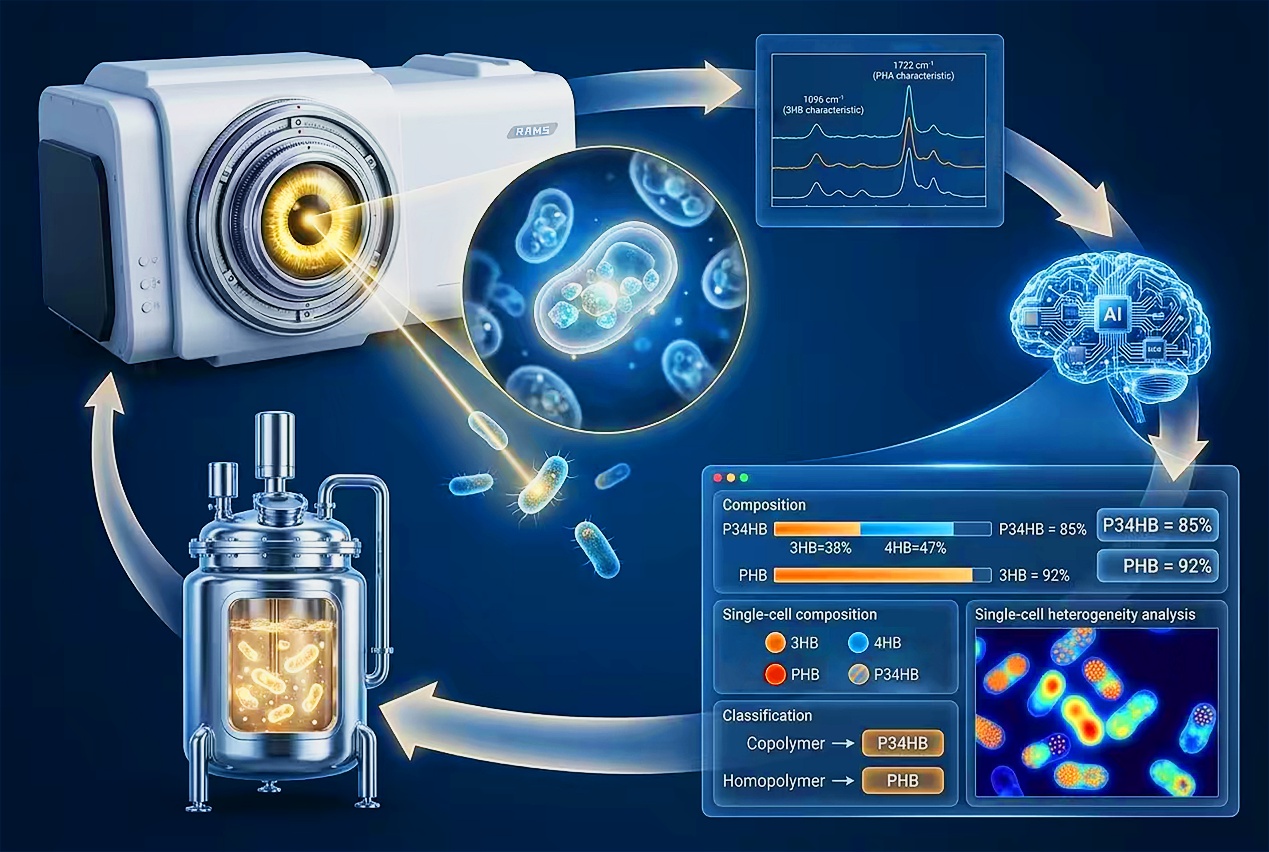
Schematic overview of the process ramanomics platform for real-time, single-cell monitoring of industrial PHA fermentation (Image ZHANG Jia)