Newsroom


Researchers from the Qingdao Institute of Bioenergy and Bioprocess Technology (QIBEBT) of the Chinese Academy of Sciences, in collaboration with their partners, have developed a novel method for the comprehensive evaluation of probiotic products using a Raman Flow Cytometry (RFC) platform.
Published in iMetaOmics, this new method allows for rapid, label-free analysis of identity, viability, and metabolic activity at both the single-cell and strain levels in complex probiotic products, creating a "microbial ID card" for each formulation.
Ensuring the accuracy and functionality of probiotic formulations is essential for their efficacy and safety. However, traditional methods such as culture-based enumeration and molecular assays can be time-consuming, labor-intensive, and limited in resolution.
To address these challenges, the researchers created the RFC-based method, which integrates high-throughput Raman spectroscopy with microfluidics and machine learning. This new system captures spontaneous Raman spectra from individual cells at a speed of one cell per second, achieving more than ten times higher throughput than previous Raman-based methods. A curated spectral reference database, combined with a linear discriminant analysis model, allows for precise classification of probiotic strains, including the detection of those present at just 0.1% abundance.
In addition to strain identification, the researchers evaluate both cell viability and metabolic activity using deuterium-labeled water (D2O) as a metabolic tracer. The incorporation of D2O into cellular biomolecules produces characteristic Raman shifts, enabling non-invasive quantification of each cell's physiological state without the need for fluorescent labeling.
The RFC workflow was validated across both single-strain and multi-strain commercial probiotic products, achieving results comparable to traditional plate-counting and sequencing methods. Compared to these conventional tools, RFC significantly reduces assay time and complexity while providing deeper insights into strain-level vitality and intercellular heterogeneity.
"The RFC platform demonstrates how in-depth single-cell analysis can be transformed into practical tools for industrial microbiology," said co-first author Prof. ZHANG Jia from QIBEBT. "This method bridges fundamental microbial phenotyping with real-world quality assurance, offering both scientific rigor and operational value."
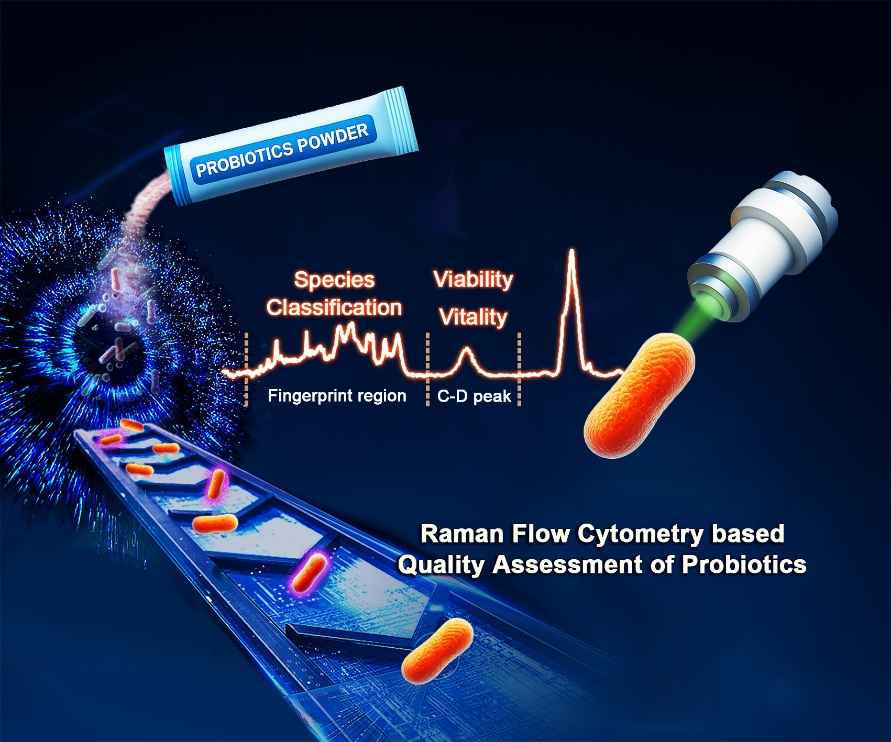
A new Raman Flow Cytometry–based technology for probiotic quality assessment. (Image by QIBEBT)