Newsroom


A research team from the Xinjiang Institute of Ecology and Geography (XIEG) of the Chinese Academy of Sciences has published a new review highlighting biochar as a promising climate-smart strategy for restoring dryland soils and mitigating desertification.
Published in Biochar on February 18, the review systematically examines how biochar can help address major ecological challenges in arid and semi-arid regions, including soil degradation, water scarcity, salinization, and declining agricultural productivity.
The researchers found that biochar can improve soil structure, enhance water retention, promote nutrient cycling, buffer soil pH, and support beneficial microbial communities. These combined effects can improve soil resilience, reduce erosion risk, and promote vegetation growth in fragile dryland ecosystems.
The review also points out that biochar has broad potential for applications in sustainable land management. In addition to its role as a soil amendment, emerging approaches such as precision application, biochar co-composting, and integration with solar-powered irrigation systems may further improve its efficiency and practicality in areas with limited water resources.
The effectiveness of biochar depends on feedstock source, production conditions, and local soil–climate characteristics. Therefore, the researchers emphasize the need for site-specific optimization and multidisciplinary research to improve economic feasibility, quantify long-term carbon sequestration, and evaluate ecosystem-level impacts.
This review provides new insights into the multifunctional role of biochar in dryland restoration and offers a useful scientific basis for advancing climate-resilient agriculture and sustainable land management in arid regions.
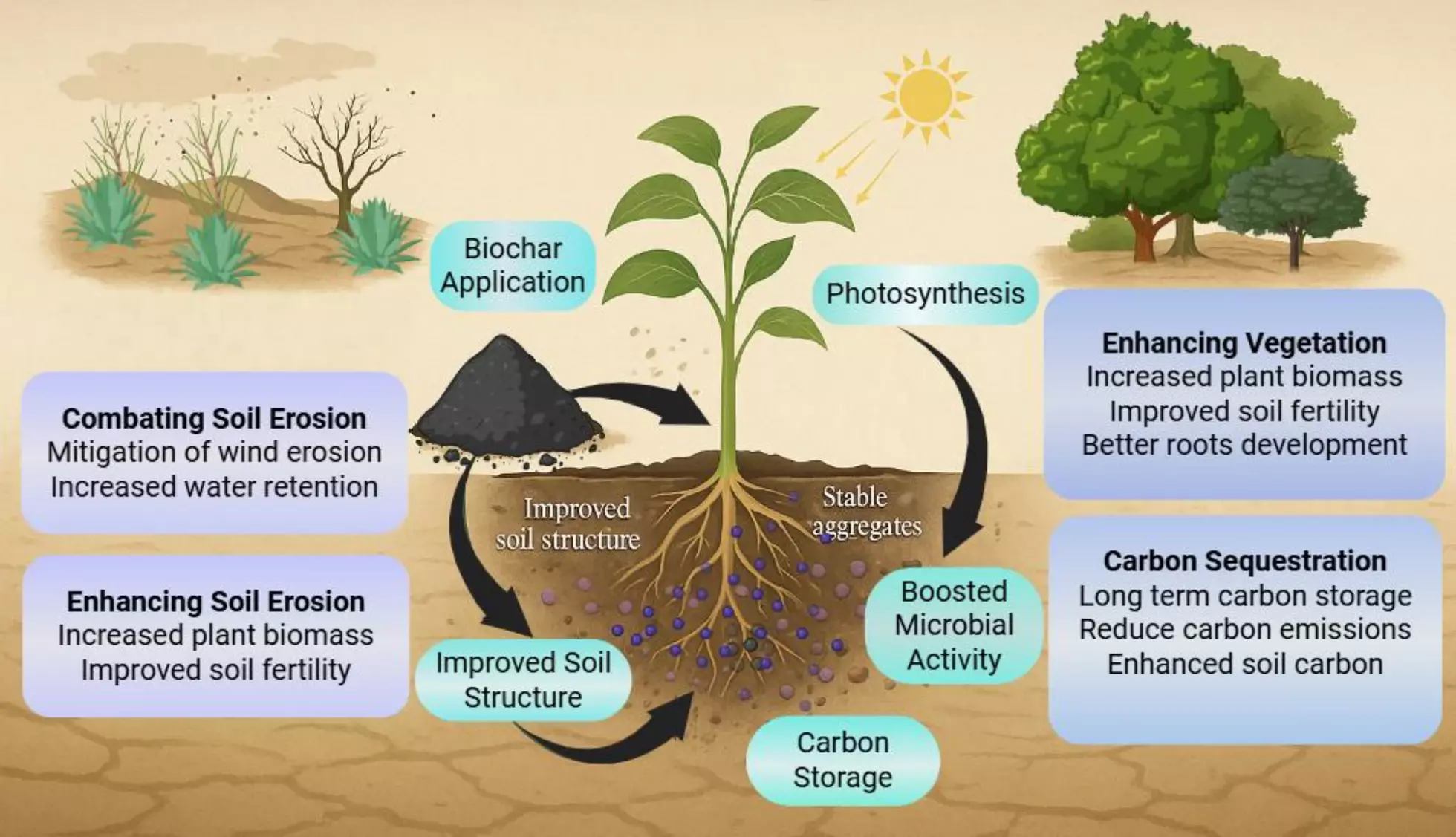
Mechanisms by which biochar mitigates desertification in arid regions. (Image by XIEG)