Newsroom


Researchers from the Institute of Applied Ecology of the Chinese Academy of Sciences have provided new quantitative evidence showing how tree canopies in temperate forests absorb nitrogen dioxide (NO2) from the atmosphere.
The study, published in Plant, Cell & Environment, sheds new light on the cycle of nitrogen between the atmosphere and forest ecosystems, and helps us to understand how trees absorb nutrients and store carbon.
Nitrogen dioxide is one of the major atmospheric pollutants and can enter forest ecosystems through a process known as dry deposition, whereby gases are directly absorbed by the leaves of the forest canopy. In nitrogen-limited ecosystems, canopy uptake of NO2 can be an important source of nitrogen for plants, potentially influencing ecosystem productivity and carbon sequestration. Despite its ecological significance, quantitative assessments of canopy NO2 absorption have been limited.
In this study, the researchers led by Prof. KANG Ronghua conducted a controlled 15N isotopic tracing experiment using saplings of four dominant tree species in northeastern China's temperate forests. The saplings were exposed to NO2 for eight hours under varying light and soil nitrogen conditions, enabling the researchers to track the absorption and distribution of nitrogen in different plant organs.
They found significant differences among tree species in the ability to take up NO2. Leaf area was identified as a major factor explaining these differences. Under light conditions, NO2 uptake increased by approximately 8–34% compared to dark conditions, largely because stomata (tiny pores on leaf surfaces) remain open during the day, facilitating gas exchange. Soil nitrogen addition produced contrasting effects: it enhanced NO2 absorption in Quercus mongolica (Mongolian oak) by approximately 29% but suppressed it in Larix gmelinii (Dahurian larch) by roughly 42%. These differences suggest that trees regulate their NO2 uptake in response to their nitrogen status, according to the researchers.
Following the exposure period, the majority of the absorbed nitrogen was stored in the leaves, indicating that foliar tissues act as the primary reservoir for the assimilation of atmospheric nitrogen. Based on the sapling data, the researchers estimated that temperate forest canopies could assimilate approximately 0.51 kilograms of nitrogen per hectare per year through NO2 uptake.
These findings deepen our understanding of how forest canopies interact with atmospheric nitrogen and improve nitrogen cycling models on a larger scale. By measuring NO2 absorption within the forest canopy, this study highlights the vital ecological function of tree leaves in connecting air quality, nutrient cycling and forest health.
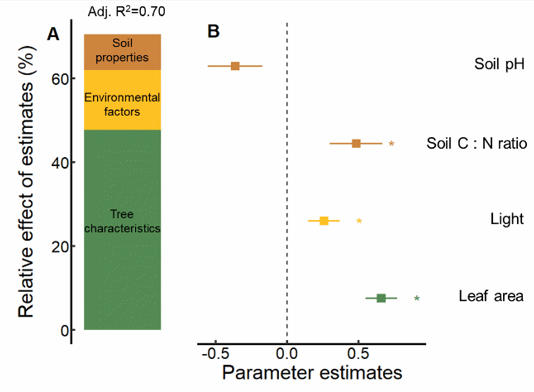
The factors affecting the NO2 absorption capacity of tree canopies and their relative contributions. (Image by KANG Ronghua)