Newsroom


A research team led by Prof. XU An from the Hefei Institutes of Physical Science of the Chinese Academy of Sciences has discovered that magnetotactic bacteria (MTB)—tiny microorganisms that can sense and move along magnetic fields—have remarkable abilities to resist and detoxify lead (Pb), one of the most toxic heavy metals in the environment.
The research results were published in Journal of Environmental Sciences.
Lead is a highly toxic pollutant with a long biological half-life and environmental persistence that poses serious threats to global health. However, efficient and safe methods of detoxifying Pb poisoning remain lacking. Studies have shown that MTB have an efficient ability to recover heavy metals and are favorable in terms of biosafety.
In this study, the researchers compared two types of Magnetospirillum magneticum bacteria: one with magnetosomes (tiny magnetic particles inside the cells) and one without.
The results showed that both types of bacteria could significantly detoxify Pb(Ⅱ)-induced various adverse effects even after six hours of Pb(Ⅱ) pre-treatment, including cell damage, oxidative stress, and DNA injury.
Interestingly, the researchers discovered that the two types of bacteria used different strategies to handle lead. The magnetosome-containing bacteria mainly adsorbed lead on their cell surfaces, trapping the metal externally. The bacteria without magnetosomes, on the other hand, absorbed lead into their cells, likely through pathways usually used for ion transport.
These differences appear to be related to the iron content of the cells — higher iron levels may prevent lead from entering the bacteria.
These findings might offer novel intervention strategies for Pb(Ⅱ) poisoning and expand the application of MTB in the field of environmental health, according to the researchers.
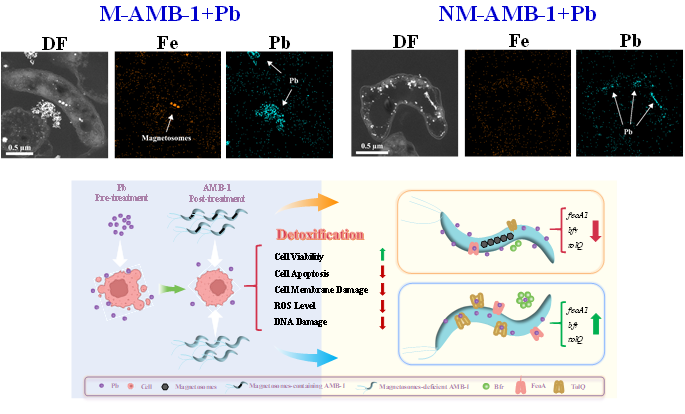
Magnetotactic bacteria antagonized lead toxicity through distinct enrichment mechanisms in magnetosome-containing/deficient bacteria. (Image by LIU Yun)