2024


A team of scientists from the Hefei Institutes of Physical Science of the Chinese Academy of Sciences, led by Prof. WU Zhengyan and ZHANG Jia, has created an innovative material that could help clean up harmful heavy metal ions (HMIs) from water.
Results of the study were published in the Journal of Hazardous Materials.
Heavy metal ions are particularly dangerous because they are highly toxic and do not break down naturally. As they move up the food chain, their concentration increases dramatically—a process known as biomagnification. This can have devastating effects on wildlife, disrupt ecosystems, and contaminate essential resources like water.
To address this issue, the research team developed a unique material using a primary battery made of iron and copper (Fe/Cu). This battery-based material was then combined with enhanced graphite oxide (GO) treated with special chemicals, including ethylenediaminetetraacetic acid (EDTA) and 2-nitrobenzaldehyde (2-NBA), which respond to ultraviolet (UV) light.
This new composite material, called Fe/Cu primary battery-based material (FCPBN), captures and neutralizes heavy metal ions more effectively than traditional methods. When exposed to UV light, the material undergoes chemical reactions that help break down and remove these pollutants from water.
Scientists tested the FCPBN on a variety of harmful metals, including chromium, arsenic, cadmium, lead, and more. It showed great success in capturing and eliminating these pollutants, with almost no leakage of harmful substances back into the environment.
"This work could provide a much more efficient and sustainable approach to deal with heavy metal contamination, and offers an environment-friendly solution for cleaning water in the future," said GE Hongjian, first author of the paper and also a researcher from Hefei Institutes of Physical Science.
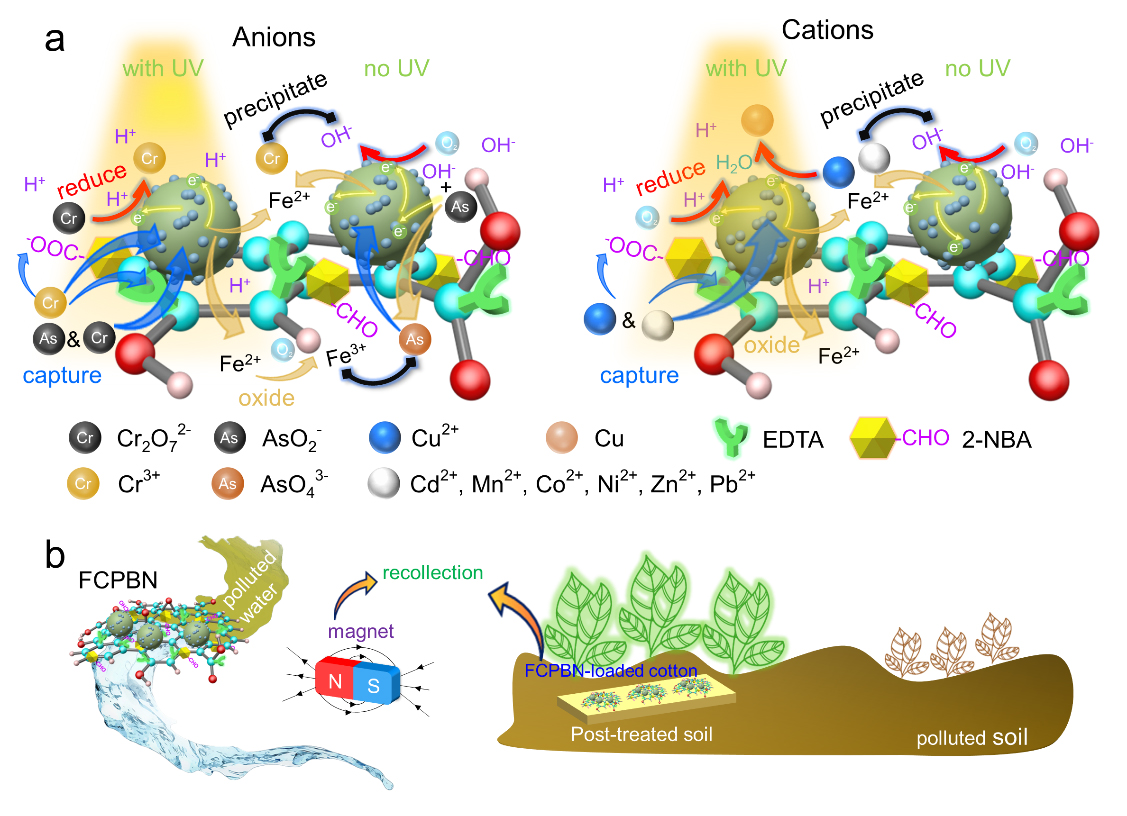
Mechanism of remediation and application prospect. (a) Schematic illustration of remediation principle of eliminating anionic and cationic HMIs via FCBPN. (b) Potential application of the technology in water and soil. (Image by GE Hongjian)