
Newsroom


A research team from the Institute of Applied Ecology of the Chinese Academy of Sciences has provided new evidence showing that winter freeze-thaw cycles and local neighborhood crowding independently limit tree growth in temperate forests.
These findings were published in Agricultural and Forest Meteorology.
As climate warming reshapes weather extremes, temperate regions are experiencing shifts not only in mean temperature and precipitation, but also in temperature fluctuations around the freezing point in winter. Repeated freezing and thawing can impair tree hydraulic function by promoting xylem embolism and reducing water transport efficiency, which can affect subsequent growth.
To quantify these impacts, a research team led by Prof. WANG Xugao, together with postdoctoral researcher REN Jing and associate professor FANG Shuai, conducted an eight-year monitoring program in the 25-hectare Changbaishan Forest Dynamic Plot within the Changbai Nature Reserve. They analyzed annual radial growth from 2010 to 2017 for 593 trees representing 20 common deciduous broad-leaved species, and evaluated how winter freeze-thaw cycles, summer water availability, neighborhood crowding, and functional traits jointly shape growth patterns.
In this study, freeze-thaw cycle frequency (FTC) was defined as the number of hourly air-temperature crossings above and below 0 °C from October of the previous year to May of the current growing season. Growing-season water availability was characterized using the standardized precipitation evapotranspiration index (SPEI) averaged from May to October. Neighborhood crowding was quantified using a neighborhood competition index (NCI) that integrates the size and proximity of neighbors within a 20-meter radius.
Using a hierarchical Bayesian model, the researchers found that tree growth declined with increasing winter FTC frequency, whereas growing-season water availability showed no detectable effect on growth. Neighborhood crowding also reduced growth, particularly for smaller trees, and its effect appeared to operate largely independently of freeze–thaw cycles, with no evidence of interaction between FTC and crowding at either the community or species level.
Further Trait-based analyses revealed a trade-off between growth potential and stress sensitivity. Species with higher xylem hydraulic efficiency (i.e., higher sapwood-specific hydraulic conductivity), lower wood density, and lower specific leaf area tended to grow faster, but were also more sensitive to increased freeze-thaw cycles. In contrast, species with more conservative strategies were generally less sensitive to FTC. Interestingly, species with higher hydraulic efficiency were less sensitive to neighborhood crowding, highlighting the value of hydraulic traits for predicting growth responses under both climatic stress and competition.
Together, these results emphasize that winter climate variability, rather than summer drought, can significantly impact productivity in temperate forests. The researchers suggest that forest management practices that influence stand density and species composition may play an important role in shaping forests' responses to future increases in freeze-thaw events.
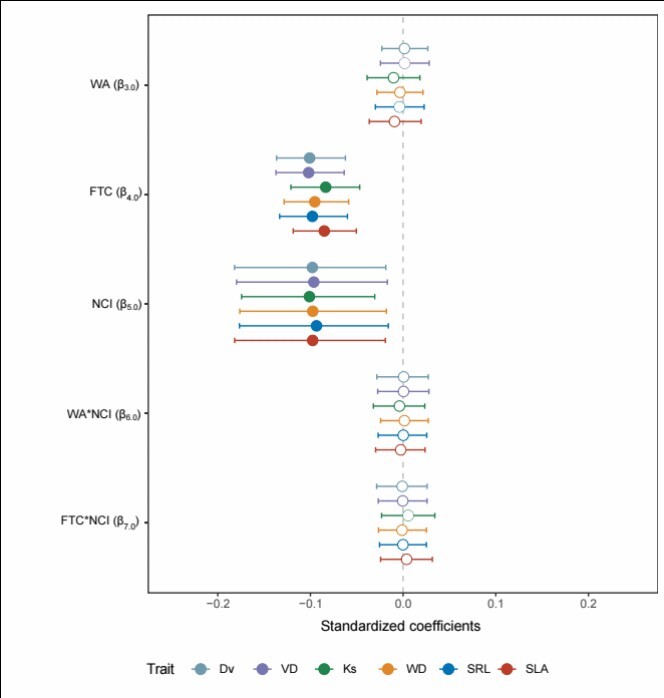
Effects of summer water availability, winter freeze-thaw cycles, neighborhood crowding, and their interactions on tree growth rates (Image by REN Jing and FANG Shuai)
