2024


In a study published online in Advanced Science, Prof. WANG Qian's team from the University of Science and Technology of China (USTC) of the Chinese Academy of Sciences and Prof. BAI Fang from ShanghaiTech University proposed a deep learning model for predicting protein conformational changes, representing a step forward in the predictive modeling of protein dynamics.
In recent years, deep learning models represented by AlphaFold have achieved success in predicting the static structures of proteins. As the function of proteins depends on their dynamic characteristics, researchers have been exploring deep learning models aimed at predicting the dynamic behaviors of proteins such as conformational changes. One of the main challenges is the severe shortage of kinetic data describing conformational transitions.
To overcome this challenge, researchers created an efficient computational framework for simulating protein allostery by integrating a physically constrained coarse-grained molecular dynamics model with enhanced sampling methods. This framework was used to simulate the conformational changes of 2635 proteins existing in two known stable states, capturing the structural information along each transition pathway. The result of this simulation was the first large-scale database of protein dynamics, providing a rich resource for studying protein motion and change.
Based on this database, researchers developed a general deep learning model named PATHpre, designed to predict the allosteric pathways between two stable states of proteins. The model demonstrated robust predictive capabilities across proteins with varying sequence lengths from 44 to 704 amino acids, and was effective for multiple allosteric systems including morphogenic proteins.
Researchers validated PATHpre's predictions against experimental and simulation data across several systems, and achieved consistent results. They even uncovered a novel allosteric regulation mechanism in human β-cardiac myosin, a protein crucial to heart function.
The PATHpre model's ability to predict not only the transition state but also the entire pathway of conformational changes offers new insights into protein function and regulation. This model has the potential to revolutionize the understanding of protein behavior and could play a critical role in the development of new therapeutics targeting protein misfolding diseases.
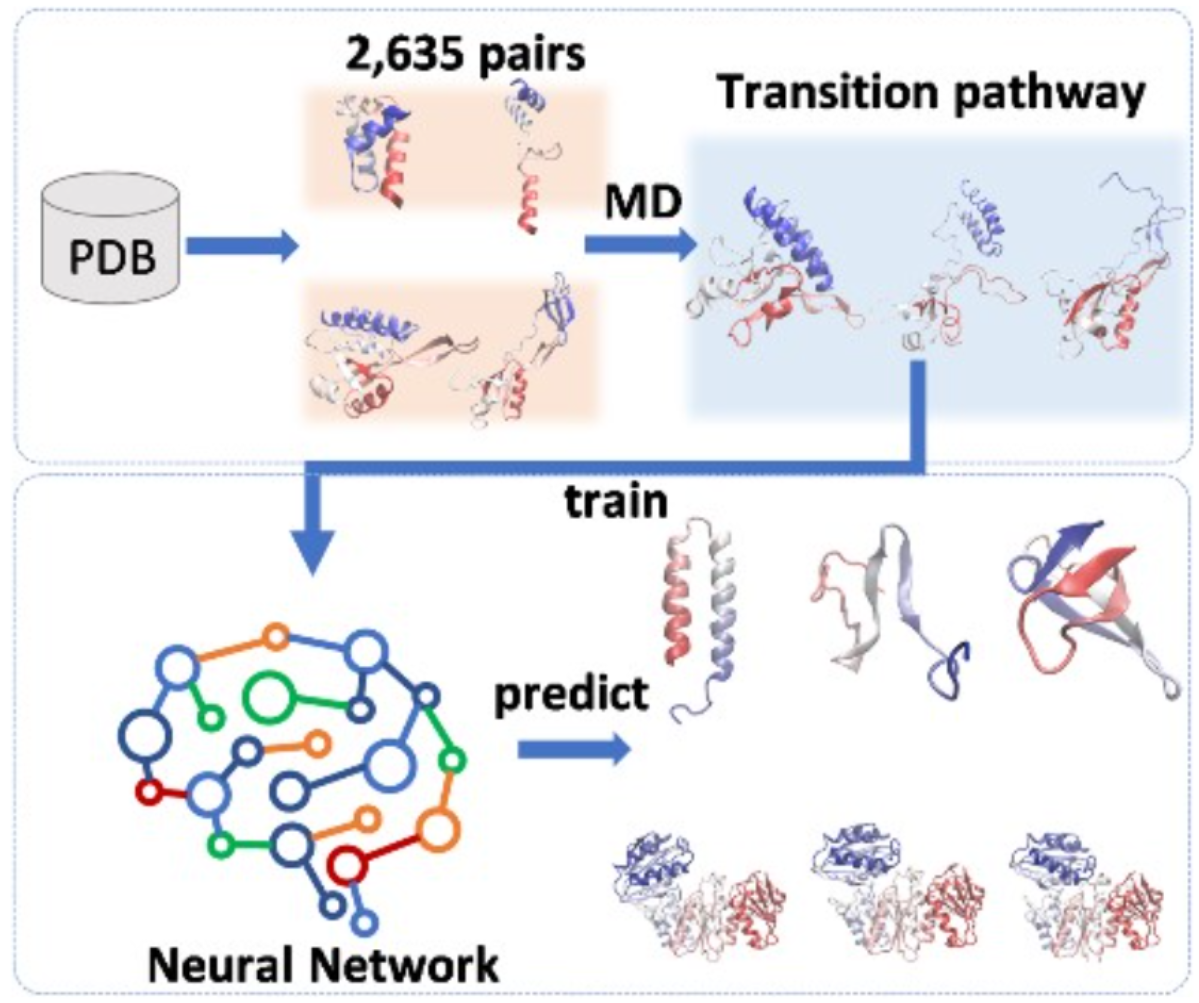
The construction process of PATHpre. (Image by USTC)