Newsroom


A research team from the Hefei Institutes of Physical Science of the Chinese Academy of Sciences has developed a novel electric field correction technique that significantly enhances the sensitivity and resolving power of ion mobility spectrometry (IMS). By introducing an isolating grid (IG) near the ionization source, the researchers effectively eliminated electric field interference, resulting in greatly improved IMS performance.
The findings were published in Talanta.
Corona discharge, one of the most commonly used ionization sources in IMS, is essential for efficient ion generation. However, it also introduces a significant challenge: the electric field produced by the discharge needle can distort the reaction region within the IMS tube, resulting in an inhomogeneous field. This distortion can cause ions to veer toward the walls of the tube, leading to trajectory deviation and reduced detection performance.
In this study, the researchers proposed a novel electric field correction method for IMS. By placing an IG just downstream of the discharge needle, they effectively shielded and corrected the inhomogeneous electric field generated by the needle. Both simulations and experimental results confirmed that the IG prevents ions from drifting toward the walls of the IMS tube and helps focus them along its central axis, thereby improving ion transport.
Notably, when the IG was placed two millimeters from the discharge needle, ion signal intensity increased by 9.3 times compared to configurations without the grid. At a distance of six millimeters, the intensity of reactant ions rose by 2.36 times, along with a 21% improvement in resolving power.
These results demonstrate that the isolating grid can effectively eliminate electric field distortion in the ionization region, significantly enhancing the performance of IMS.
This design contributes to a marked enhancement in both the sensitivity and the resolving power of IMS.
This study was supported by the National Natural Science Foundation of China, the HFIPS Director's Fund, the Anhui Provincial Key R&D Program and the Anhui Provincial Engineering Technology Research Center for Biomedical Optical Instrument.
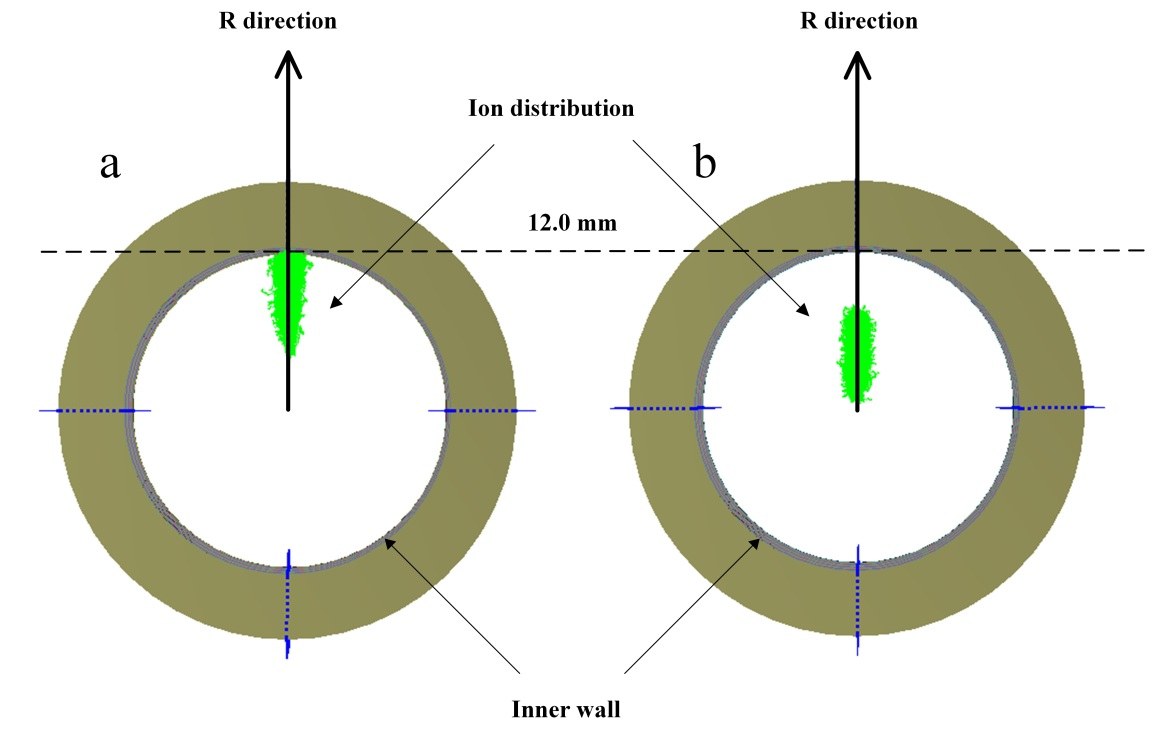
The simulations of ion distribution along one of the radial directions: (a) in the absence of the IG; (b) in the presence of the IG (Image by LUO Yuanjiang)

(a). Ion mobility spectra measured without IG and with IG at different position; (b). The ratio of the RIP area, denoted as Si to the area S0 which corresponds to the condition in which the IG. (Image by LUO Yuanjiang)