In a study published in Small, researchers from the Changchun Institute of Optics, Fine Mechanics and Physics of the Chinese Academy of Sciences developed a new nanoplatform that integrates dual-modality photodynamic therapy (PDT) and hypoxia-triggered chemotherapy, which addresses the challenges of conventional PDT in treating deep-seated, oxygen-deficient tumors while providing real-time imaging guidance for precise therapy.
Conventional PDT relies on light-activated photosensitizers to generate reactive oxygen species (ROS) for killing cancer cells. However, its effectiveness diminishes in deep tumors due to poor light penetration and oxygen scarcity. Additionally, existing imaging methods for guiding PDT often suffer from low resolution or unintended phototoxicity.
This study addresses these challenges by combining near-infrared-IIc (NIR-IIc) imaging—capable of penetrating tissues beyond 1.7 µm—with a dual-activation system for PDT and chemotherapy. Researchers engineered a liposome-based nanoplatform (LLT@Lip) loaded with lanthanide-doped nanoparticles (LnNPs), an iridium-based photosensitizer (Ir(III) complex), and the hypoxia-activated prodrug tirapazamine (TPZ).
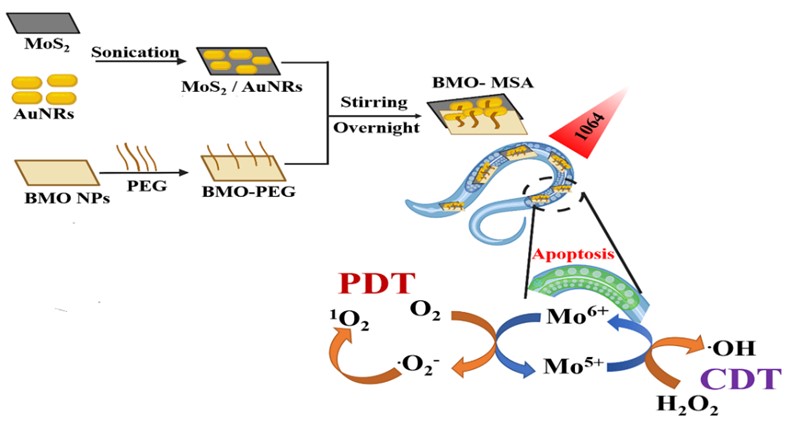
The LnNPs emit NIR-IIc light at 1800 nm under 808/980 nm laser excitation, enabling high-resolution imaging of deep tumors. Simultaneously, the Ir(III) complex acts as a dual-mode photosensitizer: externally activated by LnNPs under 980 nm light and internally triggered by tumor hydrogen peroxide via chemiluminescence. This dual activation ensures ROS production even in low-oxygen environments. Meanwhile, PDT-induced hypoxia activates TPZ, releasing cytotoxic agents to enhance tumor suppression.
In vitro and in vivo experiments demonstrated the platform’s capabilities. The NIR-IIc imaging provides sub-millimeter resolution, visualizing blood vessels and tumors up to 3 mm deep. Dual-modality PDT generated both singlet oxygen and superoxide radicals, maintaining efficacy under hypoxia. Combined with TPZ-triggered chemotherapy, the system achieved a 90% tumor cell apoptosis rate in mice, significantly outperforming single-modality treatments. Notably, the nanoplatform showed minimal toxicity to healthy tissues, highlighting its biocompatibility.
This work bridges the gap between imaging depth and therapeutic precision for challenging hypoxic tumors. By integrating real-time guidance, dual PDT activation, and hypoxia-responsive chemotherapy, the platform offers a versatile strategy adaptable to varying tumor microenvironments. Future research will focus on optimizing drug-loading efficiency and scaling up production for clinical trials.