Newsroom


Understanding soil moisture dynamics is essential for predicting hydrological responses to climate extremes. However, in subtropical regions, mechanisms regulating soil water infiltration and retention across different vegetation types, remain unclear.
In a study published in Catena, researchers from the Xishuangbanna Tropical Botanical Garden (XTBG) of the Chinese Academy of Sciences sought to clarify how vegetation types influence hydrological functions. They revealed distinct soil water regulation patterns across vegetation types.
Researchers investigated soil moisture dynamics and rainfall infiltration across four predominant vegetation types in the Ailao Mountains: primary evergreen broadleaf forests, secondary Populus forests, managed tea plantations, and natural grasslands.
By analyzing high-frequency monitoring data of volumetric soil water content collected at 30-minute intervals from five soil depths (10 cm to 100 cm) between 2019 and 2022, researchers found significant differences among different vegetation types.
Primary evergreen broadleaf forests demonstrated superior hydrological stability. They maintained the highest soil moisture levels during dry seasons while exhibiting slower rainfall infiltration rates. In contrast, natural grasslands showed rapid soil moisture depletion during droughts and consistently had the lowest moisture levels throughout the year.
Furthermore, tea plantations, despite high wet-season moisture, displayed considerable temporal variability. Secondary Populus forests exhibited intermediate traits between primary forests and managed ecosystems, though their moisture retention during droughts was lower than that of primary forests.
These findings showed that vegetation type is a dominant factor influencing both soil moisture dynamics and infiltration processes. They confirmed that native evergreen broadleaf forests enhance regional drought resilience through slow infiltration and sustained water storage, offering a critical scientific basis for ecological conservation under climate change.
“Evergreen forests act like a natural sponge, thanks to their complex structure, thicker litter layers, and greater soil porosity. They slow down runoff, allowing more time for water infiltration and storage, which is crucial for maintaining soil moisture during droughts,” said Dr. FAN Zexin from XTBG.
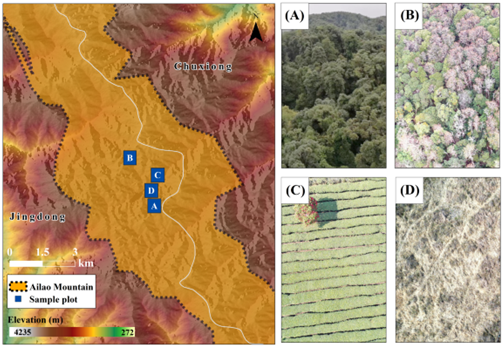
Vegetation types and their distributions in Ailao Mountains. (Image by YAN Qiaoshun)