Newsroom


By cloning and characterizing the soybean gene GmSMS6, a research team led by Prof. HE Chaoying from the Institute of Botany of the Chinese Academy of Sciences (IBCAS) has identified it as a crucial modulator of soybean seed weight and quality.
Published in Nature Communications on Nov. 26, the findings demonstrate that targeted gene knockout can increase soybean yield, revealing significant potential for breeding high-yield and high-quality soybeans.
Through analysis of the small-seed mutant sms6, the researchers identified GmSMS6 as a key regulator of both seed weight and quality. Knockout of GmSMS6 significantly increased seed weight, seed yield per plant, and seed protein content while simultaneously lowering seed oil content. GmSMS6 encodes a 14-3-3 protein that physically interacts with both the transcription factor GmbZIP151 and the E3 ubiquitin ligase GmUBQ1.
Biochemical and molecular analyses revealed that these protein–protein interactions mediate the ubiquitination and degradation of GmbZIP151, thereby precisely modulating its abundance and transcriptional regulation activity to regulate downstream gene expression.
Further Genetic evidence confirms that GmSMS6, together with GmUBQ1 and GmbZIP151 function together as an integrated molecular module governing soybean seed weight. Natural variation analyses revealed the selection patterns of the three genes during soybean domestication, the distribution of haplotype variants, and optimal haplotype combinations for improvement.
Notably, no natural loss-of-function allele of GmSMS6 was found in soybean core germplasm. Instead, an artificially induced sms6 mutation enhances the GmSMS6 activity through a single amino acid substitution, producing smaller seeds.
Together, the findings uncover a previously unknown regulatory mechanism underlying soybean seed weight and quality. This study delivers valuable genetic resources and theoretical guidance for breeding high-yield and high-quality soybean cultivars through gene editing and multi-gene assembly. It provides new insights into the regulation of seed size, morphological evolution, and the coordinated improvement of crop yield and quality.
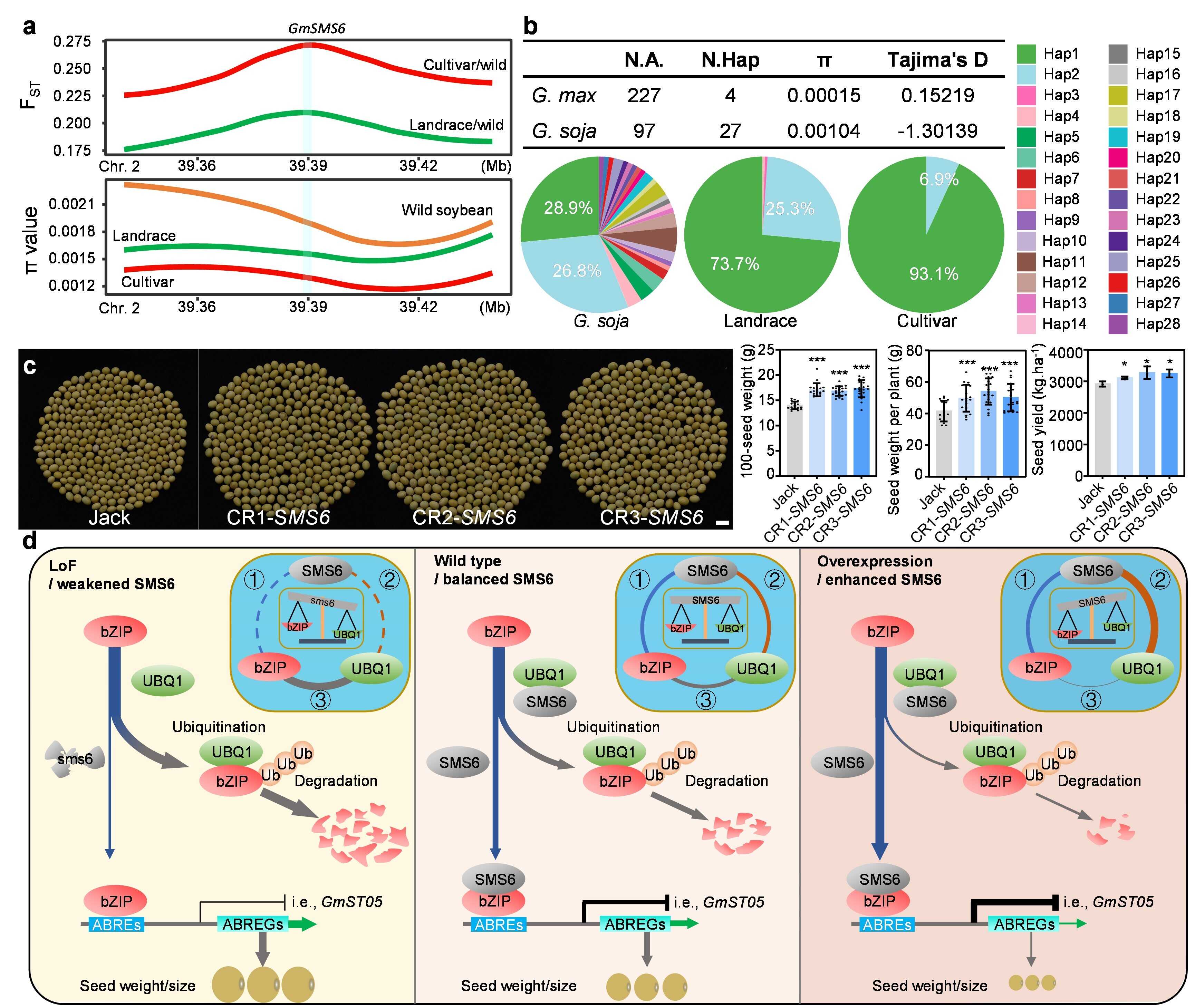
Sequence diversity and working model of GmSMS6 for governing seed size (Image by LI Bingbing et al.)