Newsroom


Forest restoration is a well-established approach for effective soil rehabilitation. In a study published in Land Degradation & Development, researchers from the Xishuangbanna Tropical Botanical Garden (XTBG) of the Chinese Academy of Sciences investigated how soil microbial communities enhance soil fertility through microscale soil aggregates during tropical forest restoration.
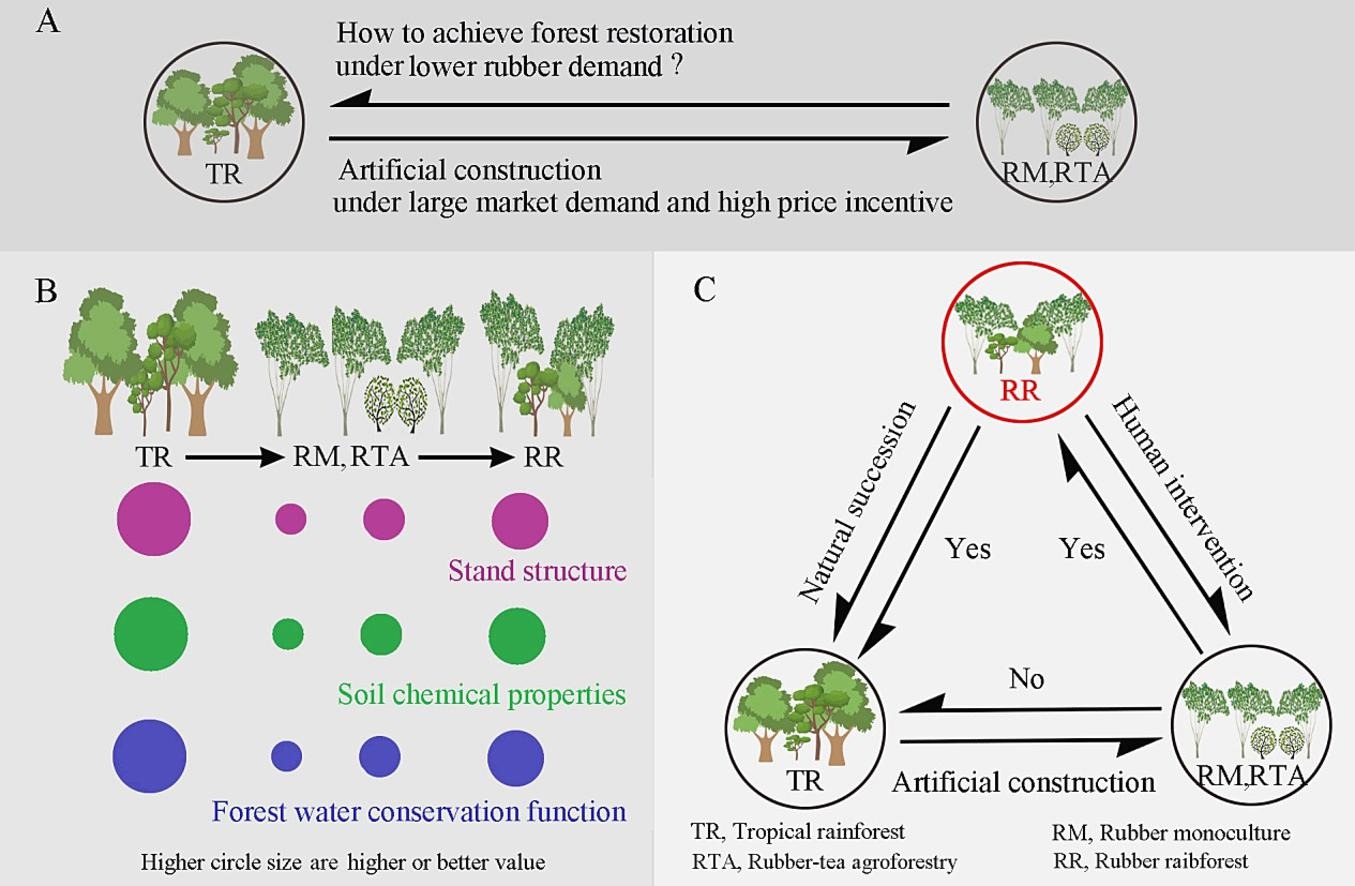
Researchers examined four forest types in Xishuangbanna: tropical rainforest, rubber monoculture plantation, naturally restored rubber monoculture, and naturally restored rubber-tea intercropping. They conducted comparative analyses of soil physicochemical properties, microbial diversity, community structure, and co-occurrence networks across these forest types and various soil aggregate sizes.
The results showed that restored forests created more favorable conditions such as increased plant diversity and changes in soil pH and conductivity, which in turn stimulated microbial activity. They also showed that smaller soil aggregates acted as tiny nutrient-rich fortresses, providing physical protection and resources that foster a thriving microbial ecosystem.
Besides, the results demonstrated that compared to rubber monoculture, restored forests displayed significantly higher levels of soil organic carbon, total nitrogen, total phosphorus, pH, and electrical conductivity. They also demonstrated that soil microaggregates in restored forests also contained the highest nutrient concentrations.
Partial least squares path modeling identified soil microbes as the most influential factor driving improvements in soil fertility with strong correlations between specific microbial groups and soil nutrients. Notably, in restored forests, the abundance of r-strategy bacteria and K-strategy fungi increased. Microbial networks grew more complex and interconnected, resembling a sophisticated underground “social network.”
These shifts in microbial life strategies and interactions are likely to enhance the production of microbial-derived organic matter, improve nutrient cycling efficiency, and facilitate ecological communication, all contributing to the accumulation of soil carbon, nitrogen, and phosphorus.
“Our findings clearly show that forest restoration and soil aggregate structure are key predictors reshaping the microbial community. Soil microbes can serve as a powerful indicator of soil resilience and health in evaluating the success of forest restoration projects,” said LIU Wenjie from XTBG, one corresponding author of the study.