Hops are an essential ingredient in beer brewing and an important economic crop. The female flowers of hops are covered in tiny glandular trichomes that synthesise and store a variety of specialised metabolites, collectively defining the flavour and quality of beer. Terpenes provide the distinctive aroma, xanthohumol has potent antioxidant properties that benefit human health and α-bitter acids give beer its characteristic bitterness.
Historically, these compounds also served as natural preservatives, extending beer's shelf life long before modern brewing technologies emerged. While the upstream biosynthetic pathway of α-bitter acids has long been clarified, the enzyme responsible for the final step, α-bitter acid synthase (α-BAS), had remained functionally unverified for over a decade, despite the identification of several candidate genes.
To solve this long-standing mystery, a research team led by Prof. WANG Guodong from the Institute of Genetics and Developmental Biology (IGDB) of the Chinese Academy of Sciences has developed a highly sensitive liquid chromatography–mass spectrometry (LC–MS) detection method capable of distinguishing between the two chiral forms of α-bitter acids (6S and 6R). Their analysis revealed that hop glandular trichomes mainly accumulate the 6S-type α-bitter acid.
This study was published in Plant Communications.
Further investigation revealed that the substance's precursor, deoxy-α-bitter acid, undergoes spontaneous oxidation when exposed to air, resulting in the formation of a racemic mixture of 6S- and 6R- types. This spontaneous chemical reaction had long hindered efforts to confirm the true function of α-bitter acid synthase. However, by overcoming this technical challenge, the researchers were able to establish a yeast heterologous expression system and systematically test more than ten candidate genes.
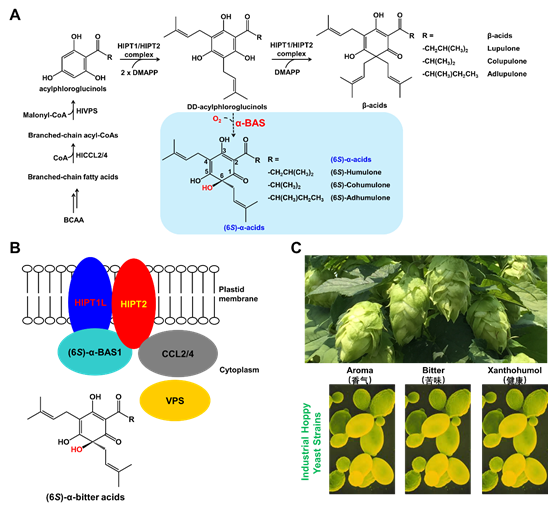
The results identified HlMO18 as the enzyme that specifically catalyses the oxidation of deoxy-α-bitter acid to produce the 6S form predominantly. The researchers also identified the key amino acid residues that are crucial for the enzyme's activity. Further mechanistic analyses revealed that 6S-type α-bitter acid synthase forms a metabolic complex with upstream enzymes, which explains why only the 6S form accumulates in hop glandular trichomes.
This work completes the biosynthetic map of α-bitter acids in hops and provides valuable insights for the brewing industry. The researchers have now elucidated the biosynthetic pathways of the three major flavor compounds in hops.
Looking ahead, they plan to use synthetic biology to engineer industrial yeast strains that can produce "hoppy beer", which has authentic hop flavours but is not made using hop plants. This approach could reduce production costs and allow for more customised, flavour-rich beers, offering a new direction for innovation in the brewing industry.
In hop glandular trichomes, a flavin-dependent monooxygenase (α-BAS) catalyzes the final step in the biosynthesis of 6S-α-bitter acid. A. Simplified biosynthetic pathway of α-bitter acids; B. Enzymes catalyzing the formation of 6S-α-bitter acid assemble into a protein complex; C. Future "Hoppy Yeast" strains used for producing "hoppy beer" with various flavor combinations. (Image by IGDB)