
Newsroom


A team of researchers from the University of Science and Technology of China (USTC) of the Chinese Academy of Sciences recently developed a lightweight prosthetic hand with 19 degrees of freedom (DOF), capable of replicating human hand functions. This prosthetic hand can assist in the functional rehabilitation and daily activities of millions of upper-limb amputees. The study was published in Nature Communications.
The human hand, with its 23 degrees of freedom, owns about 54% of the body’s total movement ability, despite accounting for only around 1/150 of the body weight. However, traditional prosthetic hands usually rely on motor-driven mechanisms, which often face limitations due to low power density, resulting in difficulties in balancing between DOF and weight. Therefore, designing more effective prosthetic hands should consider both high DOF dexterous movement and user comfort.
In this study, researchers utilized shape-memory alloys (SMA) with high power-to-weight ratios as artificial muscle actuators, and employed a biomimetic tendon-driven transmission system that amplifies the driving force of the SMA while reducing transmission resistance. Based on the characteristics of tendon-like separate transmissions, they integrated 23 sensor units into the fingers and wrist to achieve precise joint control. The developed prosthetic hand includes a cooling module with 38 SMA actuators, enabling 19 active DOF.
Thanks to this biomimetic design and high integration, the prosthetic hand weighs only 0.37 kg. It possesses human-level dexterity, demonstrating the ability to operate scissors, use a smartphone, and perform complex sign language gestures. It replicates 33 traditional human hand grasping motions and adds six more advanced grasping actions, having broad application.
Besides, the prosthetic hand integrates voice recognition technology, providing a simple, user-friendly, and cost-effective human-machine interaction system. It supports 60 languages and 20 dialects, with a recognition accuracy rate of 95% and a response time measured in milliseconds, making it suitable for use among amputees.
This study shows the potential to change the lives of amputees by giving them the ability to move more freely, perform daily tasks with greater ease, and regain their confidence. It also provides an effective solution for both humanoid robot dexterity and high-performance prosthetic hand research.
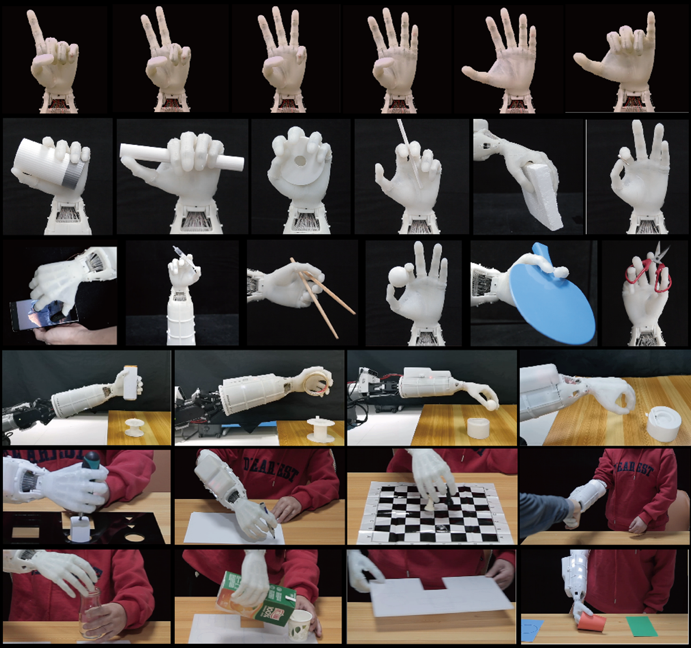
Demonstration of the prosthetic hand’s human-like gestures, gripping, operational functions, and patient experiments. (Image from USTC)
