Newsroom


In a study published in Journal of Clinical Endocrinology and Metabolism, Prof. ZONG Geng and Prof. LIN Xu’s groups at the Shanghai Institute of Nutrition and Health (SINH) of the Chinese Academy of Sciences (CAS), and Prof. ZENG Rong’s group from CAS Center for Excellence in Molecular Cell Science reported the first largest prospective cohort to elucidate the role of fatty liver in glycerolipids-type 2 diabetes (T2D) associations.
Prof. LIN’s group established a targeted quantitative lipidomics method based on HPLC-ESI-MS/MRM and applied it to detect 104 glycerolipids in the cohort sample of the Nutrition and Health of Aging Population in China.
Glycerolipids are the largest energy store and a major lipid class composed mainly of monoacylglycerols (MAGs), diacylglycerols (DAGs), and triacylglycerols (TAGs) in human. Intracellular DAGs, as second messengers, are biologically active lipids to induce insulin resistance. Emerging evidence also supports regulatory roles of TAGs in fatty acid oxidation and lipid synthesis.
However, the association between circulating glycerolipids and T2D has seldom been studied, and the complex pathophysiologic mechanism on how perturbed glycerolipid metabolism promotes the onset of T2D is not well understood.
The researchers in this study analyzed the prospective associations between plasma glycerolipids and 6-year incident T2D among participants who completed both baseline and a 6-year follow-up survey.
Among 1,781 participants free of T2D at baseline, increased nine plasma glycerolipids, including two DAGs and seven TAGs, were significantly associated with higher incident T2D with relative risks:1.16-1.23, independently of conventional risk factors including HbA1c at baseline. The associations turned to be stronger for TAGs with lower carbon atom numbers (C46-C52) and fewer double bonds (n [C = C] = 0-2).
Besides, fatty liver index (FLI) calculated based on waist circumference, BMI, total fasting plasma triglycerides and γ-glutamyl transpeptidase (GGT), was positively associated with T2D risk with relative risks:1.43, and eight out of the nine diabetes-associated glycerolipids were positively associated with incident elevated FLI risk with relative risks: 1.19-1.51. Multiple mediation model suggested that the FLI explained 12%-28% glycerolipids-T2D associations.
The findings of this study suggested that specific types of glycerolipids might serve as early biomarkers and intervention targets related to T2D development in future clinical settings, which provides new insight into the critical role of fatty liver linking glycerolipids to pathogenesis of diabetes.
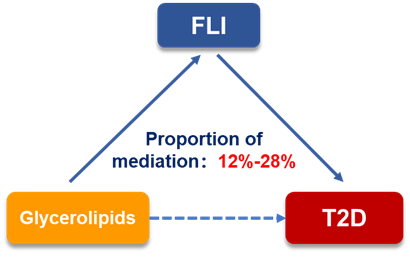
Fatty liver partially explained glycerolipids-T2D associations. (Image by Prof. LIN's Group)