
Newsroom


Silicate weathering, a vital natural carbon sink process, has long been recognized for its role in absorbing atmospheric carbon dioxide (CO2) and influencing global climate patterns. However, the degree to which human activities have impacted silicate weathering fluxes and global carbon cycling in large river basins remains poorly understood.
To address this knowledge gap, a research team led by Prof. WAN Shiming from the Institute of Oceanology of the Chinese Academy of Sciences (IOCAS), along with their collaborators, has revealed that human activities have enhanced the silicate weathering carbon sink effect in the Red River Basin since 1,500 years ago.
Their findings were recently published in Journal of Geophysical Research: Earth Surface.
The researchers reconstructed the evolution of silicate weathering fluxes in the Red River Basin during the late Holocene epoch using mineralogical and geochemical data extracted from a sediment core in the northwestern South China Sea. The results showed that while climate change was the dominant factor influencing silicate weathering intensity between 3,800 and 1,500 years ago, human activities became the primary driver after 1,500 years ago, boosting weathering-related carbon sequestration.
Specifically, the team identified that human activities including mining, metallurgy, agricultural expansion, and warfare have intensified silicate weathering in the Red River Basin since the Three Kingdoms-Northern and Southern Dynasties period.
"This enhanced weathering has functioned as a growing carbon sink, absorbing roughly 150% more CO2 than under natural conditions alone," said Prof. ZHAO Debo, co-corresponding author of the study. "This additional carbon sequestration accounts for approximately one-quarter of anthropogenic CO2 emissions during this historical period."
These findings challenge and update the traditional "weathering-climate" feedback paradigm. They demonstrate that humans do not only affect climate through greenhouse gas emissions but also strengthen Earth's negative feedback mechanisms by artificially intensifying silicate weathering.
The research provides the first millennium-scale quantitative evidence of human-induced enhancement of silicate weathering carbon sinks, the team noted.
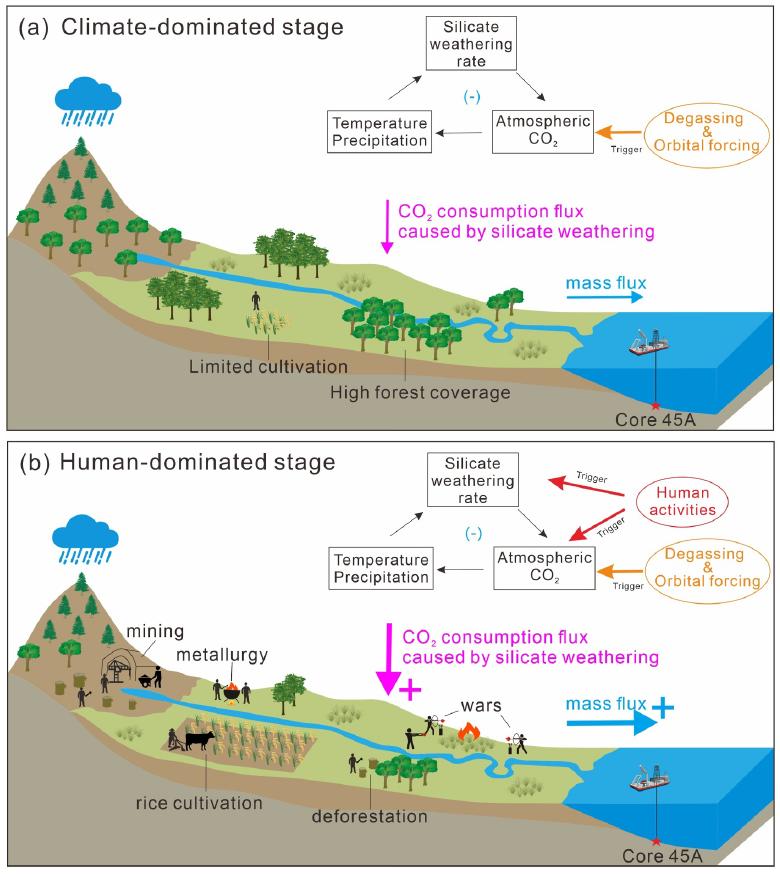
Schematic diagrams show the two stages of silicate weathering dominated by climate and human activities. (Image by IOCAS)
