
Newsroom


Researchers from the Institute of Applied Ecology of the Chinese Academy of Sciences have uncovered how temperate forest trees adjust their root chemistry and microbial relationships to cope with the combined stress of drought and variable light conditions.
Their findings, published in Plant and Soil, provide a better understanding of how forest ecosystems may respond to future climate change, especially since extreme droughts and changing canopy structures affect the availability of light on the forest floor.
Light is a key environmental factor governing photosynthesis, growth, and development in plants. In natural forests, the light environment under the canopy fluctuates constantly due to leaf movement, cloud cover, and seasonal canopy changes. As global warming drives more frequent extreme droughts and tree mortality, forest canopy gaps are anticipated to change light patterns, impacting the survival and regeneration of understory seedlings. Understanding how plants respond to the combined influences of light and drought has become essential for predicting the resilience of forest ecosystems under changing climates.
In this study, the researchers led by Dr. WANG Qingwei designed a controlled experiment using seedlings of two representative temperate tree species with contrasting drought tolerance: Quercus mongolica (Mongolian oak, drought-tolerant) and Tilia amurensis (Amur linden, drought-sensitive). They investigated how plant growth, root exudates, and rhizosphere microbial communities respond to different combinations of water and light conditions.
The results showed that both extreme drought and constant high light inhibited the seedling growth in both species. However, high fluctuating light (light intensity that changes periodically) helped mitigate the stress effects caused by constant high light. Under extreme drought, the chemical composition of root exudates differed markedly between fluctuating and steady light treatments. Organic acids and carbohydrates were identified as the primary compounds shaping the composition of rhizosphere microbial communities.
Further analysis revealed specific associations between root exudates and microbial taxa. Certain root-secreted compounds selectively recruit beneficial microorganisms such as Actinobacteriota, which enhance the plant's ability to adapt to both drought and fluctuating light conditions. The researchers also found that Quercus mongolica displayed more stable root exudate patterns and microbial responses than Tilia amurensis, confirming the former's greater drought tolerance.
These findings reveal how root exudates and microbial interactions contribute to enhanced seedling resilience under environmental stress. This mutualistic mechanism promotes plant growth and stress resistance, underscoring the significance of root-microbe symbiosis in forest adaptation to climate change. This study provides crucial scientific evidence for improving forest regeneration and strengthening ecosystem stability in a warming world..
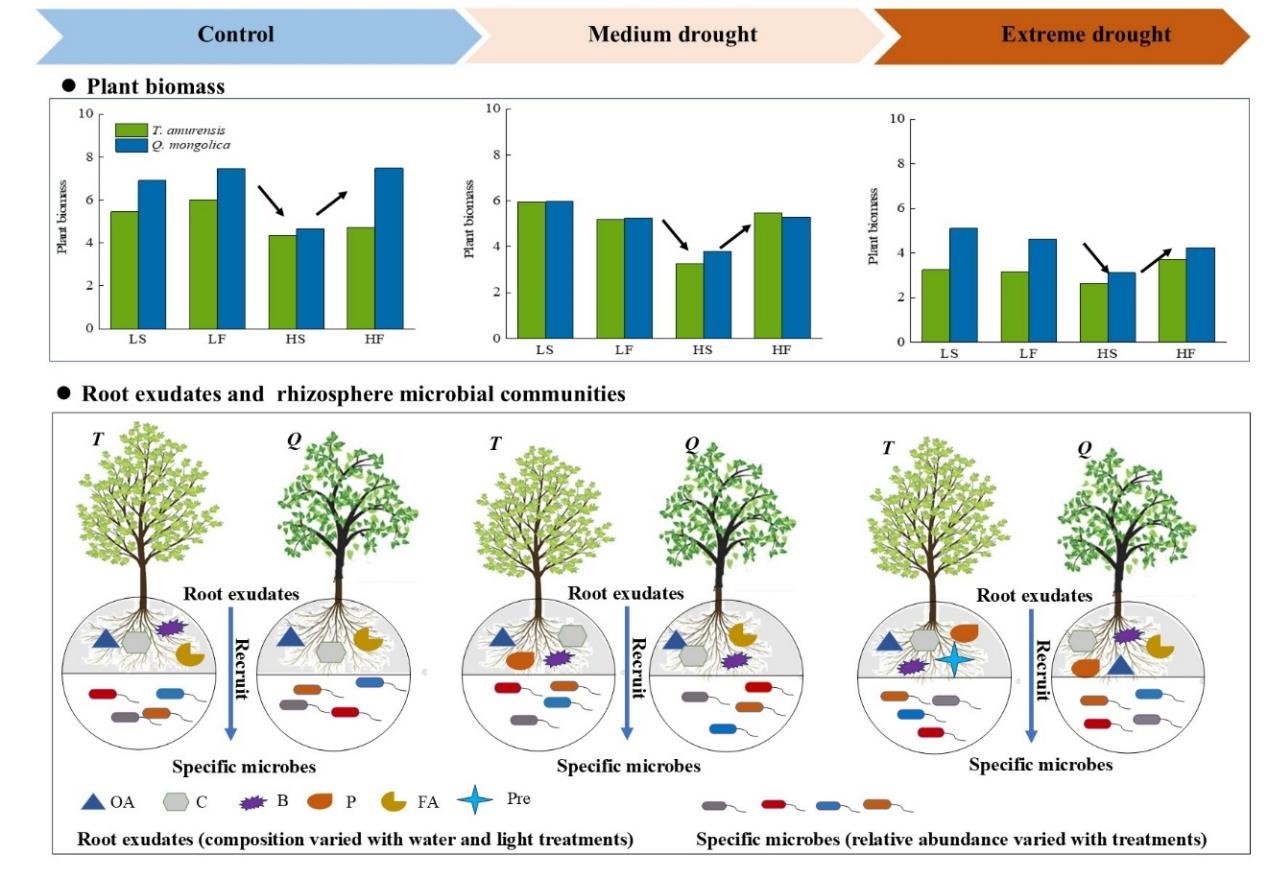
Conceptual diagram showing plant growth and root–microbe interaction mechanisms under different light and water conditions (Image by XIE Lulu)
