Newsroom


Researchers from the Institute of Applied Ecology of the Chinese Academy of Sciences have uncovered how soil viruses influence microbial activity and carbon storage under different nutrient conditions. They found that variations in the carbon-to-nitrogen (C/N) ratio shape viral behavioral strategies and their ecological roles in soil carbon turnover, a finding that may refine models of global carbon cycling and climate feedbacks.
Soils are among the planet's largest carbon pools. Microorganisms play a central role in forming and stabilizing soil organic carbon (SOC) through the decomposition of organic matter and production of microbial residues. However, viruses, key components of microbial communities in soil ecosystems, remain an overlooked factor in this process.
The balance of carbon and nitrogen in soil determines plant productivity and regulates microbial metabolism and the release or retention of organic carbon. While previous studies have examined the effects of plant litter, microbial composition, and environmental conditions on carbon and nitrogen dynamics, the role of viruses in mediating these processes has remained unclear.
To address this research gap, a team led by Dr. LIANG Xiaolong conducted a substrate addition experiment combined with metagenomic sequencing techniques. The researchers examined how viral communities in two distinct soils, collected from the Songnen and Liaohe Plains, responded to external substrate inputs with varying C/N ratios. Their study was published in Soil Biology & Biochemistry.
The results showed that soil viruses are highly sensitive to changes in C/N ratios. External inputs with different C/N balances reshaped viral diversity and community composition. In the nutrient-poor soils of the Liaohe Plain, a higher C/N ratio promoted the dominance of lytic viruses, which actively infect and destroy host bacteria. In contrast, in the organic matter–rich soils of the Songnen Plain, lysogenic viruses that integrate into host genomes were more adaptive.
The researchers further found that viral life cycle strategies, together with soil organic matter content, jointly determine how viruses regulate carbon turnover. In low-organic soils, viral lysis processes enhanced microbial respiration and accelerated carbon mineralization, whereas in high-organic soils, viral activity promoted the accumulation of microbial residue carbon, stabilizing soil carbon pools.
These results challenge conventional carbon-cycle models that emphasize plant and microbial processes while neglecting viral contributions. The study emphasizes that the C/N ratio is a key ecological factor governing subsurface virus-host interactions, as well as a chemical property of plant residues.
As climate warming and nitrogen deposition continue to alter nutrient balances, the release of carbon driven by viruses could increase, which could impact atmospheric CO₂ concentrations. These findings introduce a new variable that can be used to improve predictions of carbon storage and greenhouse gas emissions.
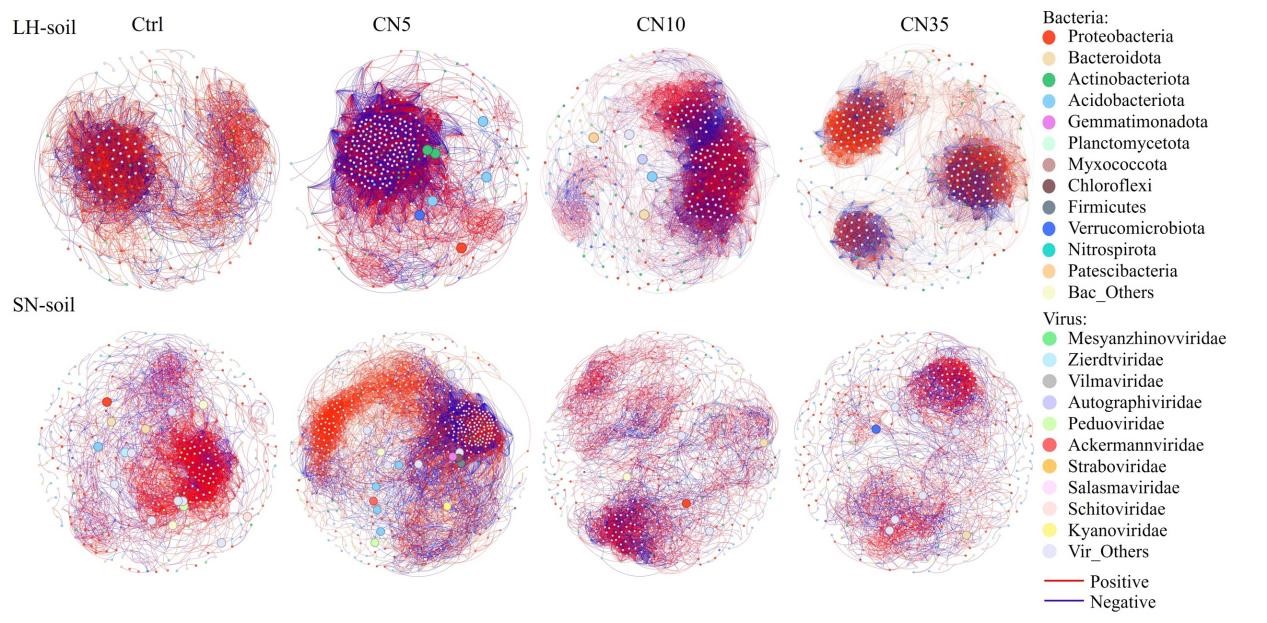
Network of interactions between soil viruses and bacteria, illustrating viral influences on microbial carbon cycling under different carbon-to-nitrogen ratios (Image by WANG Shuo)