
Newsroom


Researchers led by Dr. ZHANG Weidong from the Institute of Applied Ecology of the Chinese Academy of Sciences have unveiled that the addition of powdered wollastonite, a calcium silicate mineral, can greatly increase the formation of stable mineral-associated organic carbon (MAOC) in various soil types.
The findings were published in Soil Biology and Biochemistry.
Enhanced rock weathering, a carbon removal strategy involving the application of silicate minerals such as wollastonite to soils, has gained global attention due to its dual potential to both capture atmospheric CO2 and improve soil quality. Beyond its geochemical benefits, adding silicates can influence soil microbial activity and stabilize soil organic carbon (SOC). MAOC is especially critical among SOC fractions because it binds tightly to minerals, allowing carbon to persist in soils for decades or even centuries. However, it is unclear how the addition of wollastonite affects MAOC formation and whether soil type modulates this effect.
To address these questions, the researchers conducted a short-term incubation experiment using soils from a Cunninghamia lanceolata (Chinese fir) plantation and a maize farmland in Huitong County, Hunan Province. Both soils were amended with 5 % wollastonite and supplied with ¹³C-labeled glucose to trace carbon flow. They further used 18O isotope labeling to measure microbial carbon use efficiency (CUE) and biomass turnover.
Results showed that wollastonite addition markedly increased the amount of ¹³C-MAOC by approximately 170 % in forest soil and 250 % in farmland soil, indicating a strong promotion of stable carbon formation in both systems. However, the underlying mechanisms differed, according to the researchers.
In forest soil, MAOC accumulation was mainly driven by an increase in pH and increased available phosphorus, which together enhanced microbial CUE by about 130 %. In farmland soil, CUE remained statistically unchanged, but microbes redirected more carbon toward anabolic synthesis rather than respiration, resulting in a notably higher MAOC formation efficiency compared to the forest soil.
These findings provide a systematic evidence that wollastonite addition stimulates MAOC formation through distinct biochemical and mineral pathways in divergent soil types. The study emphasizes that microbial metabolism and mineral–organic associations jointly regulate soil carbon stabilization. By demonstrating how these processes differ between forest and agricultural systems, this study offers critical knowledge that could inform soil management strategies to enhance carbon sequestration efforts for climate change mitigation.
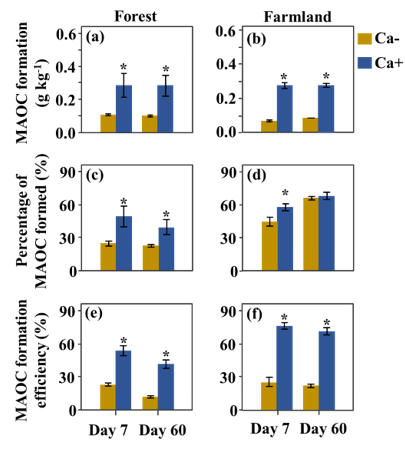
Effects of wollastonite addition on soil carbon fractions in forest and farmland soils. Wollastonite markedly increased ¹³C-MAOC in both soils (Image by YAN Yongxue)
