
Newsroom


Researchers from the Institute of Applied Ecology of the Chinese Academy of Sciences have developed an improved approach to study lysogenic bacteriophages, viruses integrate into bacterial genomes and remain dormant until triggered under certain environmental conditions.
The study, published in Applied Soil Ecology, helps scientists understand how these viruses influence microbial communities and key soil processes such as carbon and nitrogen cycling more accurately.
Bacteriophages, or phages, are the most abundant biological entities on Earth. By infecting microorganisms, they play essential roles in regulating microbial populations and ecosystem balance in both soils and aquatic environments. Among them, lysogenic phages can enter a latent phase, quietly residing within host cells until external stimuli induce them to switch to a lytic state, where they replicate and destroy the host. This transition can significantly impact nutrient cycles and microbial stability in natural ecosystems.
However, research on lysogenic phages in natural environments has long been constrained by methodological limitations. For decades, traditional studies have relied heavily on chemical inducers such as mitomycin C (MMC) to activate dormant phages. However, the effectiveness of these chemicals can vary greatly across different environments, leading to inconsistent results. Moreover, these chemicals can exhibit varying degrees of toxicity toward host microbes, likely due to differences in environmental conditions and microbial community composition. This uncertainty has made it difficult to obtain reliable estimates of prophage abundance and ecological function.
To address this challenge, researchers led by Dr. LIANG Xiaolong proposed a new methodological framework combining molecular biology tools with high-throughput sequencing techniques. The method minimizes the biases introduced by the conventional approach and allows a more precise investigation of prophage behavior in situ.
Through controlled experiments in agricultural and forest soils, the researchers found that the proportion of lysogenic phages closely correlates with soil nutrient levels, and the activation of lysogenic phages plays an important role in regulating carbon and nitrogen cycling.
In freshwater systems, the improved method demonstrated greater sensitivity and consistency in detecting prophage dynamics, overcoming the variability that has long troubled researchers.
The study presents a technically sound alternative that fills a methodological gap in environmental virology. By applying the new framework to both soil and water ecosystems, it offers a more realistic view of virus–host interactions and their ecological significance. It also provides a robust tool for future investigations into how viral life cycles shape ecosystem functions.
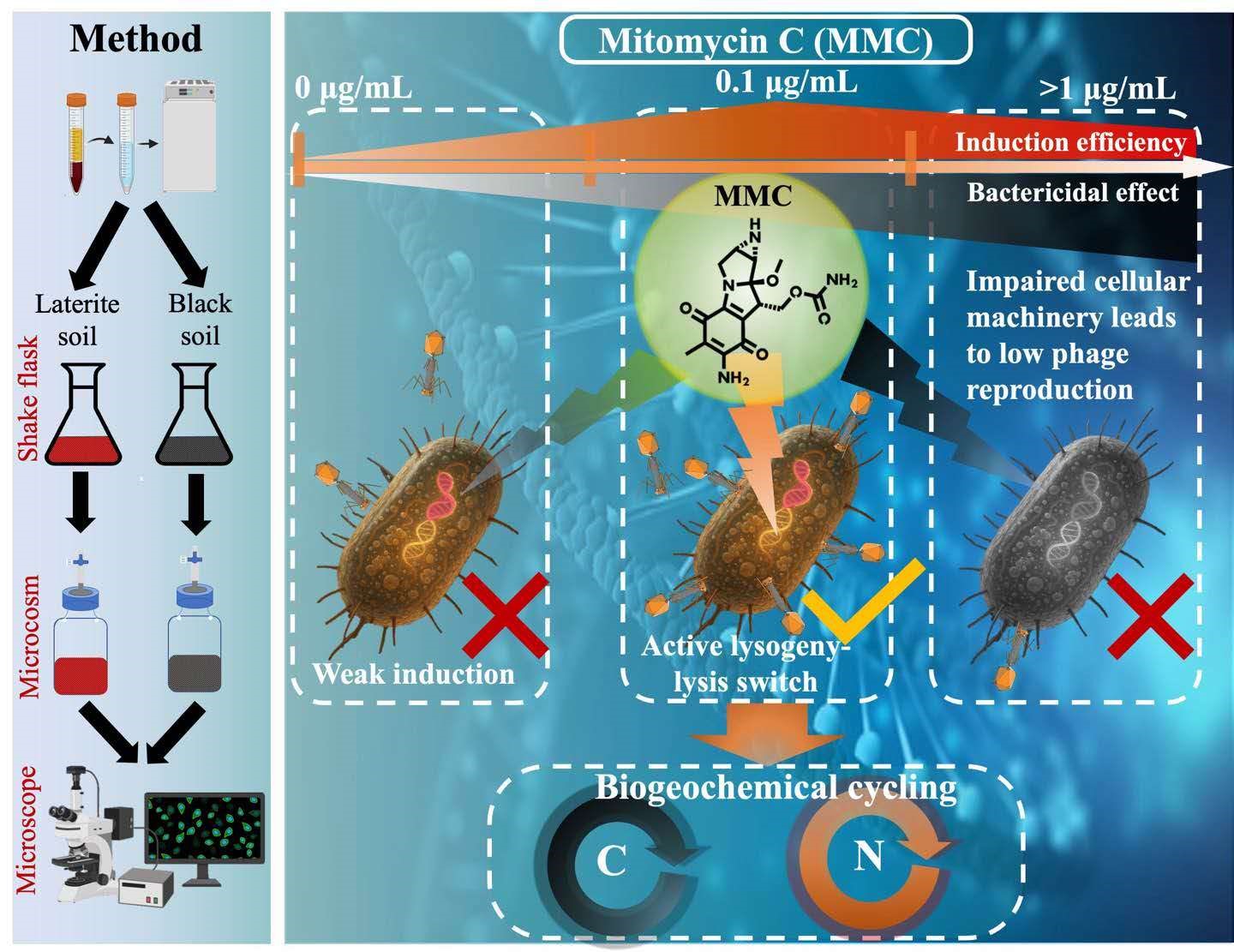
Graphical abstract of the study. The research proposes a low-dose, in-situ mitomycin C (MMC) induction protocol to explore prophage activation in soil communities and its impact on carbon and nitrogen fluxes (Image by XU Ruoyi)
