
Newsroom


Tropical cyclones are among the most destructive natural disasters, causing significant loss of life and property every year. Despite ongoing advancements in meteorological forecasting technology, accurately predicting changes in tropical cyclone intensity—especially rapid intensification—remains a major challenge.
Traditional observation methods have limitations, for instance, infrared and visible satellite observations are often obstructed by the cloud canopy of tropical cyclones, making it difficult to directly detect the eyewall region. This technical bottleneck restricts real-time monitoring of changes in tropical cyclone intensity.
To tackle this issue, an international research team consisting of researchers from the Institute of Atmospheric Physics at the Chinese Academy of Sciences, along with collaborators from Forschungszentrum Jülich in Germany, the University of Bath in the UK, and Northwest Research Associates in the United States, has proposed a novel method for tracking the intensity of tropical cyclones. This approach involves observing stratospheric gravity wave activity. The study has been published in Geophysical Research Letters.
The researchers employed advanced three-dimensional wave analysis methods and ray-tracing models to reveal, for the first time, the characteristics of stratospheric gravity waves triggered during tropical cyclone intensification. During this phase, intense, deep, and frequent convective activities generate special gravity waves that are characterized by higher frequencies, shorter horizontal wavelengths, and longer vertical wavelengths. Consequently, these gravity waves can propagate rapidly and efficiently upward to the stratosphere.
"Our study found that these waves can travel from the troposphere to the middle and upper stratosphere in about 20 minutes, and such wave activities are often observed in the stratosphere before the tropical cyclone reaches its peak intensity," explained Dr. WU Xue, the lead author of the study.
As the cyclone intensifies, stratospheric gravity wave activity also increases. This suggests that heightened activity in stratospheric gravity waves may serve as a potential early warning signal for tropical cyclone intensification. Observing these waves using satellite remote sensing instruments in the infrared and microwave bands is expected to become a new method for monitoring and predicting tropical cyclone intensification in the future.
This study lays a foundation for understanding the relationship between stratospheric gravity waves and changes in tropical cyclone intensity.
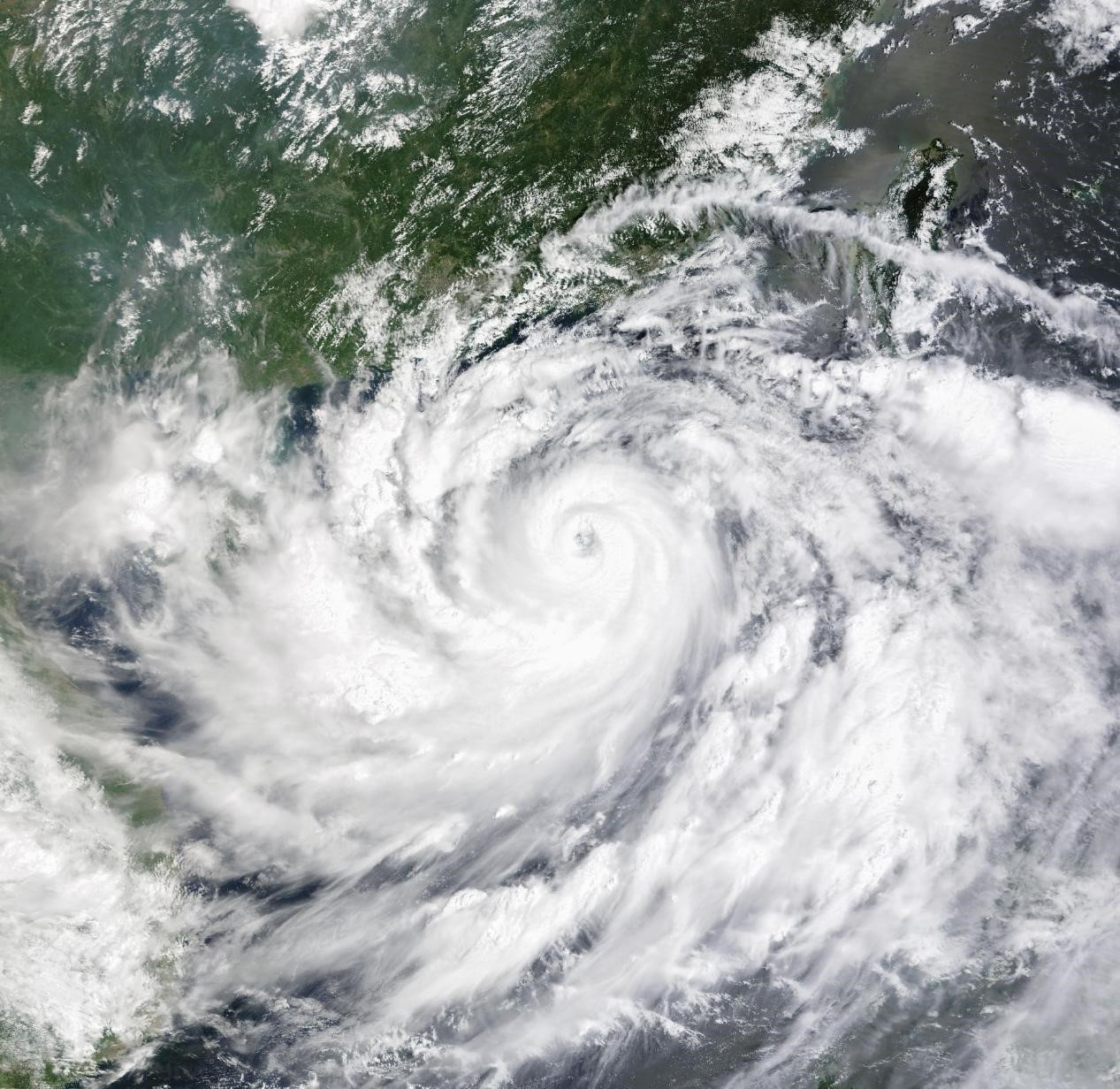
Typhoon Yagi of the 2024 typhoon season in the Northwest Pacific Basin. (Image by Michala Garrison, NASA Earth Observatory)
