
Newsroom


Loess deposits are invaluable natural archives that chronicle Earth's climatic and environmental evolution through compositional changes linked to East Asian Monsoon variability, post-depositional weathering, and groundwater activity. While these aeolian sediments provide critical insights into past climate dynamics, accurately quantifying water-rock interactions has remained a persistent challenge in paleoclimate reconstruction.
To address this challenge, researchers from the Institute of Earth Environment of the Chinese Academy of Sciences, in collaboration with domestic partners, used lithium (Li) isotopes to decode complex weathering processes and groundwater influences in loess-paleosol sequences.
The study focused on the Weinan loess section in the southeastern Loess Plateau, where the researchers conducted the first comprehensive analysis of lithium isotopic composition (δ⁷Li) across different geochemical phases: water-soluble, weak acid-leachable, and residual fractions throughout a 22-meter profile spanning glacial-interglacial cycles. The results revealed contrasts in lithium distribution, with concentrations decreasing from the residual to weak acid-leachable to water-soluble fractions, while δ⁷Li values exhibited an opposite trend. These patterns not only reflect the intensity of East Asian Summer Monsoon (EASM) variability but also highlight regional climatic differences, supported by comparative data from the Luochuan section, which showed distinct monsoon-influenced signatures.
Furthermore, this study uncovered how groundwater processes shape loess geochemistry over time. In dense caliche (CaCO₃ nodule) layers, where groundwater flow becomes restricted, Li isotopes reach equilibrium with the surrounding groundwater, preserving a distinct hydrochemical signature that differs significantly from near-surface weathering patterns. This discovery provides insights into the long-term groundwater influences on loess deposits, offering a new dimension to our understanding of post-depositional alteration processes.
This research represents a methodological breakthrough in utilizing non-traditional stable isotope tracing techniques for investigating material cycling and paleoclimate reconstruction.
This work was published in Global and Planetary Change and was supported by the CAS Western Light Cross-Team Project and the National Natural Science Foundation of China, among other sources.
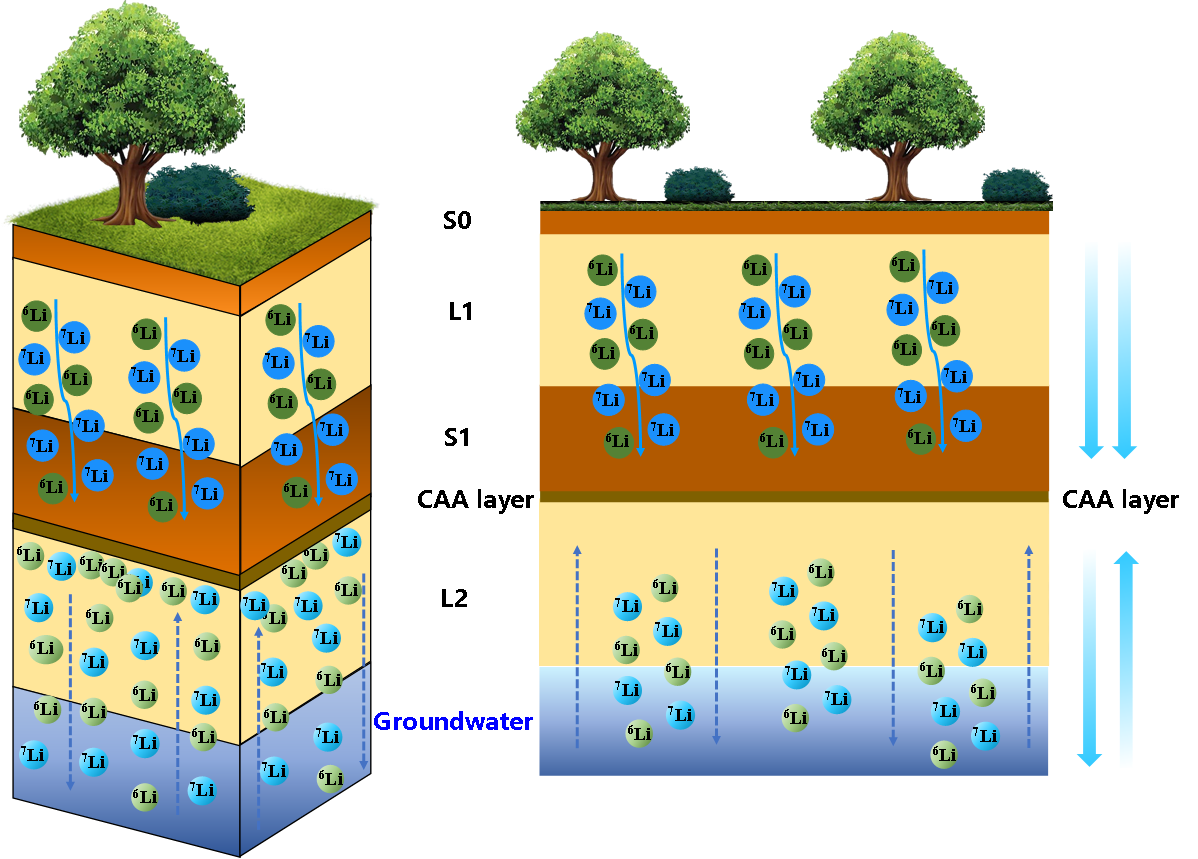
Response of acid-leachable Li isotopic composition in Weinan loess to groundwater influences. (Image by HE, Maoyong et al)
