Newsroom


The simple and cost-effective synthesis of vinyl boronate esters (VBE) remains a challenge. For the potential of their low-cost synthesis, using base metal catalysts for C(sp2)-H borylation reactions continues to be an area worth exploring.
In a study published in Inorganic Chemistry, Prof. ZHANG Teng from the Fujian Institute of Research on the Structure of Matter of the Chinese Academy of Sciences synthesized a novel series of metal phosphonate ester metal organic frameworks (MOFs), enabling efficient olefin dehydrogenative borylation under milder conditions.
Researchers synthesized four mixed-ligand phosphonate ester MOF materials, designated as CoBipyL1, CoBipyL2, NiBipyL1, and NiBipyL2. These MOFs were constructed from monomeric transition metal centers (Co or Ni) coordinated with bis(phosphonic acid) ethyl ester ligands and bipyridine linkers. The bis(phosphonate)-metal coordination structurally formed layered sheets, which were further interconnected by bipyridine ligands to establish three-dimensional frameworks.
Notably, researchers found that the cobalt-based materials, CoBipyL1 and CoBipyL2, demonstrated superior catalytic performance in the dehydrogenative borylation of olefins, achieving yields up to 84% for the targeted VBE products. And they had not detected common byproducts reported in prior studies, including alkyl boronates and alkanes in this catalytic system.
Besides, the cobalt catalysts exhibited exceptional tolerance to ambient conditions, showing no sensitivity to air or moisture. This distinctive stability significantly enhances their potential for practical applications in large-scale synthesis processes.
This study highlights the potential of mixed-ligand phosphonate ester MOFs as a viable approach for catalyst design. It also offers a new way for designing efficient catalysts for olefin dehydrogenative borylation.
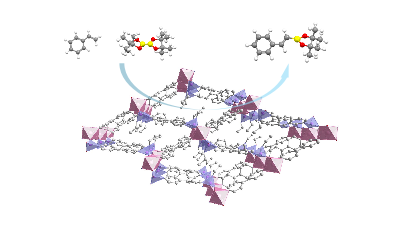
Olefin Dehydroborylation under Catalytic Conditions (Image by Prof. ZHANG’s group)