Newsroom


Ammonia is a crucial chemical raw material for modern industry and agricultural fertilizers, and is serves as a significant hydrogen energy carrier, playing a vital role in the transition to more sustainable energy. Photo-driven N2 reduction can be performed utilizing solar energy under ambient conditions, making it a more energy-efficient and cleaner technology for ammonia synthesis.
However, due to the thermodynamic barrier caused by the high triple bond energy and the kinetic barrier caused by large energy gap, problems have emerged in the active site of inefficient N2 immobilization and activation, leading to poor performance of the ammonia synthesis reaction by N2 reduction. Therefore, exploring photocatalysts and photocatalytic device for ammonia synthesis through N2 reduction under mild conditions is of great importance.
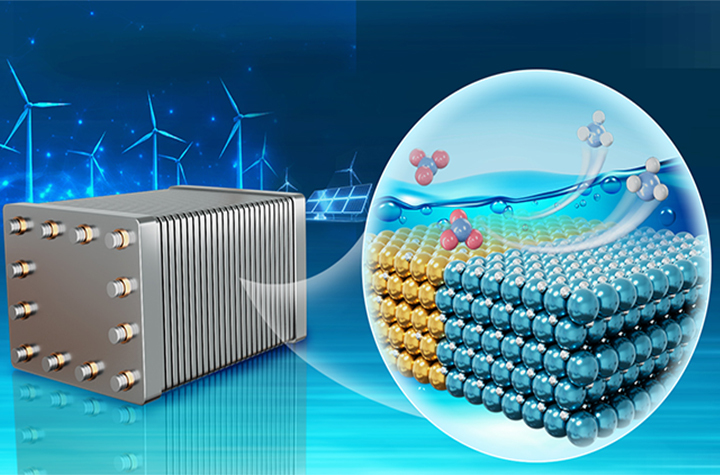
In a study published in Angewandte Chemie International Edition, Prof. WANG Yaobing‘s team from the Fujian Institute of Research on the Structure of Matter of the Chinese Academy of Sciences proposed using a proton-mediated photoelectrochemical device to separate N2 activation and N2 hydrogenation, thereby achieving photo-driven ammonia synthesis.
Researchers developed a approach by using the redox-catalysis covalent organic framework (COF) with a redox site (-C=O) for H+ reversible storage and a catalytic site (porphyrin Au) for N2 reduction reaction (NRR). This COF as anode in the designed proton-mediated photoelectrochemical device could store e- and H+ generated by hydrogen oxidation reaction (HOR) and achieved photo-driven NRR under mild concentration. This approach achieved solar energy conversion and ammonia production under green conditions.
Moreover, researchers demonstrated that the TNAu-COF obtained by 1,4,5,8-naphthalenetetracarboxylic dianhydride (NTCDA) and porphyrin Au as building blocks exhibited efficient intramolecular charge separation efficiency of 935 picoseconds by femtosecond transient absorption (fs-TA) spectra. In the designed proton-mediated COF||Pt photoelectrochemical device, HOR process and redox reactions of functional groups within COF enabled the reversible storage of protons, providing a hydrogen source for the hydrogenation of N2 adsorbed and activated at Au catalytic active sites.
Notably, the H-bond network between the reduced COF (COF-H) and N2 adsorbed on Au promoted electron transfer from Au center to N2 and the N2 hydrogenation, achieving the continuous ammonia synthesis by the photoelectrochemical device. In-situ Fourier transform infrared spectroscopy (FTIR) results showed that the absorption peaks of N2 hydrogenation intermediates gradually increased with the illumination time increasing, and, the -OH peak gradually weakened, accompanied by the increased -C=O peak. This indicated that the H from -OH on NTCDA in COF-H participated and promoted the photo-driven NRR.
In addition, theoretical calculation demonstrated that the intramolecular protons participated in the photo-driven NRR process and completed the first hydrogenation, achieving continuous hydrogenation processes and the following ammonia synthesis.
This study offers new ideas on artificial photosynthesis and on the design and implementation of proton-mediated photochemical ammonia synthesis systems in the future.