Newsroom


Scientists from the Institute of Metal Research (IMR) of the Chinese Academy of Sciences have developed an ordered patterning strategy that integrates p-type and n-type BiVO4 stripes on a conductive substrate. This strategy enables efficient Z-scheme charge separation and significantly enhances the photocatalytic overall water splitting process.
Although solar-driven water splitting is a promising route to green hydrogen, photogenerated electrons and holes tend to recombine, and surface reverse reactions severely limit efficiency. Solid-state Z-scheme heterojunctions connect two semiconductors through a conductive mediator and can provide a high driving force for water splitting while directing high-energetic electrons and holes to different components. However, conventional particle-based Z-scheme systems rely on random interparticle contacts, which makes charge-transfer pathways uncontrollable and often exacerbates recombination.
To address this issue, the researchers proposed an ordered patterning strategy. Using photolithography, they fabricated alternating stripes of p-type tetragonal zircon BiVO4 (t-BVO) and n-type monoclinic scheelite BiVO4 (m-BVO) on an FTO conductive glass substrate. The FTO layer serves as a conductive mediator that establishes Z-scheme charge-transfer channels between adjacent stripes. Photogenerated electrons accumulate on the p-type t-BVO stripes and photogenerated holes accumulate on the n-type m-BVO stripes. This spatial separation effectively suppresses charge recombination and reverse reactions.
The patterned panel was fabricated by first depositing an m-BVO film on FTO via metal-organic decomposition, then patterning it by photolithography and wet etching, and finally hydrothermally growing t-BVO epitaxially on the exposed FTO regions. The resulting t-BVO//m-BVO alternating stripes were approximately 15 μm wide. Photochemical deposition, surface photovoltage imaging, Kelvin probe force microscopy and surface photovoltage measurements confirm the Z-scheme charge-transfer behavior.
The researchers then selectively photodeposited Rh@CrOX as a hydrogen-evolution cocatalyst on the t-BVO stripes and MnOX as an oxygen-evolution cocatalyst on the m-BVO stripes. This spatially separated oxidation and reduction sites and further suppressing charge recombination and reverse reactions.
Under full-spectrum illumination, the patterned panel achieves stoichiometric overall water splitting, producing 1.77 mmol m−2 of hydrogen and 0.84 mmol m−2 of oxygen within one hour, about four times higher than the unpatterned control.
This work demonstrates that combining ordered semiconductor patterning with a conductive-substrate-mediated Z-scheme is an effective strategy for improving the efficiency of photocatalytic overall water splitting. This approach provides a new method for designing scalable photocatalytic panels.
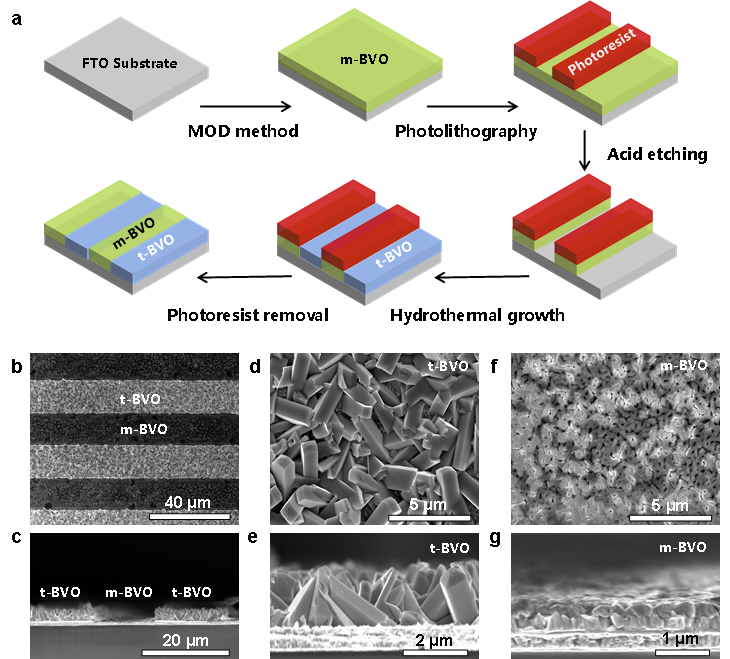
Fabrication of patterned t-BVO/m-BVO semiconductor photocatalytic panels. (Image by IMR)
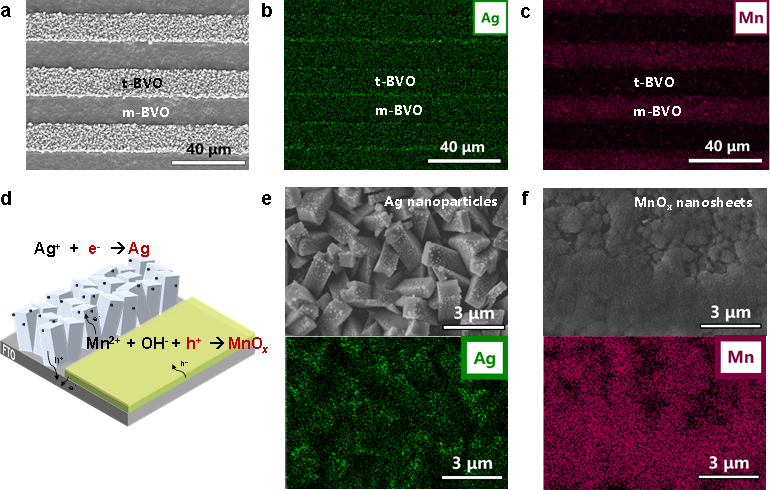
Photochemical deposition tracing reveals spatial separation of photogenerated charges. (Image by IMR)