
Newsroom


A new study of TIC 349005337, a highly active M-dwarf spectroscopic binary, has precisely measured the physical parameters of both component stars and recorded 12 optical flares, offering observational evidence for understanding magnetic activity in low-mass stars and the link between that activity and their internal structure.
Led by researchers from the Yunnan Observatories of the Chinese Academy of Sciences (CAS), the study drew on observations from the Large Sky Area Multi-Object Fiber Spectroscopic Telescope (LAMOST) and the Transiting Exoplanet Survey Satellite (TESS).
The findings were published in The Astrophysical Journal on Nov.2.
M dwarfs make up the most numerous stellar population in the Milky Way and serve as foundational benchmarks for exploring the structure and evolution of low-mass stars, as well as the habitability of exoplanetary environments. Eclipsing binaries allow astronomers to measure stellar masses and radii directly and with high precision, independent of theoretical models. Yet stellar evolution theory has long been dogged by a prominent "radius inflation" problem: the measured radii of many M dwarfs are significantly larger than models predict. A widely held explanation attributes this discrepancy to strong magnetic fields, rapid rotation and extensive starspot coverage, factors that inhibit convective energy transport. Identifying and accurately characterizing highly active M-dwarf eclipsing binaries is therefore essential to pinning down the underlying physical mechanism.
The researchers performed systematic modeling and analysis of the M-dwarf detached eclipsing binary TIC 349005337, combining high-cadence, continuous light-curve data from TESS with multi-epoch spectroscopy from the LAMOST Medium-Resolution Survey (LAMOST-MRS).
They derived the fundamental parameters of both stars. The secondary star's mass falls below the fully convective boundary (about 0.35 solar masses), placing the star in the fully convective regime. Both components show pronounced radius inflation, and the effect remains significant even after correcting for starspot coverage and third-light contamination, providing an observational benchmark for refining models of low-mass stellar evolution.
Across 65.1 cumulative days of TESS observations, the team identified 12 optical flares in the system's light curve, yielding a mean flare detection rate of about 0.18 events per day. The most energetic event was a superflare with an estimated radiative energy release of approximately 3.87×1034 erg. In solar dynamo models, the tachocline — the shear layer between the radiative core and the convective envelope — plays a central role in the generation and evolution of magnetic fields.
The secondary component of TIC 349005337 is a fully convective star with no solar-like tachocline. If some of these high-energy flares can be shown to originate on the secondary star, they would demonstrate that fully convective stars can still build up and release substantial magnetic energy without such a shear layer.
The intense magnetic activity and frequent flaring seen in TIC 349005337 make the system a natural laboratory for studying tidal interactions in binaries, magnetic field generation in low-mass stars and stellar atmospheric stability. The team also noted that the frequent superflares and intense high-energy radiation emitted by such systems — with substantial X-ray emission already detected by the ROSAT satellite — threaten the atmospheric stability of any habitable-zone exoplanets, potentially stripping their atmospheres or altering their photochemical evolution.
The work was supported by the CAS International Partnership Program, the Young Talent Project of the Yunnan Revitalization Talent Support Program and the Yunnan Fundamental Research Projects.
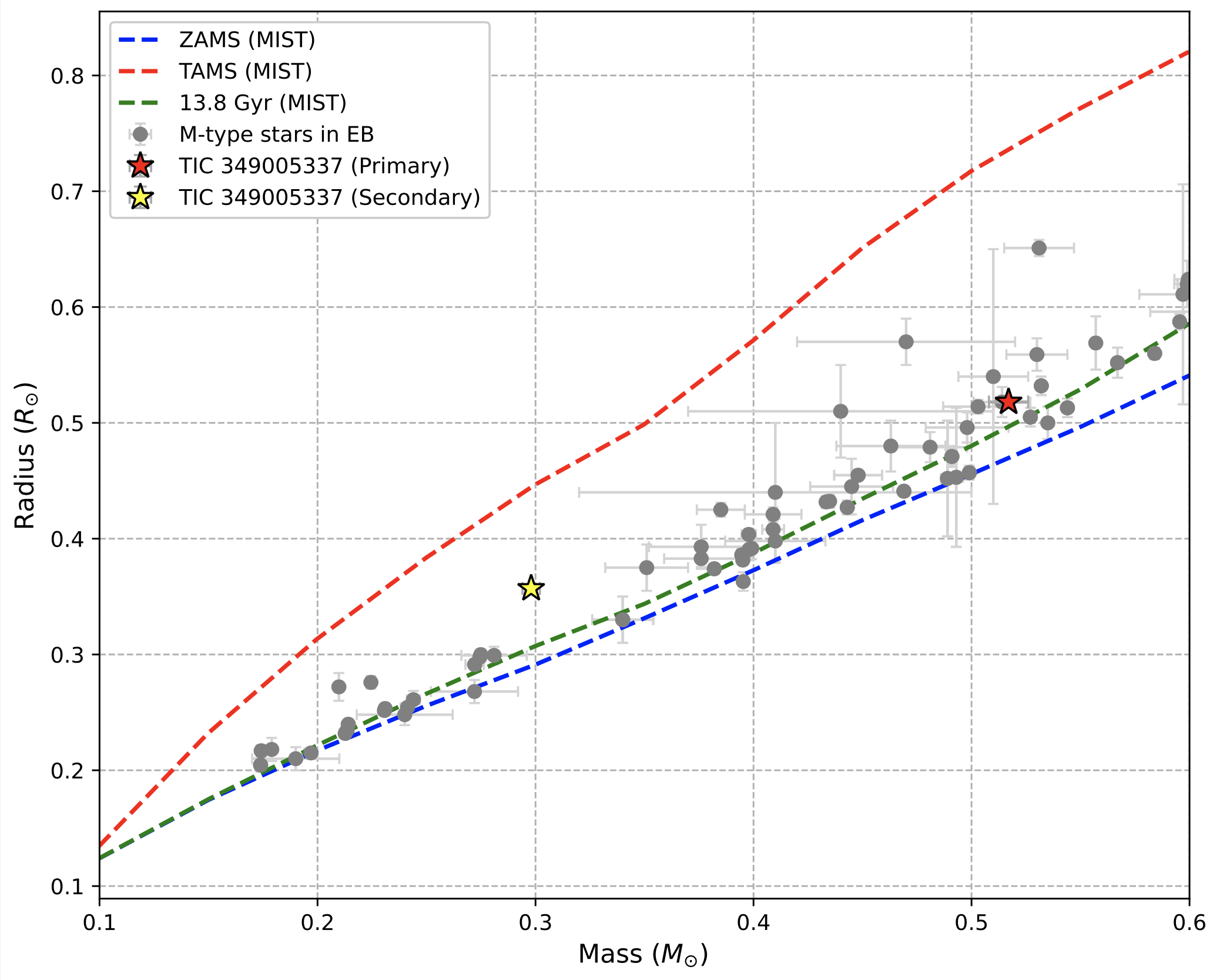
Mass–radius relation for low-mass stars (M≤0.6M⊙). (Image by ZHOU Xiao)
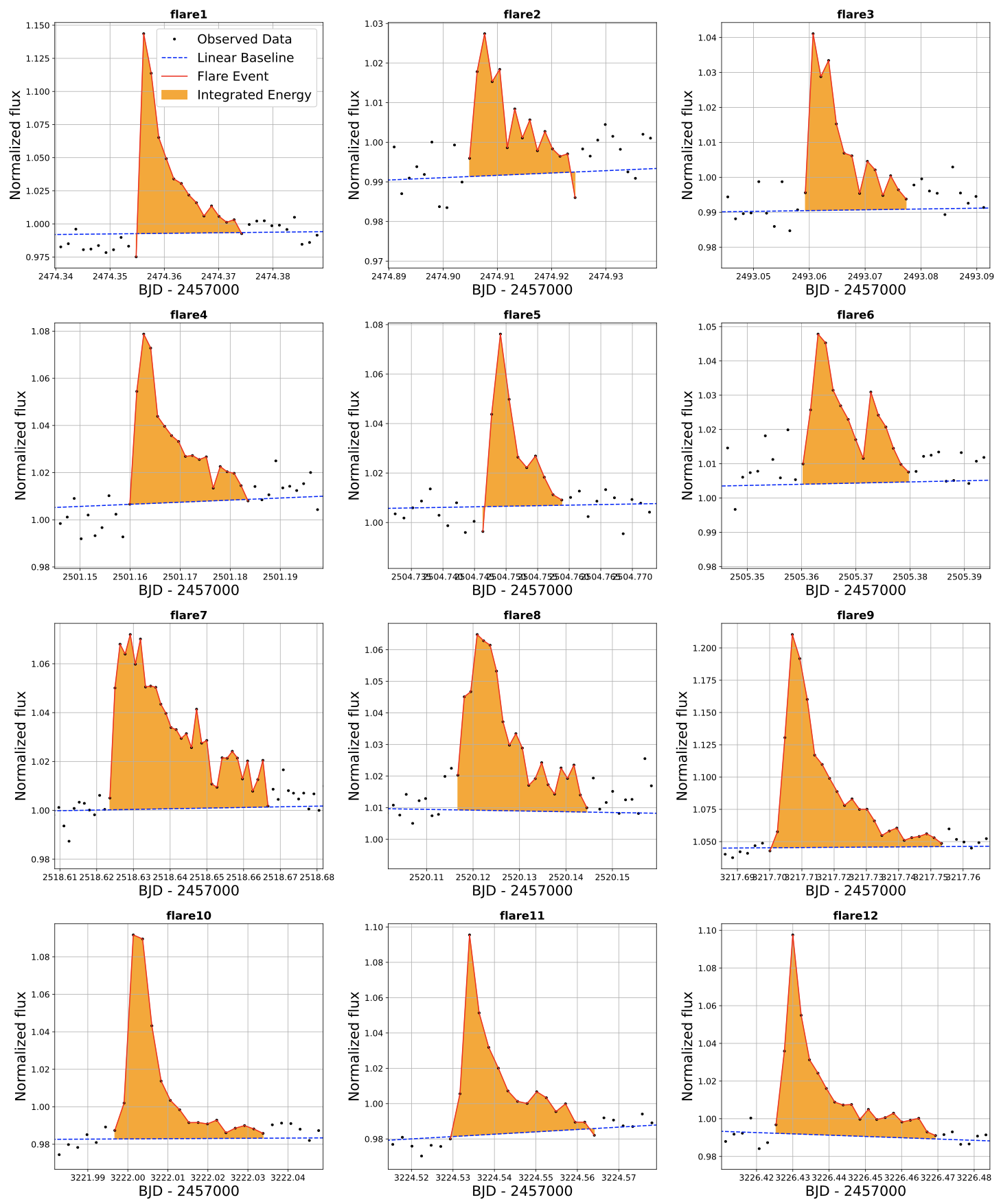
12 optical flares detected in the TESS light curve of TIC 349005337. (Image by ZHOU Xiao)
