
Newsroom


Freshly harvested fruit remains metabolically active, respiring vigorously and highly sensitive to ethylene, and is therefore highly susceptible to softening, browning, water loss, and decay. Currently, about 25% of the fruit is lost in the postharvest supply chain because of inadequate preservation, transport, or storage.
Conventional petroleum-based plastic packaging acts merely as a passive physical barrier and cannot respond to the continuously changing physiological status of the fruit. Functional packaging, in contrast, modulates the in-package microenvironment and releases active agents that intervene in fruit respiration, ethylene signaling, oxidative stress, and microbial growth; it has thus emerged as a frontier of postharvest preservation research. However, systematic analyses of how different materials and strategies act on fruit physiology, and of how these approaches can be translated into industrial practice, are still lacking.
To address these knowledge gaps, a research team from the South China Botanical Garden of the Chinese Academy of Sciences, has recently published a comprehensive review in Comprehensive Reviews in Food Science and Food Safety.
Organized around the framework of "material structure–physicochemical property–fruit physiological response," this review systematically examines functional packaging strategies, including moisture regulation, gas regulation, edible coatings, antioxidant and nutritional quality regulation, antimicrobial packaging, intelligent packaging, and shelf-life prediction.
For instance, a chitosan/nanocellulose coating reduced weight loss in grapes to 15.5% after 18 days of storage, compared with 40.4% in the control; a Pt/CeO2-P catalyst achieved an ethylene removal efficiency of over 99.9% and kept bananas firm for 14 days; and a machine-learning-assisted sensor array determined fruit ripeness with 99.09% accuracy.
The review points out that moisture and gas regulation are governed by the same set of microstructural parameters, which give rise to both synergies and trade-offs, and that fruit type dictates which functional layer should be prioritized; it therefore concludes that no universally optimal solution exists.
From an industrial standpoint, stimulus-responsive metal–organic framework (MOF) carriers and AI-enabled intelligent packaging are still confined to the laboratory or early-prototype stage. Their translation into practice is also constrained by insufficient microstructural stability, safety assessments that lag behind, the difficulty of achieving precise release control without compromising cost and scalability (cellulose nanocrystals, for example, cost roughly 13 times as much as polypropylene), and divergent regulatory frameworks across China, the United States, the European Union, and other jurisdictions.
This review proposes that future work focus on developing low-cost, self-healing bio-based materials and on integrating flexible sensors, radio-frequency identification (RFID), and machine learning to construct closed-loop intelligent packaging built on a "sensing–communication–prediction" architecture, thereby providing support for sustainable, high-performance postharvest preservation technologies.
This work is supported by the National Natural Science Foundation of China, the Guangdong Natural Science Foundation, and other funding sources.
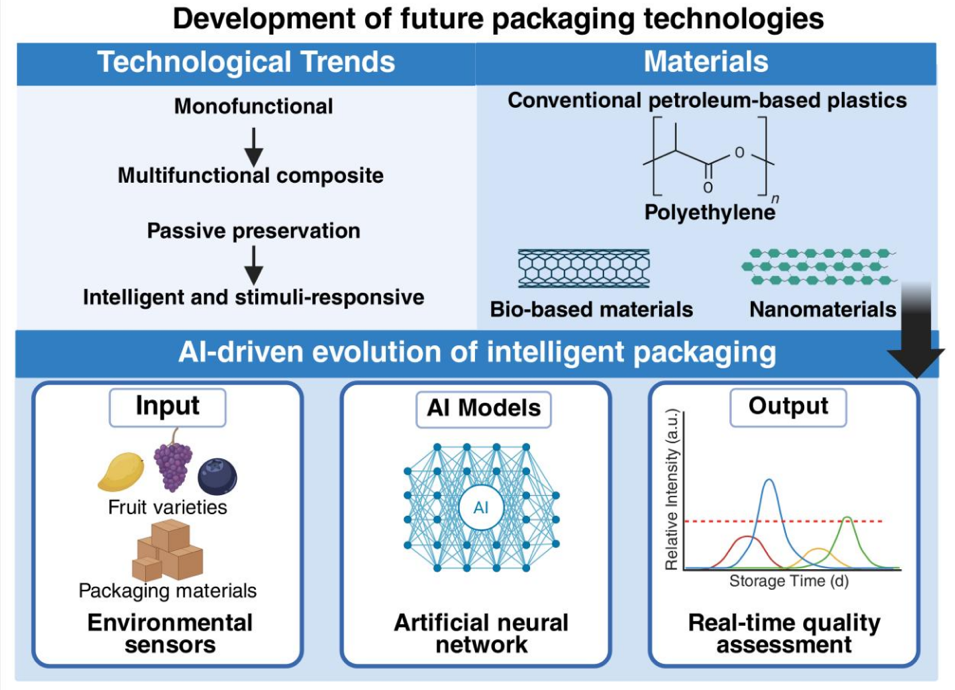
Future directions for functional packaging technologies. (Image by ZHU Hong)
