Newsroom


A new study has pieced together the evolutionary history of terrestrial animals on the Qinghai–Tibet Plateau (QTP), offering a comprehensive picture of how the distinctive fauna of the "Third Pole" took shape over millions of years.
The study, led by a research team from the Chengdu Institute of Biology (CIB) of the Chinese Academy of Sciences (CAS), was published in Proceedings of the National Academy of Sciences of the United States of America on October 26.
The QTP covers an area of about 3.07 million square kilometers, with elevations ranging from 88 to 8,848 meters. It is one of the world's biodiversity hotspots and harbors a large number of endemic species.
The QTP comprises three major subregions—the plateau platform, the Himalayas, and the Hengduan Mountains—with the latter two recognized internationally as biodiversity hotspots.
How the plateau's unique tectonic history and monsoon systems have shaped the evolution of local biodiversity has long been a focus of research in evolutionary biology and biogeography. However, previous studies have mostly focused on plants or single animal taxa, leaving the overall development of the QTP's terrestrial fauna poorly understood.
To address this knowledge gap, the researchers integrated time-calibrated phylogenetic trees covering more than 20,000 species across five major groups—invertebrates, amphibians, reptiles, birds, and mammals—and reconstructed the evolutionary history of 527 endemic terrestrial animal species on the QTP.
They found that the endemic fauna of the QTP formed mainly through in situ diversification. They also found that immigration events were nearly twice as numerous as emigration events, giving the QTP a dual role as both a diversification center and a biogeographic sink.
Furthermore, they discovered that the three subregions have played markedly different roles: the Hengduan Mountains have served as the primary "source" of in situ diversification; the Himalayas have functioned as both a "source" and a "sink"; and the plateau platform has experienced very little in situ diversification, with its fauna having formed mainly through immigration, making it an important "sink" area.
The researchers also examined how geological and climatic changes have influenced the evolution of the QTP's fauna over time. They found that the Eocene–Oligocene climate transition, about 34 million years ago, marked the beginning of sustained diversification and biotic exchange. However, the timing of these processes differed among the three subregions, reflecting differences in their uplift histories and monsoon systems.
In terms of the effects of uplift, in situ diversification events in the Hengduan Mountains and the Himalayas accelerated significantly following periods of rapid regional uplift. In terms of the effects of monsoons, immigration and emigration events in the Hengduan Mountains increased and peaked during the intensification of the East Asian monsoon, while those in the Himalayas increased and peaked during the intensification of the South Asian monsoon.
In addition, by comparing animal evolutionary dynamics with studies of plants, the researchers found a consistent pattern of "plants first, animals later" across the QTP and its subregions. They discovered that early-colonizing plant groups created suitable ecological niches, laying the ecological foundation for subsequent animal immigration and diversification, revealing a predictable cross-taxon colonization rule.
By tracing the evolutionary history of the QTP's endemic terrestrial fauna, this study deepens our understanding of the evolution of mountain biotas and provides a framework for investigating the mechanisms shaping biodiversity in mountain regions worldwide.
The research was supported by the National Natural Science Foundation of China, the Sichuan Science and Technology Program, the Youth Innovation Promotion Association of CAS, and the International Partnership Program of CAS.
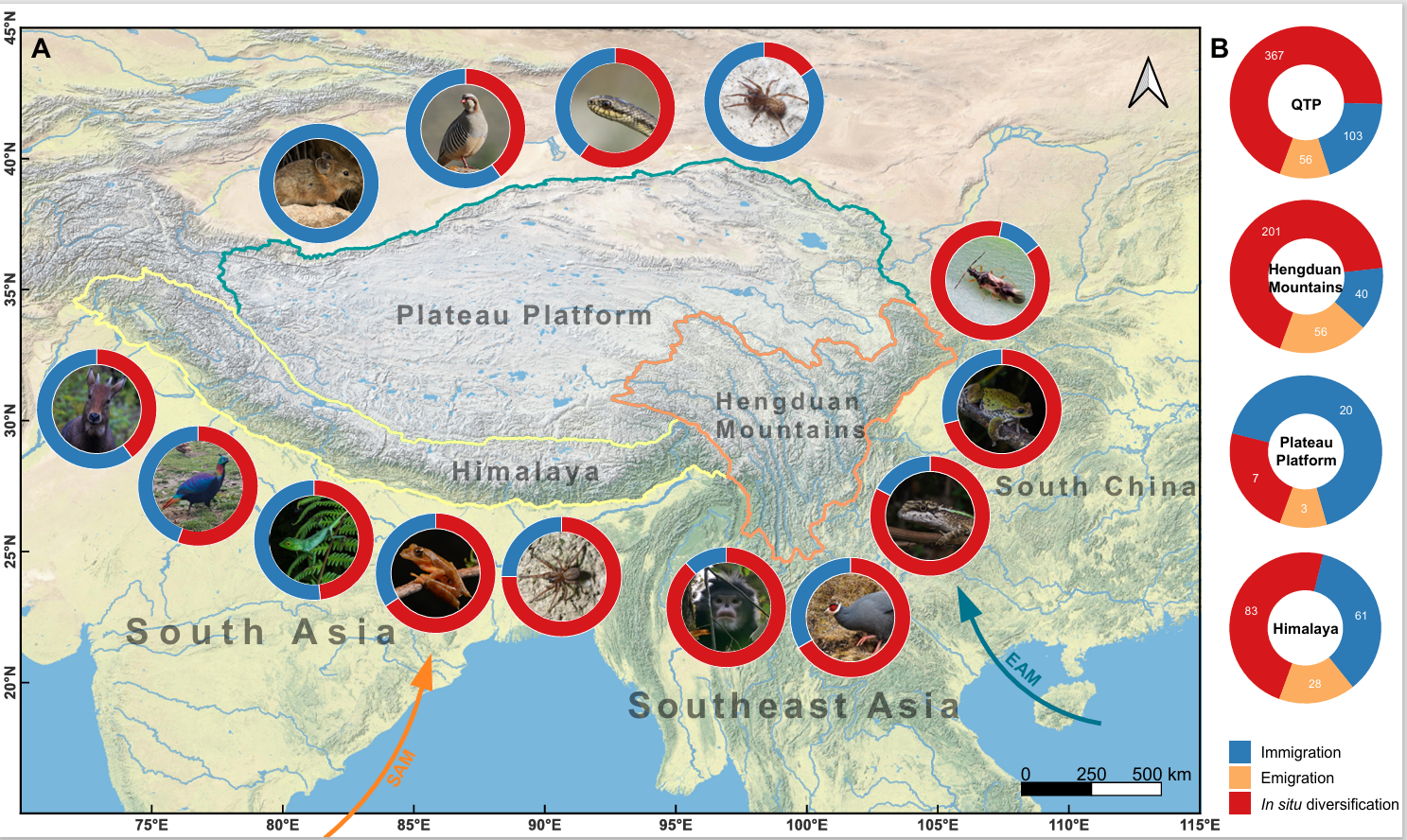
The Qinghai-Tibet Plateau region, adjacent regions, and associated biogeographical events. (Image by CIB)