
Newsroom


A new study of 62 songbird species in China's Gaoligong Mountains found that genetic diversity has declined by an alarming 43-49% over the past half-century, threatening species' ability to adapt to environmental change. The effect was observed even in species considered at low risk of extinction.
The study, which was led by researchers from the Kunming Institute of Zoology of the Chinese Academy of Sciences (CAS) and published in Science, identified landscape fragmentation at low-to-mid elevations as the primary driver of diversity decline.
The researchers integrated genome-wide data from 294 historical samples (1960s–1970s) and 294 contemporary samples (2000s–2020s) across 62 species in the Gaoligong Mountains. Comparing historical and modern genomes, the team found that all 62 species showed marked declines in genetic diversity.
More unexpectedly, the study revealed a "common species paradox": species with larger contemporary population sizes often experienced more severe genetic erosion. This is because large populations depend on gene flow across continuous habitat, which fragmentation disproportionately disrupts.
The team tested two competing hypotheses of genetic erosion: habitat loss and fragmentation. If habitat loss dominated, erosion should track species' sensitivity to reduced carrying capacity. In contrast, if fragmentation dominated, erosion should track dispersal ability.
The results supported the fragmentation hypothesis—dispersal ability was a significant predictor, while life-history traits such as clutch size and adult survival showed no significant effect. Fragmentation reduces connectivity among populations, subdividing large populations into isolated smaller ones and intensifying genetic drift.
The Gaoligong Mountains cover only approximately 0.36% of China's land area but harbor over one-third of its bird species. The region has long-established reserves and active conservation management. However, fragmentation pressure originates mainly from low-elevation areas outside protected zones, where rapid anthropogenic transformation has degraded connectivity corridors linking the Gaoligong range with adjacent mountains.
None of the 62 species is currently listed as threatened by the International Union for Conservation of Nature (IUCN), yet their genetic diversity has declined by nearly half. This implies a "cryptic extinction debt": populations may appear stable while losing the adaptive potential needed for future environmental change.
The current rate of genetic erosion also suggests that retaining at least 90% of genetic diversity within all species will be difficult to achieve, underscoring the challenges of meeting the Kunming–Montreal Global Biodiversity Framework's goal of maintaining genetic diversity.
According to the researchers, these findings expose a monitoring blind spot. IUCN Red List assessments rely mainly on population size and range trends, rather than genetic diversity.
The study instead demonstrates a feasible regional approach to genetic-diversity monitoring: building baselines from historical specimens, quantifying fragmentation effects, and linking genetic indicators to connectivity conservation.
The researchers suggest that conservation efforts should extend beyond protecting habitat area and maintaining population abundance to safeguarding connectivity and evolutionary potential, especially by restoring low-elevation corridors outside protected areas.
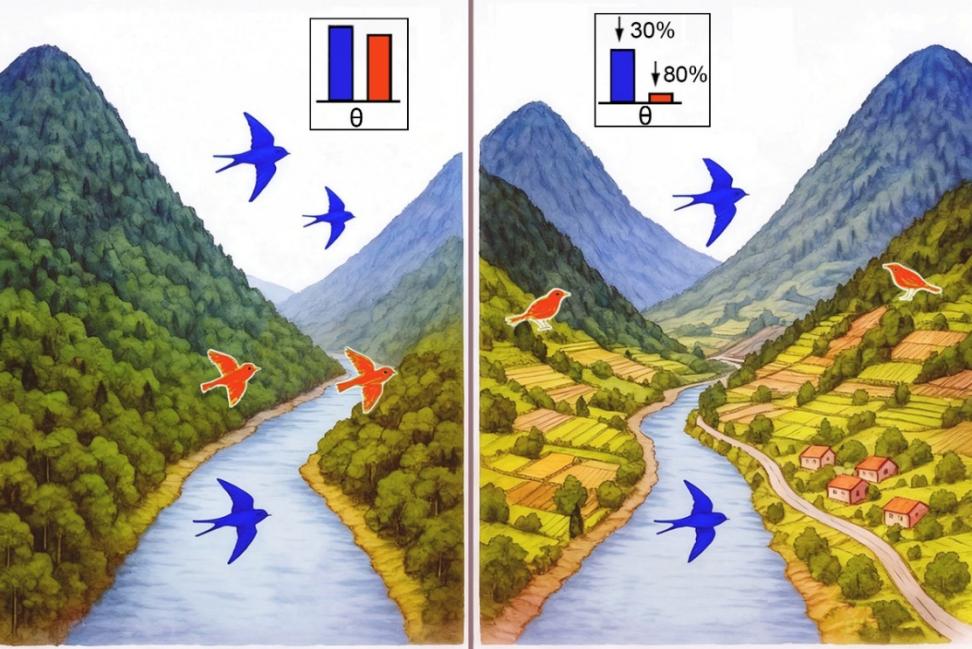
Schematic representation of landscape fragmentation and genetic erosion between adjacent mountain ranges. The left panel depicts the historical landscape (∼1950s), characterized by continuous forest from mountaintops to the river valley, which supported unrestricted movement and gene flow for both strong-disperser (blue) and weak-disperser (red) bird species. The right panel illustrates the contemporary landscape (∼2020s), where conversion of mid- and low-elevation forests to agriculture and settlements has created a dispersal barrier. (Image by KIZ)

