Newsroom


Scientists have recently developed a new strategy to improve the electrocatalytic reduction of CO2 to carbon monoxide (CO) by constructing interlayer van der Waals donor–acceptor (D–A) heterojunctions within a two-dimensional hydrogen-bonded organic framework (HOF).
This strategy transforms conventional π–π stacking from a passive charge-transport channel into an active directional charge-transfer interface, significantly boosting CO2-to-CO electroreduction.
The study, published in Angew. Chem. Int. Ed., was conducted by a research team led by Profs. CAO Rong, HUANG Yuanbiao and LIU Tianfu from the Fujian Institute of Research on the Structure of Matter of the Chinese Academy of Sciences.
Electrocatalytic CO2 reduction (CO2RR) offers a promising route to convert CO2 into value-added chemicals and fuels using renewable electricity. However, its practical efficiency is still limited by sluggish reaction kinetics, particularly inefficient electron transfer from electrodes to catalytic sites and adsorbed intermediates. Conventional strategies mainly focus on optimizing charge transport within covalent skeletons, while charge transfer across noncovalent interfaces in supramolecular frameworks remains relatively unexplored.
To address this challenge, the researchers assembled a porphyrin-based HOF, PFC-45-Co, from electron-donating cobalt 5,10,15,20-tetra(4-pyridyl)porphyrin (Co-TPyP) and electron-accepting cobalt 5,10,15,20-tetra(4-carboxyphenyl)porphyrin (Co-TCPP) through strong O–H···N hydrogen bonds.
Importantly, Co-TCPP and Co-TPyP units are periodically and alternately arranged in a face-to-face manner along the interlayer direction, forming well-defined interlayer D–A heterojunctions. The short interlayer distances of 3.005 and 3.070 Å enable close π–π contacts for through-space charge transport, while the staggered frontier orbital alignment provides an energetic driving force for directional electron migration.
Benefiting from this directional charge-transfer modulation, PFC-45-Co exhibits significantly enhanced electrical conductivity and charge-transfer capability. Its conductivity reaches 3.25 × 10⁻8 S m⁻1, which is 3.98 and 4.97 times higher than those of the single-component control HOF PFC-72-Co and a physical mixture of Co-TCPP and Co-TPyP, respectively.
The researchers then evaluated its CO2 reduction performance under neutral and acidic conditions. In CO2-saturated 0.5 M KHCO3 neutral electrolyte, PFC-45-Co achieves a CO Faradaic efficiency (FECO) of 98.4% at −0.9 V vs. RHE and a CO partial current density (jCO) of 31.3 mA cm⁻2 at −1.2 V vs. RHE, maintaining stable operation for 45 h with FECO above 80%.
More notably, under acidic conditions (pH = 2), PFC-45-Co maintains FECO of 92–99% over a wide potential range from −0.7 to −1.6 V vs. RHE, with a maximum FECO of 99.7% at −1.0 V vs. RHE, and delivers a large jCO of 111.1 mA cm⁻2 at −1.6 V vs. RHE with stable operation for 6 h. In contrast, PFC-72-Co shows FECO of only 5–76% under acidic conditions, and its jCO at the same potential is nearly 26 times lower.
According to the researchers, this work demonstrates that interlayer van der Waals D–A heterojunction engineering can transform conventional π–π stacking from a passive charge-transport pathway into an active directional charge-transfer interface. It provides a molecular-level design principle for developing conductive and robust HOF electrocatalysts for efficient CO2 conversion in both neutral and acidic media.
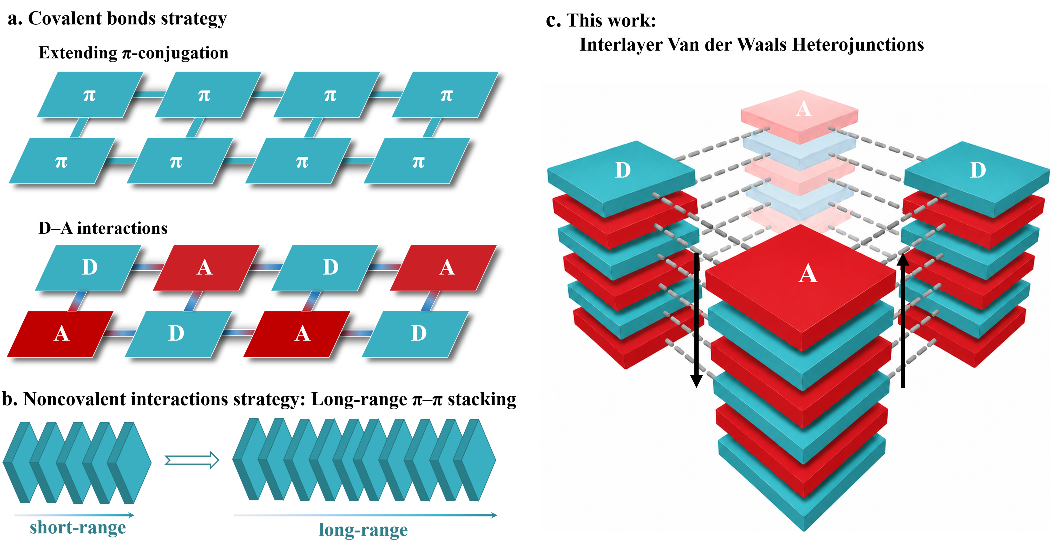
Strategies of enhancing electron transfer ability in framework-based materials (Image by Prof. CAO's group)