Newsroom


Electrocatalytic carbon dioxide (CO2) reduction uses electricity to convert CO2 into useful chemicals and fuels. Conventional electrodes often rely on polymer binders, which affects their performance and stability. Besides, using them to produce multicarbon products such as n-propanol remains challenging
In a study published in Energy & Environmental Materials and ACS Nano, a team of researchers led by Prof. MENG Guowen and Prof. TANG Haibin from the Hefei Institutes of Physical Science of the Chinese Academy of Sciences developed self-supported electrodes which improve the conversion rate of CO2 into carbon monoxide (CO) and n-propanol.
By using a three-dimensional porous anodic aluminum oxide (3D-AAO) template which has transverse pores interconnecting the longitudinal pores, researchers developed self-supported ordered nanowire array electrodes without polymer binders.
For CO2-to-CO conversion, researchers developed a 3D interconnected silver nanowire electrode called 3D-ICAg. The scaffold-like ordered and parallel-arranged Ag nanowire array structure provides open pathways for reactants and products, good electrical contact, and rich active sites.
In an H-type electrolytic cell, the electrode achieved a CO Faradaic efficiency of 97.28% with a high current density of 59.06 mA cm-2, and remained stable for 50 hours. In situ Raman spectroscopy was used to study the reaction process.
Moreover, using the same approach, researchers developed a 3D interconnected copper nanowire electrode, GB-ICCu, for producing multicarbon products. The electrode contains numerous surface grain boundaries which help activate CO2 and promote C-C bond formation.
Combined with the nanoconfinement effect induced by the interconnected nanowire, the electrode achieved an n-propanol Faradaic efficiency of 17.47% in an H-type electrolytic cell. In a flow cell, its partial current density reached 77.7 mA cm-2.
The studies demonstrate the potential of self-supported nanowire electrodes for CO2 electroreduction. By removing polymer binders and using a 3D scaffold-like structure, electrodes provide better access to active sites and improve the movement of reactants and products, while also maintaining stable operation.
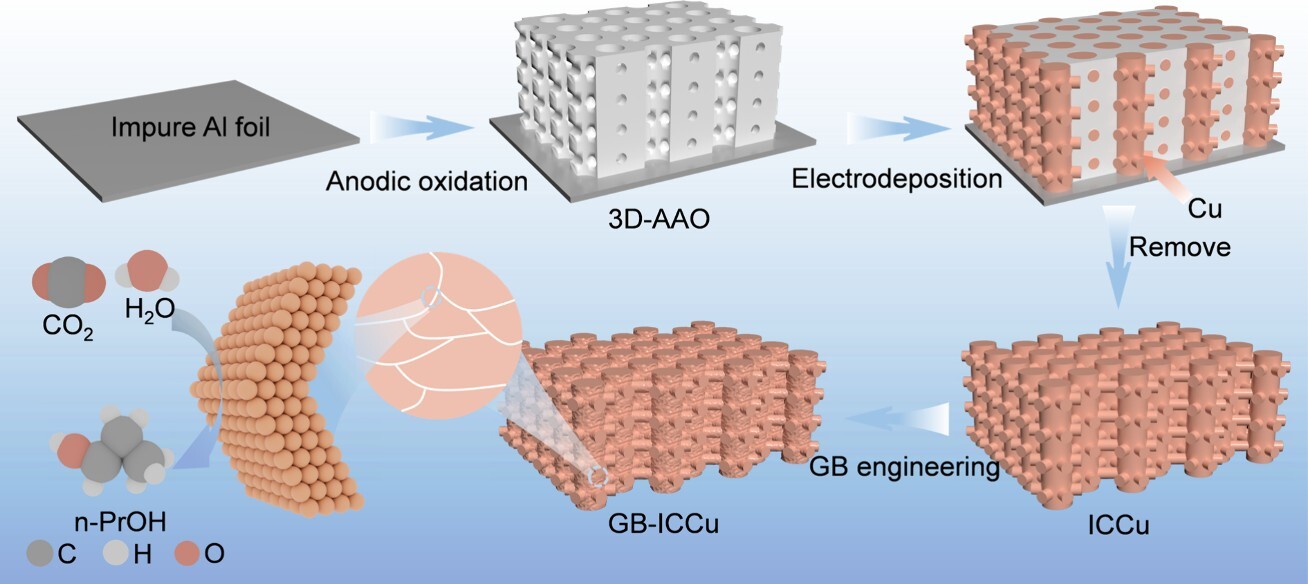
Schematic illustration of the synthesis process of the GB-ICCu electrode. (Image by TANG Haibin)