Newsroom


Heavy-fermion superconductors have long served as a key playground for exploring unconventional superconductivity and quantum criticality—phenomena that emerge from the delicate competition between Kondo screening and RKKY magnetic ordering.
In recent years, the discovery of two-dimensional van der Waals (vdW) heavy-fermion materials has opened fresh avenues for investigating how reduced dimensionality reshapes strongly correlated electronic states. Among these, CeSiI stands out: its layered crystal structure, combined with heavy-fermion behavior, makes it an especially attractive platform for studying the interplay among Kondo coherence, antiferromagnetism, and superconductivity.
Yet a central question has remained: can pressure induce superconductivity and quantum criticality in such low-dimensional vdW heavy-fermion systems?
Now, a recent study published in Nature Physics provides a definitive answer. Researchers from the Institute of Physics (IOP) at the Chinese Academy of Sciences (CAS), using the cubic-anvil high-pressure apparatus developed at the Synergetic Extreme Condition User Facility (SECUF), investigated the transport properties of CeSiI single crystals under pressures up to about 11 GPa and at temperatures as low as 50 mK. For the first time, they have mapped out the complete temperature–pressure phase diagram of this two-dimensional vdW heavy-fermion system.
Their measurements reveal that antiferromagnetic order is progressively suppressed with increasing pressure, disappearing near 6 GPa—exactly where superconductivity appears with a dome-shaped phase boundary. At the same time, the Kondo coherence temperature follows an unusual V-shaped evolution.
A detailed low-temperature transport analysis further uncovers non-Fermi-liquid behavior and a pronounced enhancement of quasiparticle effective mass near the critical pressure, pointing clearly to the emergence of unconventional superconductivity mediated by strong quantum critical fluctuations.
Taken together, these results highlight a close relationship among magnetism, Kondo hybridization, quantum criticality, and unconventional superconductivity in a two-dimensional vdW heavy-fermion system.
According to the researchers, the study establishes CeSiI as a new model platform for studying unconventional superconductivity in reduced dimensions and offers valuable experimental insights into quantum criticality in vdW correlated materials.
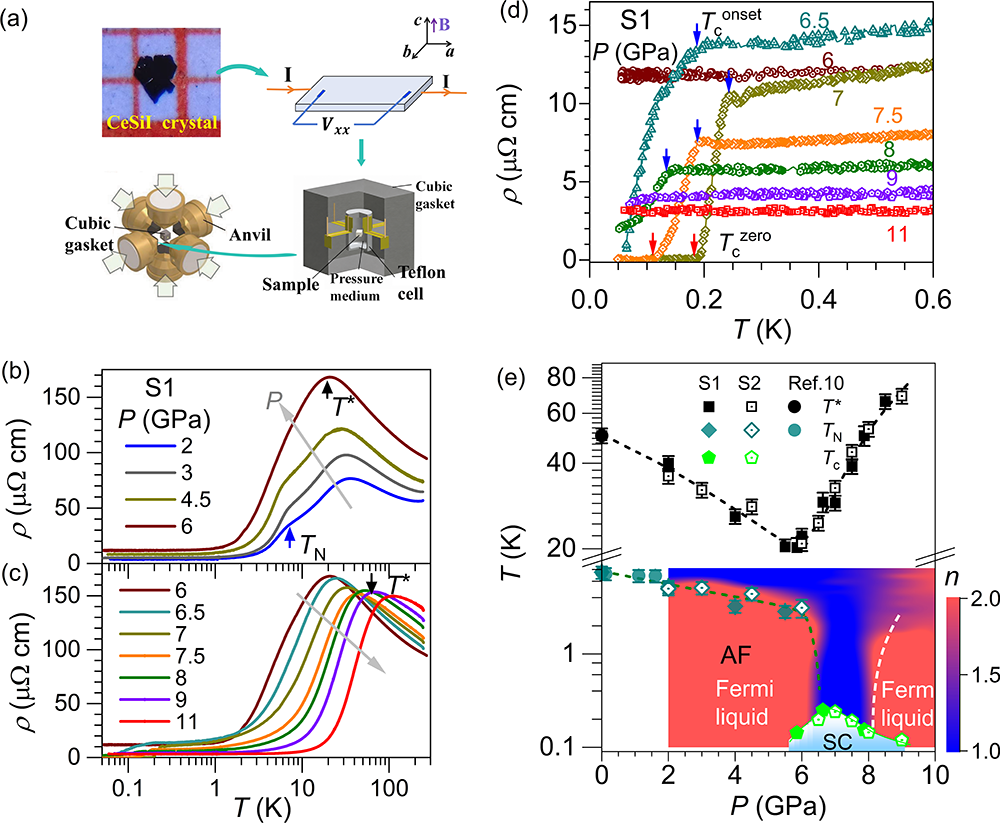
High-pressure transport measurements and temperature-pressure phase diagram of the vdW heavy-fermion meta CeSiI. Increasing pressure suppresses antiferromagnetic order, induces superconductivity near the quantum critical point, and leads to an unusual V-shaped evolution of the Kondo coherence temperature. (Image by IOP)