
Newsroom


In a study published in Science in 2023, Prof. LI Haipeng's team from the Shanghai Institute of Nutrition and Health of the Chinese Academy of Sciences and collaborators developed the fast infinitesimal time coalescent process (FitCoal) and detected a severe population bottleneck occurring approximately 930 thousand years ago.
In a study published in Molecular Biology and Evolution on July 2, Prof. LI's team and researchers from East China Normal University, Sapienza University of Rome and the University of Florence, demonstrated that FitCoal achieves both superior speed and accuracy in expected site frequency spectrum (SFS) estimation.
The researchers compared two method FitCoal and mushi as they both rely on SFS to infer demography. They ran ten billion coalescent simulations and used the averaged results as the benchmark.
Across 215 SFS categories, FitCoal's estimates matched this benchmark in 194 categories (90.2%), differing by at most a single generation elsewhere, while mushi's estimates deviated by about two orders of magnitude. FitCoal was also dramatically faster, finishing the same calculation in about 0.00013 seconds, versus 1.29 seconds for mushi.
The researchers then simulated genome-wide data conditional on the ancient severe bottleneck. FitCoal recovered the bottleneck whereas mushi failed.
Besides, the researchers confirmed that there is no significant difference between the inferred bottlenecks in African and non-African populations. Crucially, this genetic signal is echoed by independent fossil and ancient-climate evidence, including the African fossil gap, the chromosome 2 fusion, sharp Pleistocene climate shifts, and a later rise in brain size.
These findings refine the demographic history of Homo during the Pleistocene, and highlight the importance of high-precision SFS computation for revealing critical evolutionary transitions that shaped modern human ancestry.
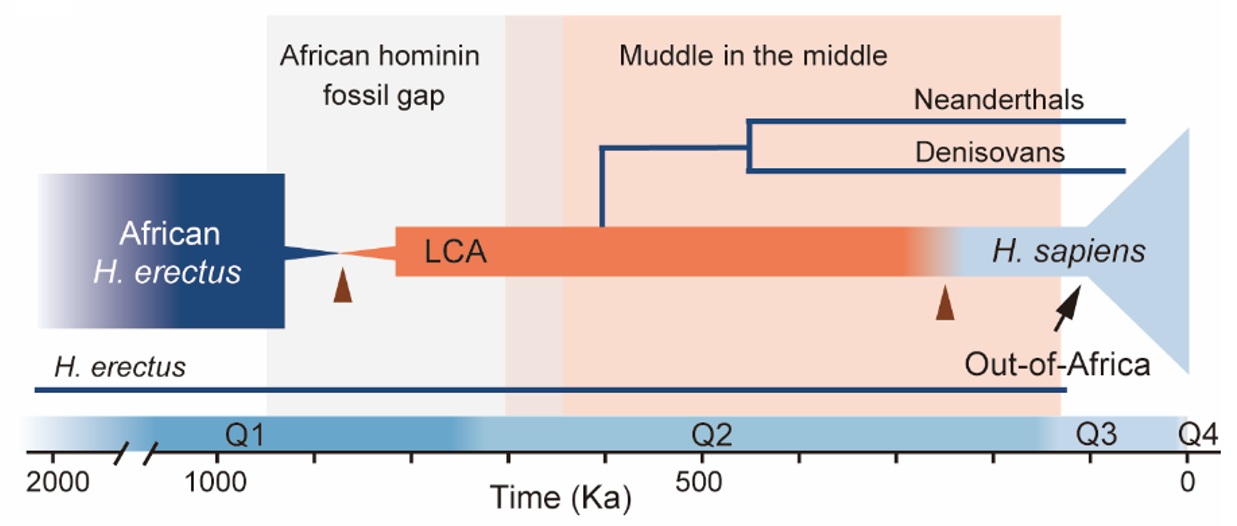
Hominin evolutionary history over the past one million years. (Image by Prof. LI Haipeng's team)

