Newsroom


Scientists have uncovered a novel RtERF1–RtXTH2 regulatory module that boosts aluminum (Al) tolerance in Rhodomyrtus tomentosa through cell wall remodeling, offering fresh insights into how woody plants adapt to acidic soils.
The research, led by Prof. DENG Shulin from the South China Botanical Garden (SCBG) of the Chinese Academy of Sciences (CAS), was published in The Plant Journal on June 17.
Acidic soils cover about 40%–50% of the world's arable land, making them a major abiotic stress that limits agricultural production. In such soils, Al³⁺ inhibits root elongation and nutrient uptake, often leading to significant yield losses. The plant cell wall acts as the first physical barrier against Al³⁺ entry, and changes in its composition are critical for Al tolerance.
Members of the RtXTH (xyloglucan endotransglucosylase/hydrolase) family drive cell wall restructuring through the modification or hydrolysis of xyloglucan chains, making them critical for Al detoxification.
Rhodomyrtus tomentosa is a shrub widely found across tropical and subtropical regions. Its remarkable adaptability to acidic soils makes it an ideal material for studying the unique strategy of "turning toxicity into benefit" in plants.
Based on the genome and transcriptome, researchers identified the XTH gene family from R. tomentosa and found that RtXTH2 is significantly induced by Al in roots and shows the most prominent expression response. Further studies using transgenic Arabidopsis and VIGS (virus-induced gene silencing) in R. tomentosa demonstrated that RtXTH2 enhances Al tolerance by negatively regulating the abundance of Al-binding sites in the cell wall.
To dissect the upstream regulatory network of RtXTH2, the researchers screened and identified RtERF1 as a transcription factor that significantly activates the promoter activity of RtXTH2.
The findings revealed that RtERF1 binds to CRT cis-elements in the promoter of RtXTH2, activating its transcription. The upregulated RtXTH2 then reduces hemicellulose and pectin content and thereby reduces Al³⁺ binding sites on the cell wall. Additionally, the researchers found that RtERF1 protein stability is enhanced under Al stress, suggesting the existence of post-translational regulatory mechanisms.
According to the researchers, this study reveals the RtERF1–RtXTH2 transcriptional regulatory module in response to Al stress in R. tomentosa, providing a new framework for understanding cell wall remodeling-mediated Al adaptation in woody plants.
The study was supported by grants from the National Natural Science Foundation of China, the Guangdong Forestry Science and Technology Innovation Project, and the Guangdong Science and Technology Plan Project.
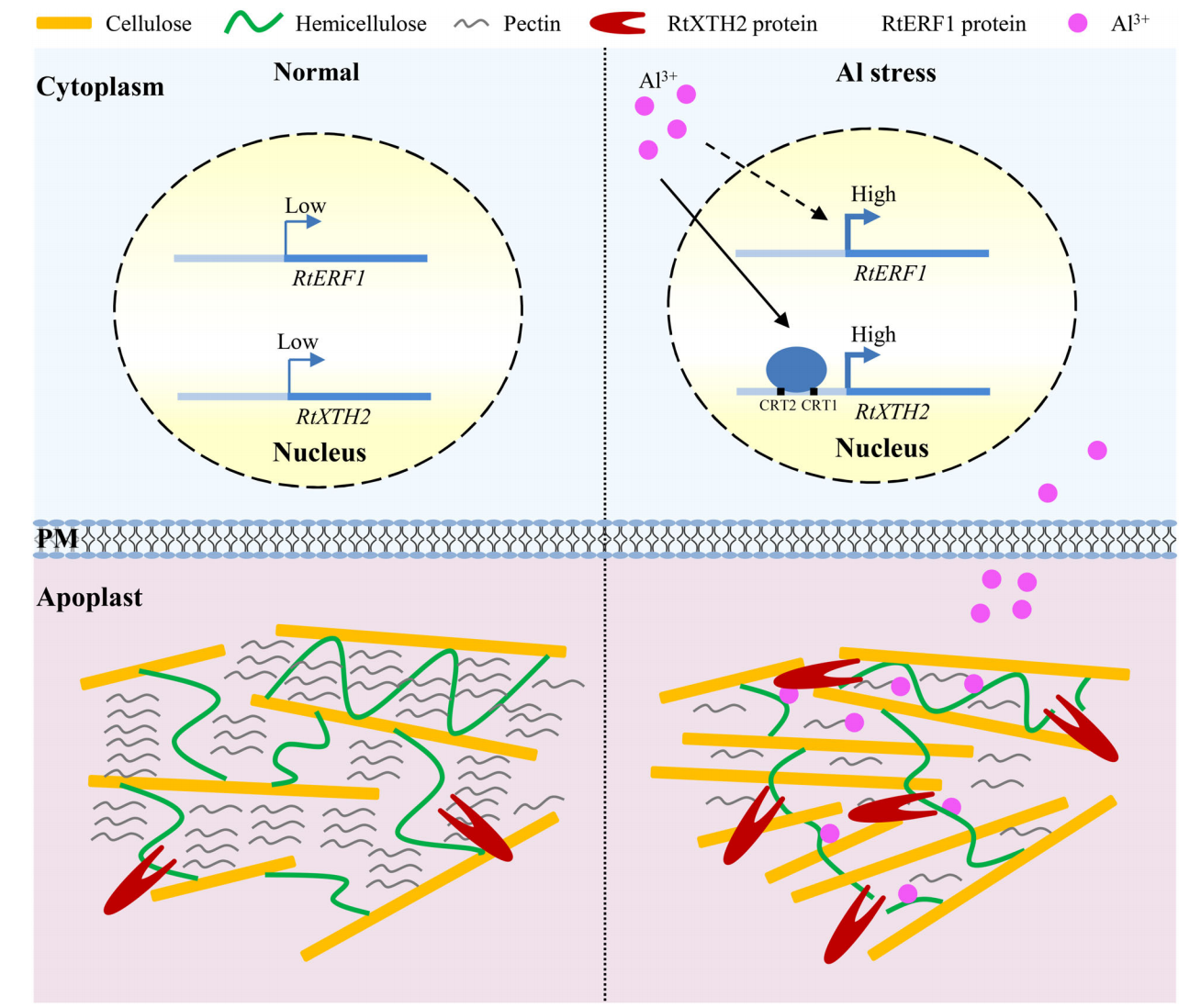
Proposed working model of the RtERF1–RtXTH2 regulatory module in response to Al stress in R. tomentosa. (Image by SCBG)