Newsroom


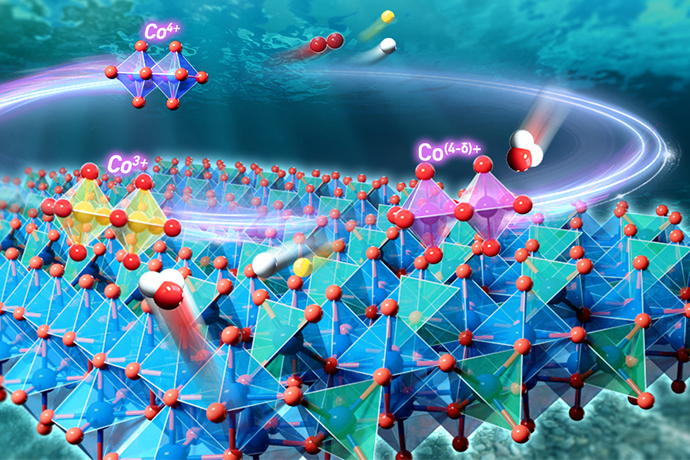
Researchers have now spatially resolved the atomic-scale interplay between hole transfer dynamics and the evolution of water oxidation intermediates on faceted BiVO₄ particles. They achieved this in a recent study published in Nature Nanotechnology by integrating operando electrochemical shell-isolated nanoparticle-enhanced Raman spectroscopy (SHINERS) with nanoscale electrochemical reaction imaging, which has led to a major breakthrough in understanding the water oxidation reaction.
Water oxidation is widely recognized as the kinetic bottleneck of artificial photosynthesis, limiting the efficiency of solar fuel production. The reaction is challenging because it demands the dynamic transfer of multiple electrons and protons at a complex catalyst–liquid interface. At this interface, photogenerated holes accumulate on the catalyst surface, driving atomic-scale structural rearrangements and regulating chemical bond breaking and formation.
Despite its status as a "Holy Grail" reaction for renewable solar fuels, the dynamic spatial coupling of charge transfer, localized structural motifs, and active-site evolution has remained unresolved in space and time—particularly under operando conditions—thus obscuring key mechanistic pathways.
Now, a research team led by Prof. LI Can and Prof. FAN Fengtao from the Dalian Institute of Chemical Physics (DICP) of the Chinese Academy of Sciences (CAS), in collaboration with Prof. LI Jianfeng's team from Xiamen University, has broken this barrier.
A key finding of the study is a critical hole density threshold that dictates pathway bifurcation. Below a surface hole density of 0.67 nm-2, both the (110) and (010) facets operate under single-hole-transfer-limited kinetics, stabilizing hydroperoxo (OOH) and peroxo (OO) intermediates. In this regime, the (110) facet exhibits slightly higher intrinsic activity.
But above this critical threshold, the (010) facet becomes catalytically superior, exhibiting third-order power-law kinetics driven by dynamic multi-hole accumulation within Bi–O–V core structures via peroxo intermediates. The (110) facet, meanwhile, shifts toward accumulating dual oxidizing equivalents, which facilitates intramolecular O–O coupling but demands higher energy input.
These findings mark a significant shift in the field: they move the current understanding of water oxidation catalysis from a static, site-centric model to a dynamic system governed by multihole-mediated structural adaptability.
Holes, the study shows, are not merely charge carriers—they actively reorganize catalytic centers in response to their own accumulation. This insight provides a new design principle for artificial photosynthesis: tailoring photocharge–catalyst architectures with atomic-scale precision, rather than focusing solely on static material structures.
"Our operando nanoscale imaging and spectroscopy reveals that water oxidation is not dominated by static active sites, but by a multihole accumulation-driven, self-adaptive mechanism that dynamically reconfigures reaction pathways on different crystal facets," said Prof. FAN.
Echoing this, Prof. LI added, "This shifts catalyst design from optimizing static structures to engineering the dynamic coupling between photogenerated charges and catalyst architecture."