
Newsroom


Organophosphorus pesticide residues pose risks to human health and the environment. Conventional analytical methods such as gas chromatography-mass spectrometry (GC-MS) and liquid chromatography-mass spectrometry have high accuracy, but rely on bulky instruments, complex sample preparation, and trained operators, making them less suitable for rapid on-site screening.
In a study published in Analytical Chemistry, a team of researchers led by Prof. JIANG Changlong from the Hefei Institutes of Physical Science of the Chinese Academy of Sciences developed a simple fluorescent sensing system that can quickly and visually detect phoxim, an organophosphorus pesticide of concern in food safety and environmental monitoring.
Researchers designed a flavonoid-based fluorescent dye (BFL), and combined it with whey protein to construct a supramolecular probe (BFL@WP). The BFL@WP probe system works through changes in the local protein environment: Fluorescence is enhanced when BFL binds to whey protein, while exposure to phoxim disrupts this interaction, leading to rapid signal quenching and a visible green-to-colorless change.
The probe showed a concentration-dependent response to the phoxim from 0 to 130 nM, with a detection limit of 1.143 nM in solution. It also responded quickly and remained highly selective even in the presence of common ions, making it suitable for complex samples.
Furthermore, researchers developed a paper-strip platform and a smartphone-based readout system. Fluorescence images recorded under ultraviolet light could be analyzed through red, green, blue (RGB) signals for quantitative detection. In this paper-strip-based format, the detection limit reached 3.277 nM. Tests in tap water, lake water, and juice showed good recovery and reproducibility.
The work provides a simple strategy for pesticide detection, offering potential for rapid on-site screening in food safety and environmental monitoring.
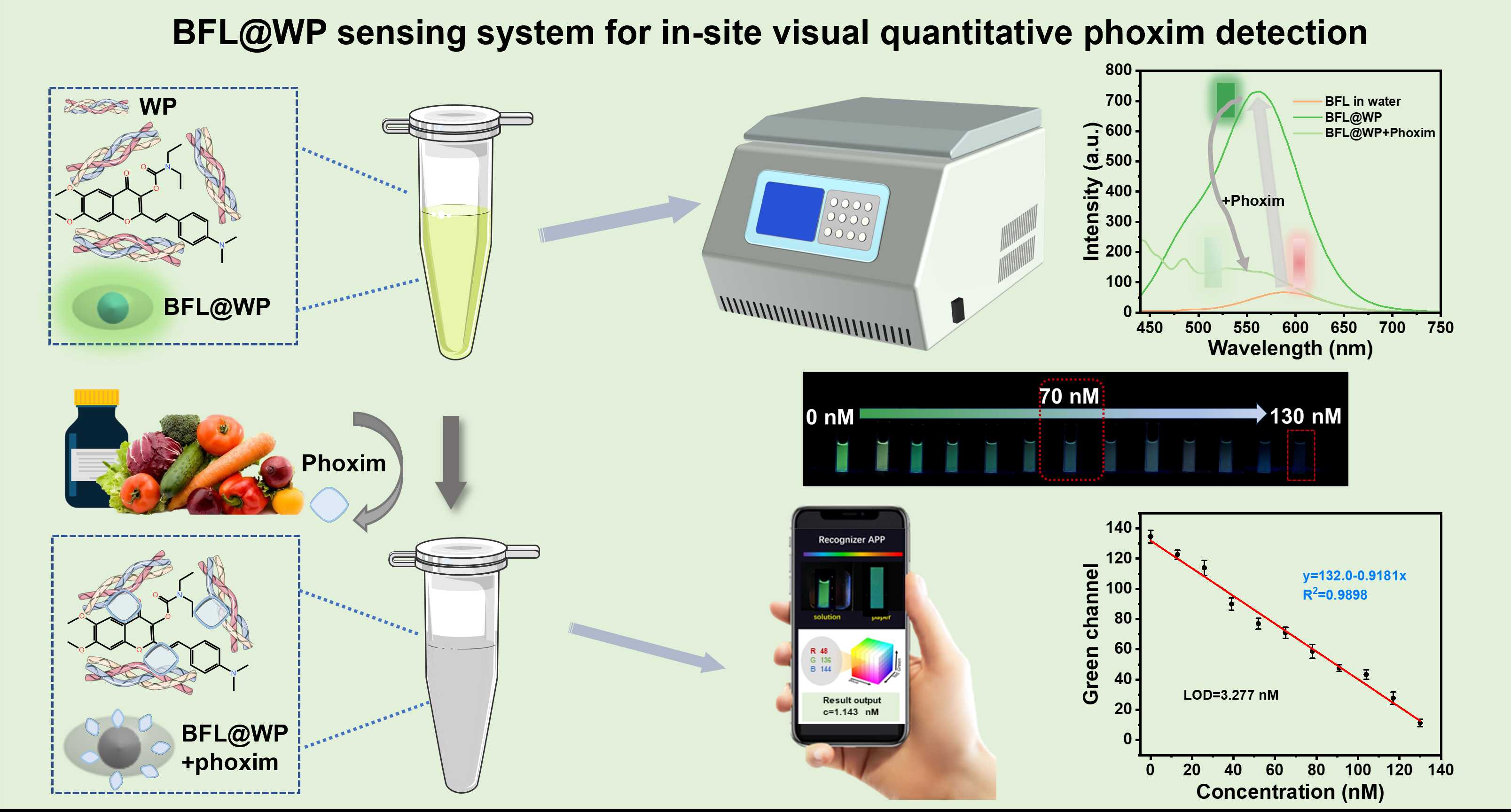
Detection of phoxim based on the BFL@WP supramolecular sensing system. (Image by LIU Anqi)
