Newsroom


What did the very first complex vertebrate brain look like? To find out, scientists turned to an unlikely time traveler: the lamprey, a jawless, eel-like fish whose body plan has barely changed in roughly 360 million years.
In a study published in Science on June 18, a team of researchers led by SU Bing from the Kunming Institute of Zoology of the Chinese Academy of Sciences, along with collaborators from BGI-Research and Liaoning Normal University, built the first three-dimensional, single-cell atlas of an entire lamprey brain, which is essentially a high-resolution map showing the location of every cell and which genes are active in each cell.
The researchers found that although lampreys diverged from jawed vertebrates about 450 million years ago, their brains share strikingly similar gene-expression patterns with the mouse across many regions. This finding suggests that the common ancestor of all vertebrates likely already had a well-organized, molecularly complex brain.
However, the researchers showed that each lineage also evolved its own innovations: the lamprey has unique midbrain neurons and oversized "Müller cells," while mammals went on to build a more elaborate, layered cortex.
Moreover, the atlas hints at how neuronal types became more specialized over the course of evolution. The lamprey has a versatile cell type called the anamniote-enriched neuron (AEN) that carries both excitatory and inhibitory signals at once—a process described as "moonlighting."
Comparing living species across the vertebrate tree, the researchers found these "moonlighting" cells to be common in lampreys and zebrafish but rare in amniotes, which instead rely on "specialist" neurons with dedicated functions. The researchers suggest this contrast is linked to an ancient whole-genome duplication.
In addition, the researchers revealed that even the cerebellum, the brain's coordination hub, shows early roots: lamprey cells resembling cerebellar neurons point to a diffuse, primitive "cerebellum-like region."
Overall, the study helps reconstruct the evolutionary blueprint of the ancestral vertebrate brain and provides new insights into how vertebrate brains became increasingly complex over time.
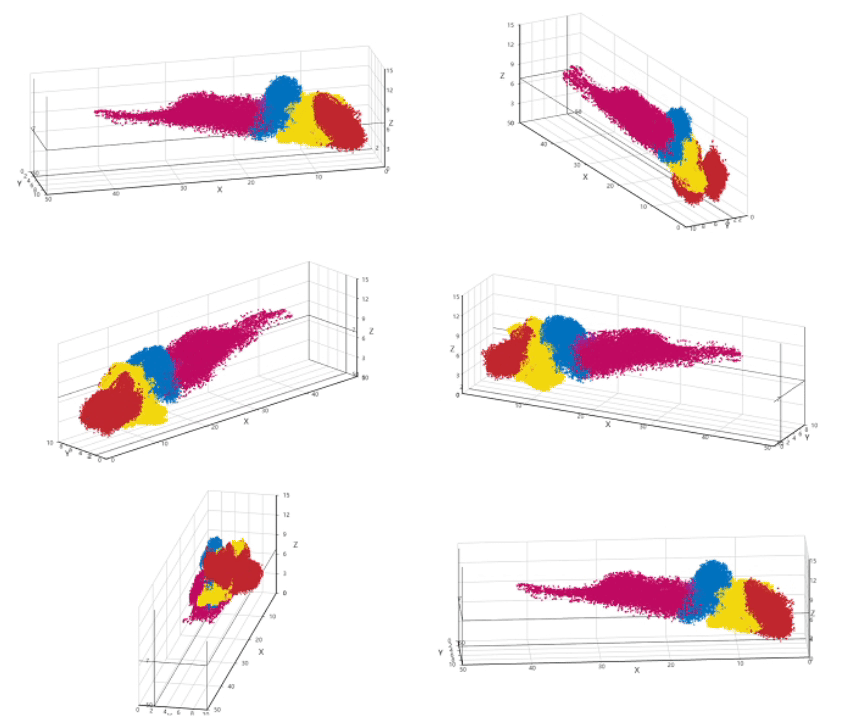
Three-dimensional reconstruction of the lamprey whole brain. (Image by Kunming Institute of Zoology)
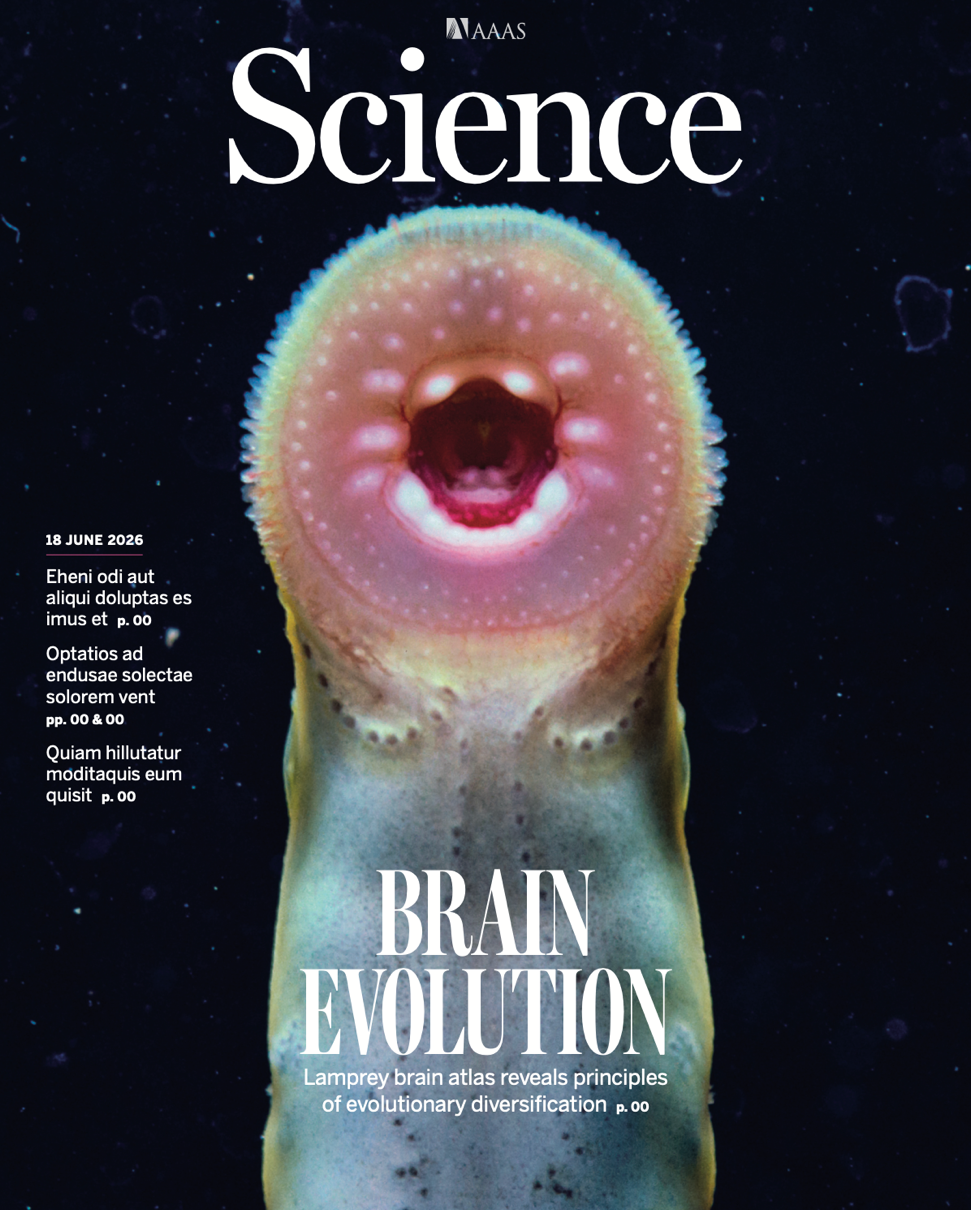
The study featured on the cover of Science. (Image by Kunming Institute of Zoology)